


Reports | 25 05 2020
Moving to a new country, urged "Amal" to start learning to read and write, after having resorted to Jordan from Aleppo with her husband and children two years ago.
Poverty is the major cause of illiteracy
There were many reasons that prevented the girls from learning between rural and urban areas in Syria, such as the poor economic conditions witnessed by rural families, unlike the people of the cities.
Yasmin from Aleppo was not up to twenty years old, went through difficult living conditions prevented her from education, and made her grow up prematurely and become a mother at an early stage.
Jasmine says: "When I finished the primary school I felt jealous of my friends, and I wanted to complete the preparatory stage like them, but my father kept me from that and force me to work with my brothers on the farm."
The girl lived in a harsh environment, what made her concerned only with marriage and work at home.
"Mobility was not difficult in my town, I know all the roads there, but here I don’t have anything except the signs of the areas’ names, and I'm not good at reading what has been written on it," says Amal. Pointing out that the lack of knowledge of roads imposed the necessity of learning how to read.
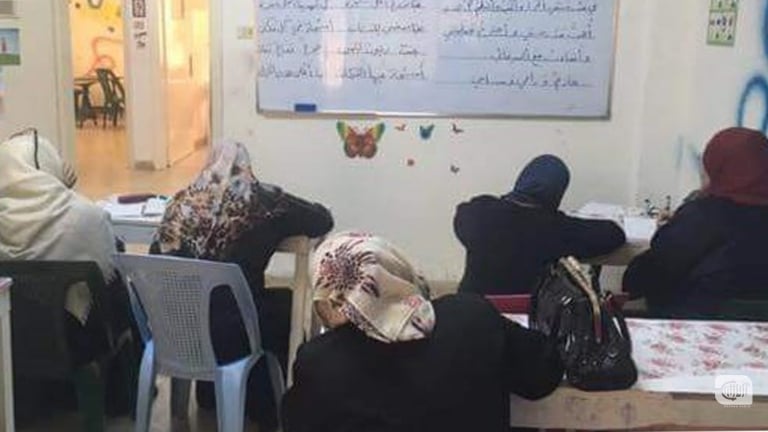
Amal is one of many Syrian refugees in Jordan, who had experienced different circumstances in their childhood that prevented them from learning at schools, what prompted them to attend a literacy course in the Jordanian capital, Amman, five months ago.

Changes hit habits!
Most of the women we interviewed in Jordan, said that many of the social obstacles are no longer existed and that because of the changes demanded by the Syrian people in the five recent years.
Suffocating beliefs imposed by the society on Um Ahmed, who has lived in the city of Hama, and was prevented from learning at a young age and also to complete her education when she became middle-aged, but she was able to achieve her desire now, after four years of her presence in Jordan.
"they demanded freedom and they were liberated, no one is observing what I'm doing now, I took part in a literacy course, and I tell my relatives and neighbors with pride" she explains, adding: "That was always my dream, but I did not dare to violate the social customs previously, which keeps the woman in her house and with her kids ".
Om Ahmed believes that illiteracy is kind of social marginalization for the individual, that’s why she tries to learn new skills in life, like start learning how to use the social media, to keep in touch with everything around.

Age was not an obstacle for them
Even for the elderly ladies, their age didn’t stop them from achieving their desire in learning, or to impact their concentration and comprehension.
Nisrin Mouselmani, a teacher in the session in the education and development center in Amman, she noticed that the desire and determination were stronger among old women and that they wanted to prove their ability to learn more than others.
Umm Ayman, who lives with her daughter and grandchildren after they came out of Syria, has become a competitor for her grandchildren in writing home works and reading texts, where she was able to regain some of her modest skills in reading and writing that she has learned in the first two years of elementary school in Syria.
She confirms: "being at the age of sixty, does not mean that I have lost my ability to learn, because who has a desire to learn will succeed in this, I do not see any difference between me and a girl of 20-years in this session because I own will."

* This report was accomplished with the support of Resources Center.