


Reports | 25 05 2020
Getting some water became exhausting for the people in Idlib countryside, most of the water networks are outside the service, and the situation did not improve after the Syrian Regime Forces’ withdrawal from the province, a year ago!
Abu Mohammed says: "our biggest problem is providing the water tanks, because of its high cost, which is 4 to 5 thousand pounds for one tank, and is influenced by an increase in fuel prices."
The failure of the regime’s water networks led to service projects for solving at least part of the problem, but the solutions were not sufficient according to what “Rozana” discovered, after meeting a lot of people and characters in the local councils in Idlib and its countryside.
Full salary to get water!
The operational costs of the projects were an obstacle to many of them, what led to be stopped, but some succeeded in implementing part of the project through many ways, what participate in solving part of the problem.
Abu Mohammed, a resident of rural Idlib, complements saying: "Every family needs more than one tank, so the average cost per month reaches up to 20 or 25 thousand Syrian pounds, and this is inconsistent with my income average."
According to the man, in Idlib and its countryside the income almost non-existent for the population there, and it can’t cover the cost of the water tanker, he said: "we call upon the humanitarian organizations and local councils, to achieve projects, dig wells, and maintain the water pumps and renew it".

Types of suffering!
Water networks in some areas of the countryside of Idlib, are out of service since nearly two and three years, even when the regime was controlling Idlib. So people are forced to buy water cisterns, and sometimes they look for it for a day or two or maybe three! And if they found any, the price would be up to 5,000 pounds, and it may rise, due to dollar exchange rate!
Ahmed Omar, member in the local council in one of the towns of Zawiya Mountain, he said to Rozana: "the largest problem in the southern countryside of Idlib, is the lack of drinking water because of the damage of the network since more than three years, which created difficulties in getting water, while the organizations do not participate in digging wells due to its own policy. "
Ahmed pointed out to that the local council is working on a project, through collecting donations from expatriates to dig wells, stressing the need for urgent assistance, about providing water for citizens.

What was the solution?
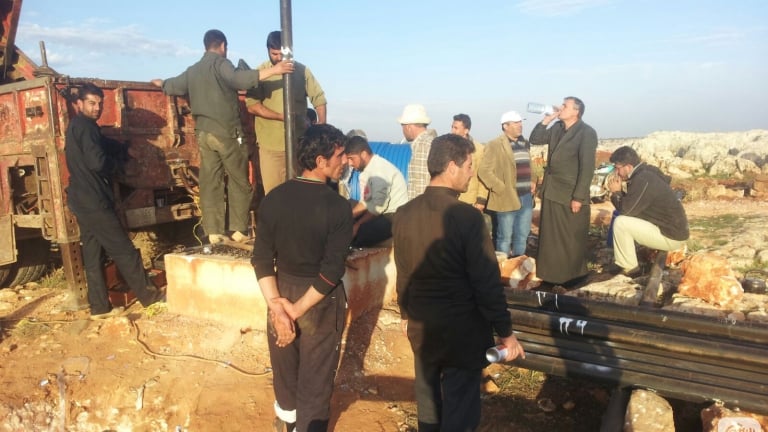
The people of Idlib countryside treated with a part of the problem, by digging artesian wells, but ran into a larger problem, led to increased digging costs in the mountain of Zaweya.
Omar said: "artesian wells cost up to 100 thousand dollars per well, especially because it exceeds 600 to 700 meters under the ground, and therefore the project is huge."
Engineer Ziad Ruslan, water project manager in “Kifrinble”, confirms that digging five wells in the area, had a great benefit to it, but was not able to continue!
He added: "As a result of the events the project stopped in 2014, and some time ago we signed a contract between the local council and the humanitarian relief Commission, in order to implement the wells remaining in the region, with an operational plan for three months, and will direct them soon".
He confirms: "We have further plans to complete the project, which covers 5 wells, approximately 60% of Kafrinble need."

Projects with unlimited possibilities!
The water projects diversified in different regions of Idlib, some of which actually participated in reducing the effects of the water crisis, such as a project of Sakba which helped to maintain the water stations in Idlib countryside, north and south, but faced many difficulties.
Project manager Mahmoud Othman explains to Rozana: "we rehabilitate and operate public water projects in many areas, and pump water across networks in case they were ready to work, or through the provision of water by fountains to the villages."
He continues: "We were able to address part of the problem with the old networks, through manufacturing spare parts for the modern generators, which is identical to the original parts, besides, we filled up underground tanks of fuel for the project."