


Reports | 25 05 2020
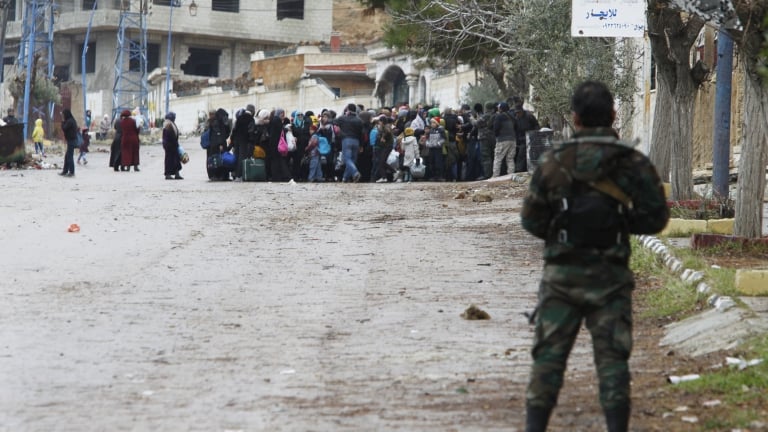
The siege policy has been used during the past five years, as a main weapon of war in Syria. Mainly by the Syrian Regime forces in different areas of the country, as well as, by the opposition factions and the organization of the Islamic State "ISIS", but in limited areas.
486,700 people live in Syria under siege, more than half of them are surrounded by the forces of the regime, out of 4.6 million people live in areas "hard to reach", according to an announcement by the Office for the Coordination of Humanitarian Affairs in the United Nations earlier this year.
But these figures may not reflect the reality, according to two non-governmental organizations which are "PAX" the Dutch, and "Syria Institute" in the United States. And they say that more than a million people are suffering from "a growing risk of death" because of the shortage of food, electricity and water in 46 towns under siege.
Rozana spotted the regions on the list of the United Nations, as areas under siege, and the number reached 19 regions, namely:
Darya
Darya is a part of the Damascus, and is just 8 kilometers away from the center of the Syrian capital, with a population of about 265 thousand people, before 2011.
Besieged by the Syrian regime forces for more than three and a half years, and during this period, it has been documented 9 deaths due to lack of medicine, and it has been unable to enter any assistance to 8300 people there until now.
But in 16th of April, a delegation from the United Nations entered for the first time, after the Syrian regime forces allowed the entry. The aim of the visit of the UN delegation was to preview the human reality in the besieged city. In 12th May, the regime’s army stopped the assistance convoy of United Nations humanitarian and the Syrian Red Crescent from entering, and they bombed the places where civilians are waiting for aid, what inflicted casualties.
In addition to the siege, Darya has witnessed an intense bombardment with barrel bombs by the Syrian regime forces, what left behind huge destruction in large parts of it.
Moadamiyat al-Sham
Also called Moadamiah, administratively tracks to the province of Damascus, and the number of its population by 2011 is about 100 thousand people.
Moadamiah is also under the siege with its neighbor Darya, but they differ in several points, as the tight siege imposed on the city by the Syrian regime forces, entered the fifth month only, but it is not the first siege.
At the end of the month of November 2012, the Syrian regime's forces began besieging Moadamiah, and the siege lasted until the end of the month of December 2013, where the Syrian regime and the opposition reach a truce agreement. The agreement states to raise the Syrian Regime’s flag in the city, and stop the fighting on the fronts, in exchange for releasing the detainees and lifting the siege on civilians.
Although the implementation of the agreement has to be start in the end of 2013, but the Syrian regime did not apply the terms of the agreement, and hindered the entry of aid several times, and the city remained under a partial siege.
But in the end of last year, the Syrian regime has completely stopped the commitment to the Convention, and launched a military campaign on the city and closed all the ports, to start a new phase of siege.
Zabadani and Madaya and Bukein
Zabadani city and the towns of Madaya and Bukein, is located on about 45 kilometers northwest of the capital Damascus, and these areas extend on the slopes of Lebanon’s mountains, which is administratively belong to the province of Damascus, and has a population of about more than 50 thousand people, before 2011.
The Syrian regime forces surrounded the three regions several times during the past five years, but it tightened the siege completely with the help of Lebanese Hezbollah since July 2015, and due to lack of medicine and food 46 people died, according to the organization "Doctors Without Borders".
And the militant factions of Iran and Hezbollah, reached a ceasefire agreement under the auspices of the United Nations in September 2015, serving a cease-fire and the evacuation of trapped Zabadani in exchange for the evacuation of people from the villages of Fuaa and Kefraya which are tapped by the opposition factions in northern Syria, but that agreement didn’t end the siege until now.
Kefraya and Fuaa (northern Syria)
Two towns located in Idlib countryside, were controlled by the Syrian regime forces, with population of about 50 thousand people, all from the Shiite community, what made the two villages, home to the some of the Lebanese Hezbollah forces.
After the "Army of Conquest," gained control over them -factions affiliated with the opposition in addition to the front Nasra (al-Qaeda)-, these Idlib towns stayed internally under the Syrian regime and loyal to them, and the opposition factions began besieging the two towns in March 2015, and for the first time, Iran stepped in negotiating with the opposition factions, for the two towns.

Eastern Gouta (Damascus Countryside)
It includes many cities and towns, with a population of 2 million and 196 thousand people, according to statistics in 2010.
United Nations’ list of the besieged areas, included 10 cities and towns in Ghouta, , which are: "Douma, Harasta, Arbin, Zamalka, Ein Tarma, Kfrbtna, Zibdeen, Jesrin, Sakba, Hamorya”, these town are inhabited by approximately 700 thousand people, and the Syrian regime is imposing the siege on them since 2013.
Assistance convoys of food and medical aid reach some areas in the Ghouta, but in varying lengths, and not enough for a long time because of the congoing bombardment of the Syrian regime on Ghouta.
Yarmouk camp (suburb in Damascus)
Yarmouk refugee camp was established in 1957, on an area of 2.11 square kilometers to provide accommodation and housing for Palestinian refugees, which is located within the boundaries of the city of Damascus, just 8 kilometers from the center of the capital. And it had a population of about 700 thousand people before 2011, 144 thousand of them were Palestinians.
Partial siege initiated by the Syrian regime forces on the camp at the end of 2012, and in July 2013, the siege became full.
Yarmouk refugee camp, which is located in the south of the capital Damascus, wasn’t alone under the siege during that period, The regions of “Hajar Aswad”, “Al-Kadam” and “Alasali” that follow administratively to the city of Damascus, also were completely under the siege, in addition to the towns of Yalda and Babbila and beit sahem, which belong to the province of Damascus.
Tightening of the siege on the south of Damascus regions, led by early 2014 to the death of more than 100 people because of hunger, which prompted towns Yalda and Babbila and beit sahem to a truce with the Syrian regime and the introduction of aid, but in mid-2014, the forces of regime closed all crossings again.
In April 2015, ISIS launched an attack on the Yarmouk refugee camp, and controlled large parts of it, in addition to control Hajar and Alasali, so the camp remained under full siege so far, while the other south of Damascus areas remained under a partial siege.
Neighborhoods of Deir al-Zour
In eastern Syria, and within the city of Deir al-Zour, ISI and the Syrian regime are partnering the siege on nearly 180 thousand civilians in four neighborhoods, which are "Kosour, Jura, Hrabsh, and Albugyliah."
The story began when ISIS imposed the siege on the four towns, in the beginning of 2015, and the regime’s role in the siege was through the exploitation of the civilians who need to receive humanitarian aid, that reaches Deir al-Zour through the Airport, where they sell them the goods (aid) at exorbitant prices.
To get out of these neighborhoods, there are two ways: first by air via Deir al-Zour airport, which is controlled by the Syrian regime, where they must pay 1 million Syrian pounds to the security branches in order to gain an approval to move from from Deir ez-Zor Airport to Damascus Airport, and 300 thousand Syrian pounds to travel from Deir ez-Zor Airport to Qamishli Airport.
The second way: is the overland travel to the western countryside of Deir al-Zour, and must pay 500 thousand Syrian pounds, and currently this way is off, because of the recent clashes between "ISIS" and the forces of order in the neighborhood Albugyliah near the besieged neighborhoods.
Other areas
The 19 areas listed in the list of the UN, as besieged areas, are not alone in suffering, according to the Dutch organization "PAX" and the organization "Syria Institute" in the United States, there are other areas, most notably: the neighborhood “Waer” within the city of Homs, where about 100 thousand civilians are suffering there, in a siege entered its third month, after the suspension of the implementation of the "truce", which took place between the opposition and regime forces under UN sponsorship.
The areas of Houla ,Talbisa and Rastan in the northern countryside of the city (Homs), where the Syrian regime imposes a siege on them for nearly 3 years. Jobar neighborhood of Damascus, which is inhabited by about 225 people, and other cities and towns in the countryside of Damascus.
In addition to the cities, towns and neighborhoods mentioned as areas under siege, there are dozens of other areas classified as zones of difficult access, which are homes to thousands of civilians, civilians suffer from the shortage of food and medical supplies and the rise in prices of basic needs.