


Reports | 25 05 2020
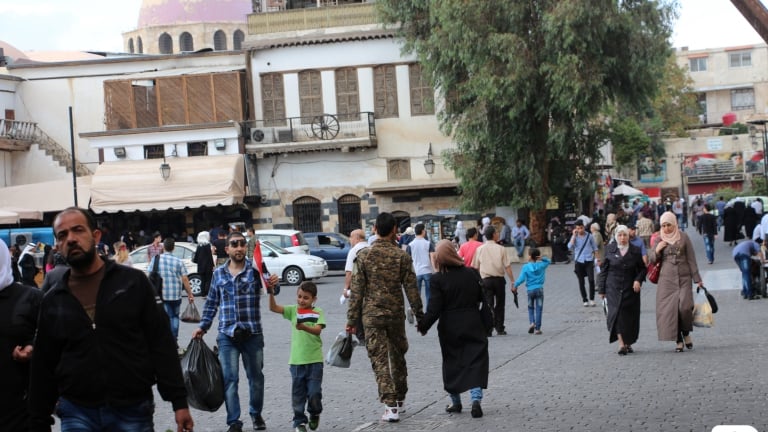
It is hard to find a taxi driver in Damascus these days that does not work for the regime’s security forces, or for the military. This is not new to Syria. Informants and regime loyalist and thugs have always been a part of the Syrian social fabric, but now it has become more obvious. The regime’s men now dress in military-like clothes, which they wear as a symbol of their power and connections. Their clothing is part of what enables them to terrorize people, harass traffic officers, or just pass smoothly through checkpoints.
Before the revolution, the regime’s informants were imbedded in people’s daily lives too, but they did not advertise it the way they do now. The informant could be a taxi driver in civilian clothes. He might start by asking his customer general questions about his life and whether he was satisfied by the government’s performance. If the customer sensed that something was not right, he or she would stay quiet, but if not, the customer might offer their honest opinion, and unfortunately end up in one of the regime’s many security agencies.
A Mobil Security Agency
The situation is very different these days. Ahmad, a university student, says that “he is willing to walk for long distances, just in order to avoid taking public transportation.” “A very large percentage of taxi drivers openly wear their military uniforms or the uniforms of the security agencies. Taking a taxi means that a person is simply in hands of an informant who is waiting for the person to say the wrong thing,” he added.
“It feels like I am in a mobile security agency. Taxi drivers in military uniforms are all over the place around President Bridge, although it is supposed to be illegal for drivers to take the President Bridge-Jaraman route,” said Dirar. “Who has the courage to give them a ticket or fine them? They all work for the regime’s security agencies during the day, and as taxi drivers in the evening,” Dirar added.
A Taxi Driver Confiscates a Client’s Identification Card
A young man said, “one time, a customer had an argument with a taxi driver because the latter asked for a higher rate (the rate of a ride towards Jaramana Bridge was raised from 200 Syrian pounds to 300, and then to 350). During the argument, the driver confiscated the customer’s identification card, gave it to one of his colleagues, and threatened that he would end up in security agency.”
This incident is similar to what happened to Jalal, who works in the private sector. “The taxi driver, who was in a military uniform, was taking me from the Sina’a neighborhood to Masakin Barza. Close to the al-Hayat Tunnel, a speeding motorcycle drove by. The driver did not give way to the motorcycle, so the motorcycle passed us at a very high speed and broke the taxi’s side mirror. At that point, a chase began.”
According to Jalal, after a long chase, the two stopped and began to fight. Each of them asked the other for his identification card, because each one worked for a different security agency. At that point a lot of people had gathered around them, and they had to end the fight.
Local Public Transportation
There are too many stories. Nizar spoke about another fight that had taken place between a minibus driver wearing a military uniform, and a checkpoint officer in Damascus, because the officer had asked for the driver’s license. Another one refused to let his car be searched by officers at the Somaryya checkpoint.
According to Nizar, these practices are promoted by the Syrian regime itself. “The regime’s goal is to spread terror among people. This is why it encourages such practices. People feel that they could be stopped and interrogated by anybody and at any moment—it does not have to be at checkpoints anymore. It feels like we live in a military camp, and that we should be ready to obey orders at any given moment,” Nizar explained.
“Even taking local public transportation has become horrifying. Most drivers speak with the coastal accent [the accent of the Alawite sect], and most clients, especially those going towards Somariyya and Mazza, are in military uniforms or carry guns. Even the transportation supervisor is in a military uniform,” he added.
Military Uniforms Serve a Different Purpose in the Sha’lan Neighborhood
According to Ihsan, the military uniform has become ubiquitous, despite the fact that the authorities prohibit their sale, unless it is through the Ministry of Defense’s official outlets, and then only to holders of security identification cards. However, it has become normal to see produce sellers, convenience store owners, and even a kiosk owners wearing these uniforms. No one knows what the nature of these people’s work is, or even where they are from, since they all tend to speak with the coastal accent.
“There are young men who have volunteered for the National Defense, or other pro-regime groups, only to obtain security identification cards and military uniforms. We see them everywhere in the Sha’laan and al-Malki neighborhoods. All they do is harass women,” Ihasn added.
Ihasn believes that limiting the sale of these uniform to only those who hold security credentials has not worked. Instead, it created an opportunity for some people to make money—although the fabrics for military uniforms are imported only through the Ministry of Defense and the Ministry of Internal Affairs, and although they are supposed to be only sold in the Ministry of Defense’s official outlets, military uniforms are available in many places, and are sold for very high prices.