


Reports | 25 05 2020
The Media institution Rozana, participated in an investigation based on the recently leaked documents of "Panama". The investigation shows the names of people and companies that are suspected to be terrorism financiers and supporters of the Syrian regime by providing fuel to the military aircrafts that were striking barrel bombs on several Syrian areas.
Rozana was the only Syrian institution that has worked with the International Consortium of Journalists Investigative (ICJI) in accomplishing this investigation, through a group of journalists and citizens journalists who preferred anonymity.
One morning in mid-2014, before the summer sun had reached its peak, two elderly men in Aleppo, Syria, sat on plastic chairs, chatting quietly and drinking black coffee. From his perch outside his food stall, Sabri Wahid Asfur and his friend Abu Yassin watched their neighbors go about their day.
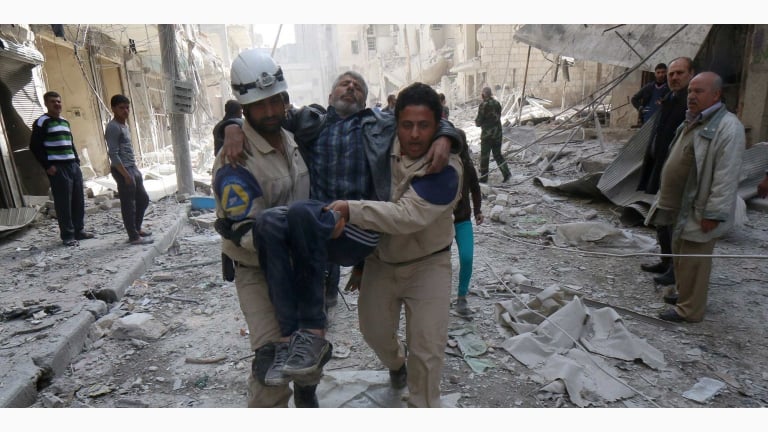
Suddenly, bombs hit the ground, scattering bricks and debris. Seconds later, they exploded, sending thousands of pieces of shrapnel — nails, rebar — in all directions. The crudely made barrel bombs had been designed for maximum human damage.
As the smoke lifted, Asfur reached for Abu Yassin.
“I looked at my friend when I recovered my vision and saw his body in shreds,” Asfur remembers. “He was exhaling his last breath.”
The attack was one of hundreds of aerial bombings that Syrian President Bashar al-Assad’s regime has carried out during the country’s six-year civil war, killing thousands of its own people. The deadly air campaign would not have been possible, U.S. authorities have charged, without a network of companies that dodged international embargoes by supplying the oil and gas that kept the military aircraft in sky.
Three of the companies that the U.S. alleges helped supply the fuel were customers of a global law firm, Mossack Fonseca & Co., which helped the companies incorporate and maintain offshore branches in Seychelles, a tax haven in the Indian Ocean.
The law firm continued doing work for at least one of these closely-linked companies after the three of them were blacklisted by the American government for supporting Syria’s war machine – joining dozens of other Mossack Fonseca customers sanctioned by the U.S. Treasury Department’s Office of Foreign Assets Control.
Mossack Fonseca, which is based in Panama but has offices around the world, has worked with at least 33 individuals or companies that have landed on the Treasury Department’s OFAC list, according to an analysis of the firm’s internal files by the International Consortium of Investigative Journalists, the German newspaper Süddeutsche Zeitung and other media partners.
In some cases, individuals and companies had ceased to work with Mossack Fonseca before being sanctioned. In other cases, the entities were active customers when the sanctions were put in place.
The reporting partners reviewed more than 11 million documents — emails, client accounts and financial records — that show the inner workings of Mossack Fonseca from 1977 to December 2015.
For years, the records show, Mossack Fonseca has earned money creating shell companies that have been used by suspected financiers of terrorists and war criminals in the Middle East; drug kings and queens from Mexico, Guatemala and Eastern Europe; nuclear weapons proliferators in Iran and North Korea, and arms dealers in southern Africa.
“It sounds almost like a corporate death wish taking on that many horrible people,” said Jason Sharman, a political scientist at Australia’s Griffith University and co-author of a groundbreaking study of anonymous companies. “You’d think that, even if they were cynical, they’d be reluctant dealing with U.S. sanctioned entities and taking on the United States.”
Mossack Fonseca denies wrongdoing
A spokesman told ICIJ that the firm relies on intermediaries such as banks and other law firms to review the backgrounds of the customers that they refer to Mossack Fonseca. These middlemen are supposed to notify the firm “as soon as they have knowledge of a client of theirs having been either convicted or listed by a sanctioning body,” the spokesman said. “Likewise, we have our own procedures in place to identify such individuals, to the extent it is reasonably possible.”
The time it takes to resign varies by jurisdiction, the spokesman said, and some authorities require the agent to remain in place to prevent interference with an investigation.
The spokesman added that Mossack Fonseca has “never knowingly allowed the use of our companies by individuals having any relationship with North Korea, Zimbabwe, Syria and other countries” that have been listed as sanctioned. If it did discover it had unknowingly represented a company that was being used for unlawful purposes, he said, the law firm would take “any measures that are reasonably available to us” to deal with the issue.
Fuel for war
OFAC, the U.S. Treasury Department’s blacklist enforcement unit, announced a series of sanctions in 2014 barring U.S. citizens from dealing with individuals and companies suspected of supporting the Syrian regime.
One of the companies was Pangates International Corporation Limited, a petroleum products specialist headquartered in the United Arab Emirates that had been a Mossack Fonseca customer for more than a decade.
OFAC put Pangates on its blacklist in July 2014, charging that Pangates had supplied the Syrian government with 1,000 metric tons of “avgas” — aviation fuel necessary to operate military aircraft.
“Certainly any armed Syrian Air Force aircraft will be using avgas,” said Jane’s Defence Weekly Europe Editor Nick de Larrinaga.
Pangates is part of the Abdulkarim Group, a sizeable Syrian company with offices in Damascus. OFAC also sanctioned two other Mossack Fonseca clients with alleged ties to the Abdulkarim Group or its directors — Maxima Middle East Trading Co. and Morgan Additives Manufacturing Co.
In addition, it sanctioned two Syrian citizens linked to the companies.
OFAC identified Ahmad Barqawi as general manager of Maxima Middle East Trading Co. and Wael Abdulkarim as Pangates’ managing director. It said Wael Abdulkarim had “worked to arrange numerous shipments of base oils and aviation gasoline to Syria.”
In June 2014, Pangates, Maxima and the Abdulkarim Group worked with a Russian oil and gas firm to obtain oil destined for Syrian government-controlled refineries, according to OFAC.
A representative of Morgan Additives told ICIJ that the basis of its blacklisting by OFAC was “in error.”
Barqawi resigned as the company’s manager before the OFAC listing and Wael Abdulkarim resigned when the sanctions were announced, the representative said. Morgan Additives is not currently owned or controlled by Wael Abdulkarim, the representative added.
None of the other companies or individuals sanctioned in connection with the Syrian air war responded to repeated requests for comments via email, registered mail and telephone.
In a previous comment to media, Pangates acknowledged delivering oil to Syria but claimed not to know about its ultimate destination or purpose.
“We are selling to non-Syrian firms who are not on the EU and US sanctions list,” the company told Reuters. “We do not know exactly who is finally using the fuel but according to our information the product is used for civil humanitarian purposes.”
The secret files show Pangates’ relationship with Mossack Fonseca began in 1999, when the law firm incorporated Pangates in Niue, the Pacific island nation where Mossack Fonseca once had exclusive rights to incorporate offshore companies.
When authorities in Niue shut down the island’s offshore registration industry in the wake of complaints about money laundering, Pangates moved to Samoa and, in 2012, to Seychelles. At one point, the company valued itself at $7.5 million.
Nine months after the U.S. first sanctioned Pangates, Mossack Fonseca was still handling the company’s paperwork, certifying that it was a Seychelles company in good standing. Later still, Mossack Fonseca helped Pangates close its Seychelles business and sent it a bill for $1,100 to cover its fee for that service. It asked Pangates to pay online or through Mossack Fonseca’s bank account in New York.
It was not until August 2015 — more than a year after sanctions against Pangates had been announced — that Mossack Fonseca acknowledged the blacklisting and scrambled to find ownership details, utility bills or any other identifying information from the Dubai administrators of Pangates and Maxima Middle East. Mossack Fonseca finally reported that the companies were on international sanctions lists to Seychelles regulators in August 2015.
Assad’s cousin
The files show that Mossack Fonseca also worked with Rami Makhlouf, a cousin of Syria’s dictator, Assad. As early as 2008, U.S. Treasury officials had flagged Makhlouf as a “regime insider” who “improperly benefits from and aids the public corruption of Syrian regime officials.” Treasury froze Makhlouf’s U.S. assets and banned U.S. companies or people working with him. Later that year, in awidely reported announcement, the U.S. Treasury Department blacklisted some of his companies.
Although he had long been a customer of Mossack Fonseca, the firm’s emails at the time record no mention of the sanctions. That changed in 2010, when British Virgin Island authorities demanded information on Drex Technologies S.A., a company owned by Makhlouf that Mossack Fonseca had incorporated ten years earlier. Mossack Fonseca employees looked for — and quickly found — information that had circulated widely for years, including details of Makhlouf’s political ties and alleged smuggling.
At this point, the files reveal, Mossack Fonseca’s head of compliance wanted to drop Makhlouf immediately. But one of Mossack Fonseca’s partners resisted, hoping the firm would not lose the business.
That partner, Chris Zollinger, wrote colleagues that “there are allegations (rumors), but not any facts or pending investigations or indictments.” He noted a colleague’s earlier notes from a conversation between Mossack Fonseca and HSBC, the UK-headquartered bank that served as Makhlouf’s financial manager, in which the bank assured the law firm that HSBC’s Geneva and London offices “know about Mr. Makhlouf and that they are comfortable with him.”
If HSBC didn’t have an issue with him, Zollinger said, “then I think we can also accept him.”
However, he ultimately agreed with dropping the firm after further urging from his colleagues and mounting official investigations into Makhlouf’s business empire.
Zollinger recently told Süddeutsche Zeitung: “In retrospect my comment in the e-mail was wrong, which I regret.” He added that, as registered agent, Mossack Fonseca had “no influence on the transactions or the business of the company” linked to Makhlouf.
Makhlouf did not respond to requests for comment.
