


Reports | 25 05 2020
Mamdouh Azzam
It was hard for him to imagine that when abandoned, houses feel sad, neglected, or withdraw back to times of childhood. He would have never believed it if someone had told him so.
However, what happened made him change his convictions, his beliefs, and even the way he perceives his surroundings. It seems that he was forced to leave his house and that it happened in haste since the bombs began to fall on his neighborhood from everywhere. In their random way, the bombs killed all available creatures, one after another, and sometimes collectively.
At the beginning, he announced, with his usual stubbornness, and as he had done every time he spoke, that he would never leave his place; neither after one bullet nor after a whole clip. He would simply never leave. He used to draw his strength from his beliefs about home— the place that is like a womb, and from all that he had learned, and all that he had taught to others over the years.
But he eventually succumbed to requirements of survival, or maybe to those who wanted to continue to live. Hence, he unwillingly left the house. This was the simple truth that he tried to explain to us. While his wife and one of his sons were reenacting the battles, and the sounds of bombing surrounded them, he was silent, watching and pondering the words they spoke. It seemed as if he realized that the stories his family was telling about the war, the bombs, and the explosive barrels, were just a justification to leave their own house.
But he did not give up— he would visit his house whenever he was able to sneak into his neighborhood. Sometimes, he would go through al-wa’r neighborhood, or through the little farm routes. When he came back from his first visit, he told us that the roof was leaking. It was winter time. He swore that the roof had never leaked before. Why do you think that happened? He asked, but he was not waiting for an answer. He deeply believed that houses could not stand alone and that the sudden leakage was the house’s expression of its loneliness. He discovered other things changing in the house every time he went back to visit. One time, he would say that the wall bulged. Another time, he would say that the floor of the northern balcony was cracked, and little weeds were working their way up and out, and they would widen the cracks if he did not fix them soon with white cement. He told us once that the bed’s mattress bulged as if it was sick, and he claimed other times that water was leaking into the living room, where they used to spend their winters. He believed that these were early warnings. The house’s soul longs for us, and is feeling sick and lonely, he kept saying.
“Did any of you try leaving your own house? You can only imagine what I am talking about, but none of you have seen the house,” he always said.
There was no way for us to question what he said because none of us visited the house to make sure that it was fine.
He was not feeling well. The more he watched the house falling apart, the more he felt useless and fell sick.
“Houses long for people,” he kept repeating.
For the first time in his life, he leaned on belief and told himself that there was no way to escape fate. If he was destined to die under rubble, then why not let it be the rubble of his own house.
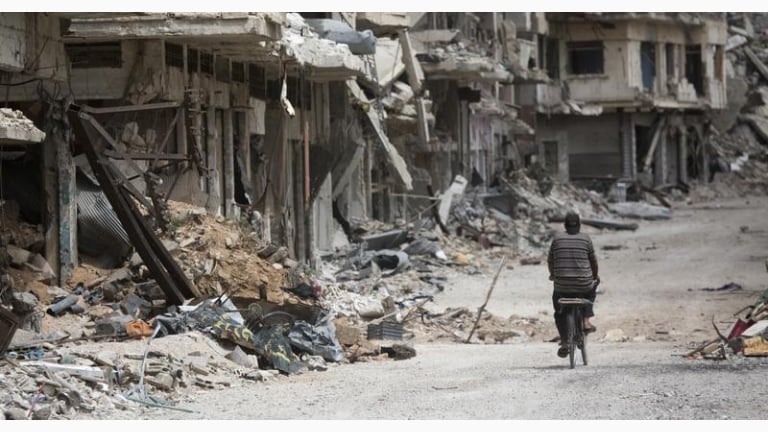
Interestingly, fate created another dilemma: a random shell actually hit the house. No one knows the source of it, since as you know, all shells look alike. However, it did destroy the house while he was away. When he went back to visit, his house had become rubble.
He was destined, it seems, to witness the destruction alive, not as a dead body under the rubble.