


Reports | 25 05 2020
Two years ago, in a rare visit to one of my old neighbors in the area of al-Biqaa in Lebanon, I heard, for the first time, horrible stories about people’s suffering from the landmines during the Lebanese civil war. Although decades had passed, I saw terror in people’s eyes when they told their stories. They were still angry, and were still hurting for all the beloved ones that they had lost.
One of the stories that hurt me the most was the story of Um Khaled, an eighty-year-old woman who had been bereaved of her son thirty-five years ago. Out of curiosity, and thinking that it was a plumbing object, her son, who was a young kid, carried a metal object that he had found on the ground next to their farm. The object exploded in seconds, killing the small child and his sister. Although this happened years ago, I was able to see the two children through her teary eyes.
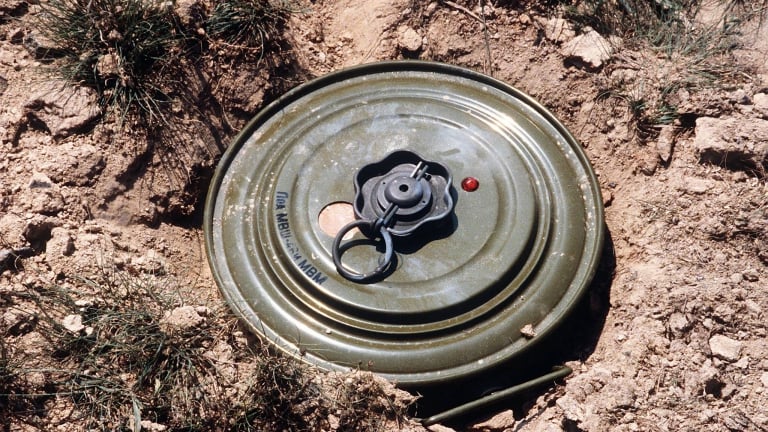
Landmines destroy everything in their surroundings. It is a weapon that not only targets people, it actually destroys people, animals, and the environment. One of the horrifying dangers of landmines is that they remain explosive for a very long time, and they are very hard to find, even by specialists.
Many countries have used landmines in their wars, but according to Landmine Monitor, in 2012, Syria was the only country to use landmines as weapons. The Syrian regime installed mines, not only in military areas, but also in besieged, opposition-controlled areas that were densely populated. The Syrian regime installed landmines in Aleppo, Idlib, Daraa, and along the Syrian-Turkish borders. It also dropped marine mines on Marrat al-Numaan, and Darayya.
While Lebanese people are still traumatized by the landmines, and still have not been able to completely clean the country of them, Hezbollah recreates in Syria the misery that the Lebanese suffered years ago. It participates in the genocide of Syrian people by installing its landmines on the Lebanese-Syrian borders. The landmines on the borders have caused many injuries to people who were transporting the injured through the mountains into Lebanon. For example, one group of wounded Syrians and paramedics were killed by a landmine while they were crossing the mountains, trying to reach Lebanon for treatment.
Hezbollah also installed mines around Madaya in al-Zabadani, which suffers from a very tight blockade and systematic starvation that aims to empty the area of its peoples. Many people in these areas have lost their lives to the “traps,” as they call landmines. The Russian-made landmines are installed around checkpoints, and all the tiny exits and entrances that connect towns to other areas through country roads. The landmines are usually connected to each other with threads, and when someone steps on a mine or on a thread, the whole group of landmines explodes. Another type of landmine is a circular one that explodes when a moving object gets close to it. Because of their hunger and the complete lack of basic necessities, many people in Madaya take the risk, and attempt to cross through the minefields, hoping to secure some food on the other side. According to the medical commission, these attempts have led to the death and the injury of many people, including children.
What makes the situation even worse is the lack of doctors and medical organizations in Madaya. Although the United Nations has managed to allow some food in, and has managed to evacuate the wounded in the past month, the suffering continues and will continue as long as the blockade and the landmines are still in place.
Due to the lack of doctors in the town, Mohammad Diyab Yusuf, a veterinarian from Madaya, is now in charge of treating wounded people, taking care of pregnant women, and even performing caesarean sections, amputations, and surgeries.
“By 2014, all medical specialists had left the city. There was only one doctor left in the field hospital, so people in Darayya asked me to be in charge of it. The doctor trained me in urgent care, and I began to practice. As for injuries caused by mines, I treated a man in his twenties, and amputated the limbs of five children in five months. Before the recent UN aid arrived, I operated on seven young men, and a short while after, I operated on a 65-year old man,” he said.
Many painful stories and horrible experiences are documented every day. The suffering continues, and people cannot tell what is in store for them. No one is able to stop the current continuous killing, and no one knows how long it will keep going. All of this is because of an oppressive regime that kills its own people, destroys its own country, and abolishes the future of many generations.
Save Syria! Save its children!