


Reports | 25 05 2020
The local councils in Idlib and its countryside are very active, despite the challenges they are facing with their work. Council officials say that the main two challenges they face and affect their work are: the lack of the donor’s interest in their projects in addition to the airstrikes that hinder their activities.
On the other hand, residents who follow the councils’ activities think that many of these projects are necessary to be implemented, since the councils are financially unable of carrying out these projects on their own.
Rozana asked many questions to the representatives of the local councils in Idlib and its countryside. The answers are almost limited between searching for projects funding and the talks about small projects that were implemented in some areas. One resident accuses the council representatives of distinguishing between the northern and the southern countryside of Idlib. According to him, one is poor with services, while the funding is being spent on the other countryside.
Abu Ziad, born and raised in Idlib spoke to Rozana: “The idea of the local councils is good, and now they are following the path of the councils that were presents during the regime time. However, they are lacking a lot in the services sector, for what they offer is very little and simple, but I think it is a good start.”

Councils and Militarization
Ali Sultan, a member in the executive office in Idlib’s governorate council, confirms to Rozana Radio that the main mission of the councils is to secure the basic necessities for its residents from electricity, water, education, health and sanitation.
Q: What about the council’s relationship with military factions? Sultan answers, “there is no relation between the local councils and the military factions. The latter are often busy fighting on the fronts, and we, as city councils, provide a service and do not influence the views of those factions. On top of that, their tasks are far from the tasks of the local councils.”
Sultan explains, “There are many problems and obstacles facing the work of the councils, especially the huge need for services, which is met by lack of resources that are unable to fully cover all aspects of the services.” He adds,” The second problem is the airstrikes that’s bombarding the villages, and towns in Idlib countryside, and this contributes in sabotaging the building, increasing obstacles we face at work.”
A town deprived of bread!
People of “Kufr Owaid” in Idlib countryside are suffering from the lack of bread due to the closure of the town bakery a long time ago. Lack of flour and the high operation costs for the bakery were the reasons behind the closure. As for the village council, they stand helpless in front of this problem, but they are trying through popular initiative to implement few projects in the area.
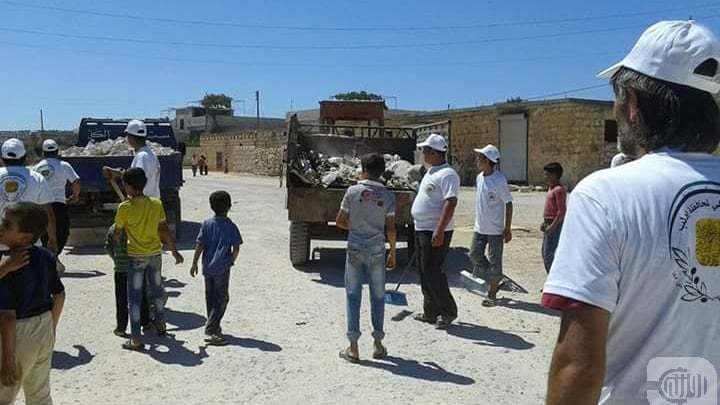
Engineer Ahmad Al Shamaly, Head of the local council in the municipality explains to Rozana,”Support for the council is frequent, but not continuance; which caused the bakery to close down. However, as a local council we are trying to deliver services with the support that we have available, “of course, if any”. But most of the times, we are forced to use the help of popular initiatives to cover public services such as hygiene and fixing roads.”

Bombing, the Main Barriers to the Councils Work
The problems of the local councils in Idlib and its countryside aren’t limited to the lack or little support they are getting to implement their projects. But it exceeds that to include airstrikes, which affect towns, cities and neighborhoods in Idlib and its countryside.
“The council is suffering from two dilemmas, the first is the continuance airstrike that didn’t stop in “Kufr Zeita.” – Munoor Maa’yoof, Head of the Local Council in Kurf Zeita, Idlib Countryside
According to Munoor, the second dilemma is the lack and little financial support, “since the start of the council, five months ago, we haven’t received any financial support, not from the governorate council or the ministry or any other organization.”
How does the level of services look like?
Residents of Idlib city spoke to Rozana more about the level of services that the councils provide for its residents, and the suggestions that they have.
Mustafa Gharibi, a resident of Idlib, asserts,” we see activities by the local councils such as providing some services; however, they lack the support of charity organization.” He adds,” the residents of the city are in need of many big projects, such as digging water wells, or distributing electricity generators in order to avoid two problems; electricity and water cuts.”
Hussam Bakkour, a resident of Kurf Nibl, says, “The services provided by the northern local councils of Idlib countryside are much better than the services provided in its southern countryside- you can’t even compare them. As if we see that there are two parties in Idlib countryside, the northern and the southern, the first gets most of the support and the second is poor in that front.”
There are 160 councils in Idlib and 148 councils in its countryside, while most of them stopped working, some of them are still active. These councils were formed in January 1st, 2012; they depend on financial support from international organizations and investment projects.
There are many tasks awaiting the local councils, and the problems they are facing are huge in light of the increasing necessities for the residents and lack of resources of the councils. At the same time, and according to the representatives of the councils, work is still continuing through implementing small projects or starting local voluntary campaigns to deliver a certain service.