


Reports | 25 05 2020
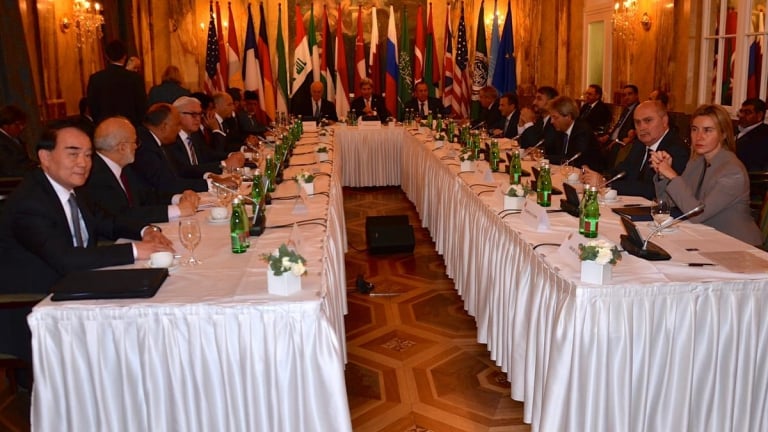
The active diplomatic movement on the Syrian issue has now become centered around one singular argument: the "War on Terror;” particularly following the recent terrorist attacks that hit Paris, the responsibility for which was purportedly claimed by the Islamic State [Daesh]. As for the fate of Assad and his regime, both of whom bear the primary responsibility for the ongoing Syrian disaster; the sharp tenor of officials from the "Friends of the Syrian People" had receded. They, who often sold Syrians illusions about their firm desire to see Assad leave; about their alleged siding with the Syrian People’s Revolution and its right to claim freedom and dignity.
Given that the Syrian regime and its allies are the most to benefit from this shift in the focus of international attitude towards "the Syrian file;” it is highly likely that they are involved in some manner in enabling "terrorism" and its organizations—both inside and outside Syria. This possibility is available to each party willing to "invest" in the "global jihad” exchange—whether via a breakthrough of any of the jihadist network cells’, and turning them to work in their favor; or via a set of deals with groups here and there on a “mutual benefits” basis, a matter for which we had previously dedicated some attention.
At a minimum, the regime and its partners have been able to take advantage of the behavior of the "mujahideen" themselves—its presumed opponents—and their terrorist practices which they commit and of which they proclaim their pride. The regime has rehashed an entire enormous media and public relations network, which has diligently been to work, so as to render the "War on Terror" the exclusive moniker of what is happening in Syria. These efforts included the obfuscation of the regime’s own terrorism; and why not? It is, after all, an "ally" in the "War on Terror!”
The regime would never have been successful in its aforementioned effort, however, nor would the “West’s” leaders have been able to find justification therefore vis-a-vis their constituents; had it not been for a set of realities on the ground. The regime itself had undoubtedly contributed to the promotion of these realities; but it had been merely finishing what Syrian opposition groups—including in particular the “[Muslim] Brotherhood,” and some former "leftists" who joined it—had already started. The Muslim Brotherhood and its doppelgängers, and from behind them their regional sponsors, had systematically sought to militarize, Islamize, and Sectarianize the Revolution since its first months. This played a crucial role in enabling the "mujahidin" penetration thereof.
It must, therefore, be recognized that this shift in the international situation was actually preceded by the overwhelming prevalence of the jihadist image of the armed opposition in Syria; until it almost became a general characteristic and the only one that glues it together—albeit with distinctions from one faction to another. A sizeable portion of the "military component of the Revolution”—as some theorists of militarizing the Revolution persistently dubbed it—therefore became exposed to being branded as terrorist. That has been the case, ever since "global jihad" was able to find a strong foothold in Syria, via "Al Qaeda" and its Syrian Branch—Al-Nusra Front [NF], headed by al-Jawlani; which entered into “alliances" with other significant factions of the very same "military component.” Added to the aforementioned, was the emergence of al-Qaeda’s more radical splinter—Daesh—with numerous armed opposition factions pledging allegiance thereto, and to "the Caliph al-Baghdadi."
With the situation’s developments on the ground, the Islamic armed groups—of all stripes and different degrees of militancy—became the overlords of all fronts and in control of most areas beyond the regime’s control, at the expense of the Free Syrian Army [FSA]. After they were beatified as "revolutionaries" and considered "part of the Syrian people’s Revolution" in official proclamations by opponents (some of whom were even “secular!”); the "mujahidin" (enemies and expiators of democracy) replaced the "rebels" (seekers of freedom and its martyrs)—some of whom who had managed to escape the regime’s oppression became victims of jihadists of different stripes, whether by murder or arrest.
All this, and opposition representatives continue to laud the “mujahidin" victories, fawning them and justifying their practices. This sycophantic position vis-a-vis jihadi groups, and "solidarity" with them in many cases, finds its explanation in the fact that opposition politicians and intellectuals—who long monopolized for themselves the claim of "representing the Revolution,” instead of acknowledging that the Revolution’s goal still remained democratic change and activity in its compass—had reduced it to the mere demand of overthrowing the head of the regime. They found in the "mujahidin" a strike force that could help them in achieving just that. Syrians today seem to be reaping the results of these foolish wagers.
* Opinion pieces do not necessarily express the views of Rozana Media.