


Reports | 25 05 2020
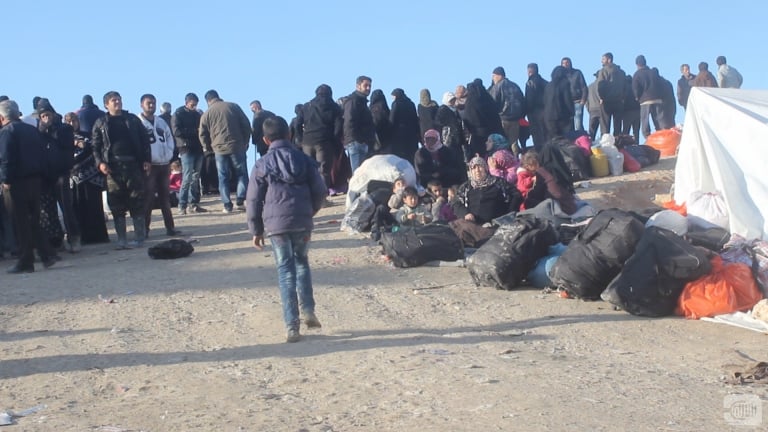
Large numbers of displaced Syrians continue to flee from the shelling and fighting in Aleppo and its rural areas to the Syrian side of the Turkish border. More than 75,000 people are at the Baab al-Salamah border crossing, waiting for a decision from Ankara that might allow them to cross into safety.
Like many other Syrians, Rana, a 10-year-old girl from the city of al-Baab in eastern, rural Aleppo, is waiting at the borders with her family. Running away from the Islamic State, which controls their city, and from the Russian air raids, the family walked for hours at night through dangerous side roads, until they finally arrived to the borders. “We fled from the Islamic State and from the Russian bombardment of our city. We’ve been here, at the Syrian-Turkish border, for a while. We tried really hard to get a permit to cross to the other side, but we failed,” Rana told Rozana.
People in the City of al-Baab are Trapped
Those who cannot leave the city of al-Baab live under incredibly challenging conditions. They are stuck between the Islamic State, which prevents them from leaving and confiscates the property of anyone who leaves, and the continuous attacks of Russian aircraft.
The Islamic State also prohibits busses from transporting people out of Islamic State-controlled areas in eastern, rural Aleppo, especially busses that are heading to Turkey or areas controlled by the Syrian opposition, because the Islamic State considers them to be “countries of blasphemy.”
“The Islamic State prohibits us from leaving. They force us to stay in areas under their control,” a man for al-Baab said. “People used to cross to Turkey through the border city of al-Raaie, but the Islamic State has recently set up many checkpoints there in order to prevent people from seeking shelter in Turkey,” he added.

The Islamic State Regulates Travel
Last year, the Islamic State issued a law that prohibited men and women between the ages of 14 and 40 years-old from leaving the city of al-Baab. Anyone seeking to leave must check in with the headquarters of Hisba, the Islamic Police, in Manbij, northeastern Aleppo.
According to the activist Adnaan al-Hussein, this law serves Islamic State interests on many levels— it prevents those whom the Islamic State seeks to recruit from leaving, and it gives the Islamic State the chance to use civilians as human shields that may protect them from air raids.
People, on the other hand, fear the recent advances of regime forces, which have given the regime control over the village of Eisha, only seven kilometers away from al-Baab. This advance has located the regime only three villages away (Al-Beera, Abu Taltal and al-Baltoushiya) from Tadif, another town that is very close to the city of al-Baab. It seems that it is just a matter of time before the regime will take control of these little villages, since the Islamic State defense lines in the area have completely collapsed.
The activist Baraa al-Halabi believes that the Islamic State cedes areas to the regime without serious fighting. “The Islamic State has set up checkpoints around the city. Its members prohibit people from leaving, unless a person has a critical medical condition which cannot be treated within the Islamic State areas,” he said.

Travel Ban Impacts Students and Workers
Not only did the Islamic State trap people inside, but the travel ban has also prevented students from taking their midterm exams, since universities are located in areas controlled either by the regime, or by the opposition. The ban also prevents many governmental employees from receiving their monthly salaries, which are the only source of income for many families.
“The salary I receive from the Syrian regime is the only source of income I have. Now that the Islamic State has closed the road between al-Baab and Aleppo I do not have the money to even feed my family, and there are no job opportunities here in the city,” said a man from al-Baab.
As for women, traveling is even more difficult, since the Islamic State requires that they be accompanied by a Mahram, which is a male relative that they cannot legally marry. Um Abdo is one of the many women that the Islamic State prohibited from traveling to Turkey because she does not have a Mahram to accompany her. Um Abdo, a mother of five whose husband has been missing since the beginning of the revolution, was hoping to go to Turkey and find a job after the Russian shelling destroyed her workshop. She has five children.
The city of al-Baab, which today is home to 150,000 people, is one of the largest cities in eastern, rural Aleppo, and has been under the control of the Islamic State since early 2014. Since they broke the siege on the Kweires military airport, the regime’s forces and their allies have been trying to take over the city of al-Baab. Although the Russian government claims to be targeting the Islamic State, the city’s vital facilities, such as schools, hospitals and markets have been subjected to continuous shelling by Russian aircraft.
