


Reports | 25 05 2020
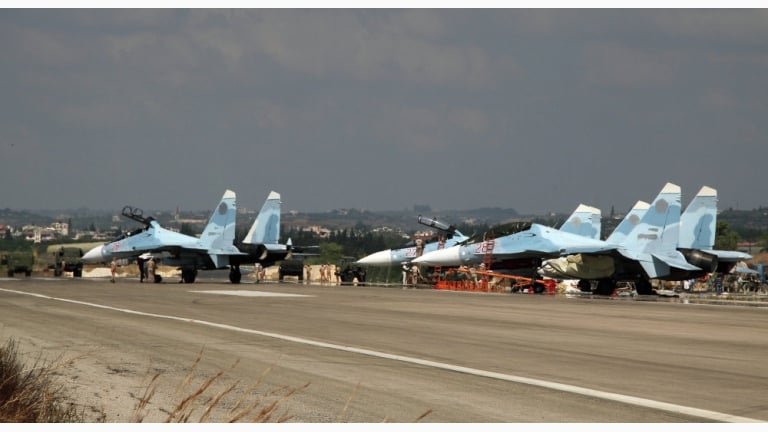
Russian lies for several years on the right of Syrians in shaping their own future, are fully exposed by the agreement between Russia and the Syrian regime. This not only puts Russia in control of the Syrian state and regime, through the prevention of any questioning of Russian military by the Syrian judiciary, but also allows the Russians to introduce any weapons they wish to, and being exempt from any taxes. The Russians are well aware of the regime’s weakness, but they wish to impose the current humiliating military agreement on any future Syrian regime. The Russian inflexibility toward the negotiating delegation as well as towards the armed groups stems from precisely this point: Syrian political powers will never accede to the current agreement, nor will they accept Russian tutelage.
Russia has actively obstructed all international resolutions against the regime and caused the failure of the Geneva Convention. It has, ever since its own military intervention at the end of last September to change the equation on the ground, and to impose a negotiation process that would help re-qualify the regime under the pretext of the opposition’s weakness and the presence of jihadist groups on the ground; the opposition would, thus, be forced to accept the Russian diktat. The leaking of the agreement with the regime comes within this framework. Russia therefore now imposes a full occupation—or, to put it differently, is trying overtly to do so.
Russia’s blackmailing of the Riyadh Conference delegation has been incessant, even reaching the limits of the absurd through Russia’s imposition of a second delegation as representative of the opposition—not merely to inject its own agents into the Riyadh delegation. Even more heinous was the setting of specific names thereof; names that are, from the onset “burned.” This, of course, was a futile attempt; for the Riyadh delegation seems fully aware of the seriousness of its role at the moment: Without its agreement to the negotiations or to whatever outcome they may deliver, the negotiation will be a failure in advance—even if it were with the Moscow-appointed delegation alone.It is entirely possible that Moscow wishes to pass time—as some analysts allude—via the game of negotiation. Russia itself, however, is at a nadir due to the collapse of oil prices on which its economy is heavily reliant, from one side; and because of the widespread Islamic rejection of its policies in Syria and the surrounding Islamic republics. A fear of extensive Afghanization in Syria and the return of Russians jihadists to it at a later stage, is also at play.
Russia is also aware that the regime no longer possesses the ability to confront both the people and the jihadisms. It has—since 2012—sought the assistance of Iran, Hezbollah, and Shiite militias; all of whom have also failed. All attempts to restore the army’s spirit seem to have failed in garnering any results. There, therefore, are multiple factors which seem to impose a political solution on Russia—rather than simply content itself to the criminal solution.
The factor preventing Russia to part, once and for all, with its prevaricating policy is American silence on—even approval of—Russian brutality in Syria. But the growing Saudi and Turkish distancing from the U.S. may change some variables in the regional equation. The option of allowing anti-aircraft missiles, which will stop the Russian airforce and put pressure on the Russians to provide a direct political solution; remains a mere possibility at present. There are, then, major complications blocking the negotiating route.
The request, by the Negotiation Authority delegation, for the implementation of confidence-building measures by both the regime and Russia is an entirely sound demand—these include the entry of aid, the lifting of the sieges, the release of detainees, or putting a halt to the bombing; it would likewise be right if the opposition were to demand the military factions to release civilian detainees they are holding, or for other procedures. These necessary measures are to be achieved before entering into negotiations; if rejected, they must be noted against the regime in accordance with international resolutions that require the regime to carry out these procedures—yet that it has refused to. The negotiation, which will be under the auspices of both the United States and Russia, and through a series of international meetings, has clearly become a total necessity; the war on the ground, via the media, and through constant pressure on the opposition delegation; deserves a pause and a careful assessment. It indicates that there is an international will to achieve it.
While observing the war on the Syrian ground, the war will rage even higher in the coming days on all fronts. Regime forces will retreat as a result,and the Russian airforce will be of no use in these battles. For, inasmuch as Russia is exercising the dual options of war and politics; so do the forces opposing the regime. The Russians will learn that no party will achieve their illusions of an international trusteeship for them. The minimal demands of the Syrian people must be achieved; otherwise, the negotiations will be an absolute failure, Russia will be proclaimed as being a full occupation force. This will herald a national war of liberation, thereby opening the door to even fiercer conflicts than the current one.
To say that the negotiations are an international and regional game, is not at all a falsehood. Russia, Iran, America, Turkey, Saudi Arabia and Qatar do indeed have the greatest influence therein; there is an international coalition, Russian intervention and a thousand forms of financial support and arms arriving into Syria. All of this, however, does not mean that any political force can also negotiate. The forces capable of negotiating—and currently enjoying international consensus—are the delegation emerging from the Riyadh Conference, which represents key political forces. It now has the onus of rejecting all forms of pressure directed towards it in this period; as well as to make the serious threat of withdrawing from the negotiations, if the pressure translates into diktats that would turn the delegation into nothing more than false witnesses. In this framework, Staffan de Mistura’s role should be clearly restricted to being a mere envoy of the Secretary-General of the United Nations—not a an authorized mediator. He shall not be entitled to enter any new names into the negotiating delegation.
In this context, all political and revolutionary forces ought to pressure the General Negotiating Authority to reject all attempts to interfere with policies that emphasize the issue of the formation of a transitional council with full constitutional powers; to reject the recent Russian agreement with the regime; to stress the need to evacuate all armies—whether supporting the regime or the jihadi armies; and to reject the idea of forming a national union government, that would inject new blood into the current system or the current opposition as well. The humanitarian situation must be separated from the political solution, and the latter must be pursued so as to achieve the minimum of Syrians’—all Syrians—demands of the Syrians; and so as to transform Syria into a modern state, and put an end to all causes of internal conflicts.
* Opinion pieces do not necessarily express the views of Rozana Media.