


Reports | 25 05 2020
By: Rouhada Abdoush
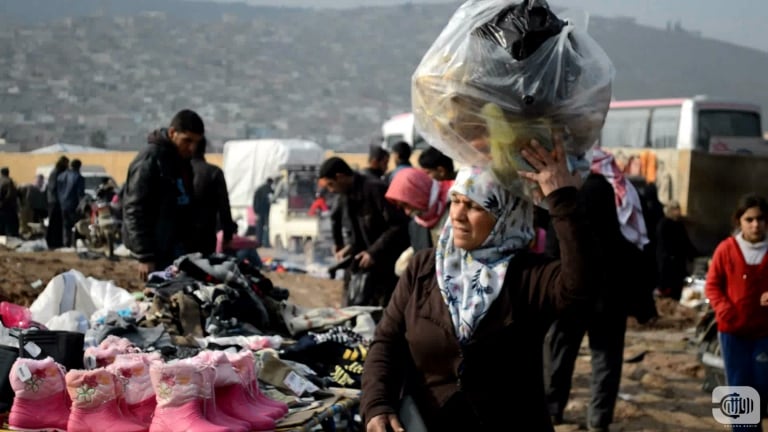
I stood for quite some time facing the quadragenarian lady wearing her dark-colored scarf, before I asked her about her quite obvious condition—given her stoic quest with all the strength she could muster, attempting to sell the very bread bags of which I had just purchased a few.
She was one of a group of adult women and young girls scattered on the roadside, working from morning till night—some in shifts, while others consider the road much safer than where they lived.
Sabah, a mother of three, talked about her conditions and how she does not want to rely on anyone to feed her children. After being driven out of her home in Jobar, she lost her husband and was forced to live in a shelter. None of the men she went out with were capable of working with the same freedom she could: She had greater freedom of movement, she would never fall under suspicion, or be called out for forced labor—unlike all the men in her family. She chose this particular profession among several others in the shadow economy (Domestic cleaning lady, stairwell cleaner, stall salesperson) and considered it a career. It requires experience, strength, and patience to stand, to negotiate with customers, to display her loaves of bread in a manner attractive to passersby—mostly in their cars.
Sabah knows nothing about resolution 1325 or what it comprises regarding peacemaking women—that decision whose clauses, among other things, ensured women’s rights to participate, to be protected, relieved, and receive convalescence during armed conflicts. She is just another bread vendor, subject to harassment, theft, numerous attempts of exploitation, and sexual harassment—which she resists with the cooperation of the rest of the women. There is no one to protect them, for fear of matters escalating and becoming more complicated; theirs is a purely female protection—with their own hands, if need be. In their own private lives, they are providing for entire families of elderly and children. There are among them those who support their children and their small families in a desperate effort to prevent the children from having to go out to work themselves—but their luck runs out, and their best efforts are thwarted; they are, finally, forced to seek their children’s assistance. This remains a far better option than using their older male children, who were forced—by virtue of disease, fear, and dejection—to coop themselves up inside their homes, shelters, or open parks. That is not to mention those lost, arrested, or killed.
The fact that resolution 1325 was originally decreed to "support the basic role played by women in all aspects of peace and security, the recognition of their role as leaders in peacemaking, and putting an end to sexual violence in wartime” notwithstanding; it remained a dead letter. Who is it, on the ground, who supports the role of real women, fighting it is that works to support the role of REAL women who are actually struggling to bring peace to their families and their communities? Who can protect those women subjected to all forms of violence—among which are economic and sexual exploitation?
Were it not for the support of women working in the shadows for themselves through their own solidarity; very little else can be said of state, government, or international organizations’ support. These call upon a few aristocratic ladies who head centers inside Syria, supported by state institutions; as well as a few activists outside Syria, whose own suffering pales in front of that of women inside the war. They call upon them to speak and demand a leading role in peacemaking; to hold activities, and provide ill-prepared reports and statistics lacking in accuracy and impartiality; to share their souvenirs, photos, and plans that remain nothing more than ink on paper. All this, to subsequently produce political leaders from both the opposition and the regime, without the presence of women in decision-making positions; thereby perpetuating the social stereotype about women, despite them breaking all barriers, and creating the impossible.
As such, the chasm between the bread sellers—the real women struggling to make peace, without any knowledge of either Security Council resolution 1325, or all those fancy conferences and workshops; and between those other women, chairing boards, without having suffered or possessed any true awareness of what is happening on the ground. This manifests the real reason behind the exclusion of women from political participation; behind ignoring all the contribution these women—who have resisted all this sexual and gender-based violence, who resist for the sake of true peace-making—have made. Sabah’s responsibility ends not when with the sale of her loaves of bread. She sews her children’s necessities with her hands, she economizes on expenditures, she organizes matters, and she assumes the burden of guiding all the family’s problems and issues—resolving them. She creates happiness to all family members, at the expense of her own exhausted body, patiently holding herself together. In this, she resembles many of her colleagues in the profession, all of whom have mastered the art of dealing with the daily loaf; it has become an integral part of their lives, with which they rebuild their families and protect themselves—with their own hands. They struggle for peace to prevail among the members of the family; with the hope that it may make up for what has been lost, and the agony they had to live through for years.
Sabah does not, however, hide her dread of what is coming next, when the conflict ends, and the men return to their traditional gains. She, therefore, says while biting on her hot loaf pf bread: “Oh how I fear my husband’s return in the future and, instead of supporting me, he will see the years have taken their toll on me, and decide to remarry… Men are like this life: Neither of them can be trusted.”
* Opinion pieces do not necessarily express the views of Rozana Media.