


Reports | 25 05 2020
Awareness in Syria, prior to 2011, in its most essential form had been a religious awareness. The world was comprehended from this angle; one may be a doctor, an engineer, a teacher, a politician—yet possess a religiously-based awareness. On this, Syrian philosopher Tayeb Tizini says that not all those educated are necessarily cultured. This awareness was perpetuated by the failure to construct a modern economic structure, and the survival of the same old social structure. The political regime has championed the development of all forms of religious awareness, in an effort to besiege the modernist awareness, which rejects the old status quo and fully comprehends the seriousness of the present religious dominance; through which humans’ relationship to life is funnelled through the relationship with God and religion, not through the relationship with the state and the regime. Therefore, any form of poverty and absence of rights an suffer individual may is due to divine will and to an inherent weakness in himself; if one were to enrich oneself, the same reasons would be at play. This form of awareness is, of course, based on a totalitarian authority, that drives people to reject all confrontational options confrontation, in favor of seeking God—and his heaven or hell—directly.
The religious and sectarian pluralism in Syria also means the existence of multiple forms of religious and sectarian consciousness; each of which evaluates the other from its own particular angle and, therefore, demonizes it. Religions are, by nature of their being, at conflict with others; sects are an expression of political and social conflicts albeit in a religious cloak; whatever residual awareness remains is nothing but the old inherited awareness itself. The only novelty is that this awareness no longer is political and employed in the sanctioning of killing the other; it has, rather, become a form of consciousness, coexisting with the distinct other. It has, therefore, retreated from its erstwhile political function, in favor of an individual identification of oneself in a purely religious sense. There admittedly are several reasons for this, the mention of which would be an endeavor too great for this present essay.
The existence of religious pluralism, was not the leading cause for driving Syria into the situation that appeared as of 2013 onwards—particularly with the expansion of Iran's entry [into the Syrian arena] under the guise of Hezbollah. As mentioned above, the main form of awareness was of a religious—and, therefore, sectarian not political—nature; yet quite open to sectarianization. It this very aspect in which the regime—as well as the fundamentalist and jihadist groups—have invested; it was equally encouraged by certain parties in the opposition, which harbored the hope that this sectarian route would be one of the ways to bring about the regime’s fall. Awareness has largely become sectarianized, after having simply been either religious or non-religious.
There were, in the Syrian regime’s educational curriculum, religious education courses; one for Muslims, the other for Christians. This was not out of recognition of sectarian pluralism. All received Baathist-indoctrinated education; Christians were taken out of the classroom, with only Muslims remaining. This was a social division, but one that did not arouse any particular rancour or hatred. Religious Education teachers certainly were not aware of its seriousness; their teaching style had been fundamentalist rather than sectarian, and unlike the prevalent popular form of religion.
Far more serious in this regard, was the fact that all other educational subjects in the curriculum [physics, chemistry, biology, philosophy, and others] never addressed the archaic religious consciousness. I would argue that the majority of these subjects’ teachers possessed no understanding of this idea; thus the majority of Syrian students over many decades were unable of interpreting natural phenomena by which they were surrounded employing the scientific material they received in schools! Consequently, forms of loose dissociated ideas simply piled atop one another, with nothing changing. With time, only that which is practical to employment remains, whatever is not, is automatically erased; with the one immutable constant being religious consciousness. The more straitened the conditions, the more it provides illusory palliative solutions to people. The regime maintained religious Sharia education—the entirety of which is fundamental and, therefore, a true “opiate of the masses,” in that it offers scant solution to the existing predicaments; rather burdening the individual with auto-responsibility for any failures or miseries. Religion in modern times, however, has become an issue for the faith-based relationship with the divine; not a vision or policies to explain the problems of life. What explains the latter are the sciences of politics, economics, sociology, philosophy and other modern disciplines.
The great [Syrian] exodus to Turkey, given the latter’s relationship with the Muslim Brotherhood, meant that the task of education was entrusted to them. They consolidated religious consciousness in all its forms—as if in perfect harmony with the regime. Behaviors hostile to modernity in all its forms were rife, imposing the veil in schools, limiting teaching staff to Islamists exclusively, striking National Education out of the curriculum while consecrating religious material. The Libyan curriculum—alien to Syrians, their culture, and the particularity of their society—was adopted in numerous schools; a huge leap backwards even from what the regime pursues in its areas of control. Syrians thus were turned into a hodgepodge of religions and sects; not a people whose primary language is Arabic, who belong to the Arabic cultural sphere; as well as to Kurds and other nations from the other side. Educational practices serving the Muslim Brethren were imposed—in a repetition of the regime’s time-honored practice. That is, the very same archaic religious awareness structure was thus consolidated.
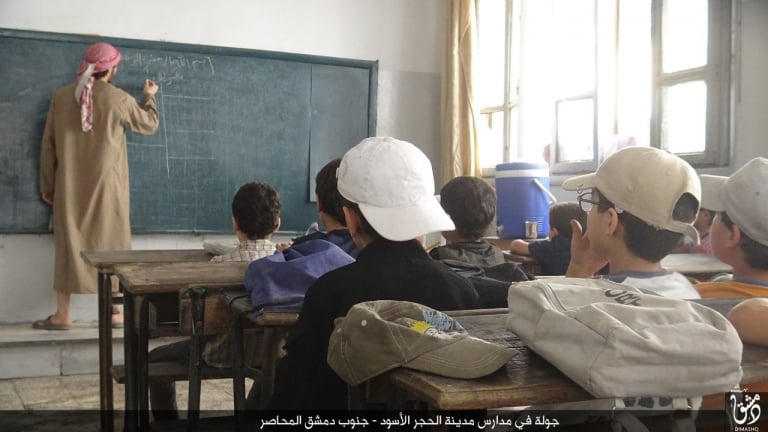
The most serious experiment in this regard must be that of jihadi groups, Daesh in particular; as it offers itself as a state and is actively seeking to set one up. Education has its own Diwan [or Ministry, loosely], and is limited to the teaching of books about unitary [Islamic] faith, the Holy Quran, the Arabic language, and mathematics mainly. All technical, physical education material, arts, social, philosophical, and Christian religious education was simply stamped out of the curriculum. All those working in Daesh’s education service—most of whom are not properly qualified to do so, at any rate—are expected to sign a “repent document;” by means of which they proclaim their rejection of the “positive” [earthly] curriculum. The exclusive answer to any violation in such issues is capital punishment. Not to be outdone, the al-Nusra Front [NF] similarly imposed its own education system—almost identical to that of Daesh’s.
The regime has also instituted a separation of sexes in Syrian city schools; education was mixed in the countryside, due to the lower numbers of students. Similarly, Daesh and the NF have both established a separation of the sexes adding, however, a more serious dimension; that is male teachers for male students, and female teachers for female students—something that reminds of Saudi Arabia. Any examples to illustrate ideas—even if in mathematics!—should emphasize religion, jihad, and arms.
The regime conducts [Ba’th] party education courses; so too do Daesh and the NF. This perfectly dovetails with the mindset they wish to consolidate in the areas over which they impose their authority on the people, by brute force of arms—First and foremost.
Many fear that these schools will spit out generations of graduates, the cleansing of whose minds from what they were force-fed will be anything but easy. There is, therefore, a sectarian awareness against the other being instituted—an “other” that may include Sunnis, even a jihadist’s own family! This education is prompting many an analyst to adopt a sombre vision vis-a-vis the outcome of all this. Children are, undoubtedly, harmed by such an education; yet this is not wholly a result of this war, nor because such education is socially acceptable. Education under the Syrian regime is designed exclusively to serve its hegemony and control; yet it has not been successful in preventing the people from categorically rejecting it. The same may be said of Daesh’s education and the fundamentalist role of the Muslim Brotherhood.
One cannot blithely write off the seriousness of that which is taking root in the conscience of generations; but an end will be put thereto, once all parties are seated around a negotiating table, and solutions are come up with to commence a new phase in Syria. The danger lies not in the education offered under the influence of arms. It rather lies in any coming educational system that does not constitute a break with the previous awareness; that consecrates religious consciousness, and sanctifies the customs of archaic social traditions; that fails to change this archaic consciousness’s structure, and even employs it in favor of conjuring false solutions to real problems; that helps prohibit people from playing any effective political role to attain their interests. Religion ought to be separated from education, once and for all; thereby making religion a private matter. Educational curricula need to offer a comprehensive explanation of all aspects of nature and life.
All Syrians have a stake in this issue, and in ending the old form of education in all Syrian cities.
* Opinion pieces do not necessarily express the views of Rozana Media.