


Reports | 25 05 2020
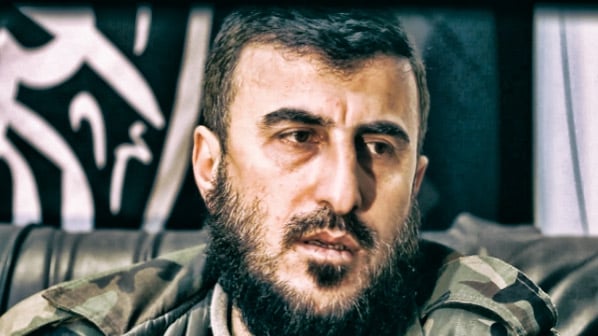
By the beginning of 2015, Zahran Alloush imposed himself as the absolute ruler of the Eastern Ghuta. He led a campaign to "cleanse the country from the abomination of corruption,” which translated into ending the autonomous anarchy of some fighting battalions from his ultimate authority; having a month prior also “cleansed” the Ghuta from Daesh—with the exception of Al-Nusra Front [NF] which remined outside his command, yet also coordinating with him on all matters pertaining to the confrontation with the regime, and its own operations. What is significant—in the context of Alloush’s imposing his totalitarianism—was his killing of famed commander Abu Ali Khabbiyyeh; a death that was an absolute joy for the regime, added to the killing of numerous others as well.
This man, Zahran, was a salafist. He was arrested, in 2009, on this background, and there are those who claim that he was coordinating with al-Qaeda in Iraq at the time—with the knowledge of the Syrian regime. He might have wished to develop his own independent venture, and this led to his imprisonment. It is worth noting that the notorious Abu al-Qaqaa, ell-known for his al-Qaeda links in Iraq, as well as with the Syrian regime, was also killed when his function came to an end in 2007. Salafist and jihadist organizations at the time were under the control of security services, with which they "played" facing US threats to change the regime—as soon as matters in Iraq came under their full control!
Zahran’s political vision is a salafist vision; hence his famed saying that “democracy lay under his feet.” Yet Zahran, progressively after having formed the Army of Islam, became supported by Saudi Arabia, through the offices of his own father—the Islamic preacher and founder of the "Assad Institutes for the memorization of the Quran" in 1985. After he realized the absence of any role for a salafist role in the Ghuta or in any coming regime; he backtracked on his former views, in favor of a recognition of democracy and politics. This was one of the reasons for his being invited to the Riyadh [Opposition] conference, and his adherence thereto. Ahrar al-Sham followed suit as well. Zahran here had merely sought to qualify himself for the change that is necessary for him to be recognized as a political representative of the Ghuta in the transitional phase; or perhaps would have promoted one of his own men to this position. He would thereby retain his “army,” as well as imposing his own political role by force of arms; simultaneously thus allowing the countries supporting him—Saudi Arabia, and others—to guarantee their own interests in the coming political order.
Zahran competed with the Syrian regime in laying siege to civil activists and the true instigators of the Revolution in the Ghuta—even their arrested. One striking example of such is his continuous denial to [having any relation to] the fate of the four activists—Samira al-Khalil and her companions. At any rate, Zahran and his salafist comrades were released in 2011—the regime releasing them with the implicit intent to sabotage the Revolution. The conspiracy theory frame of mind, or the notion that their release was only ordered after full coordination with the security apparatus, notwithstanding; the presence of the Islamists in the Revolution represented a political gain for the regime and loss for the Revolution. Both were instrumental in the successful transformation of the Revolution to a total war; eradicating the presence of civil activists as previously mentioned; contributing to the siege; as well as turning the conflict with the regime into a secondary issue—while the main issue became the establishment of a totalitarian religious authority, that controls people’s mobilization, and restricts their anti-regime activities.
Ever since entering the Ghuta, Zahran presented himself as the leader of a military battalion. He gradually—as a result of his salafist connections abroad, his nexus with his father and Syrian salafism as well—began to eat away at other factions and battalions. He played a significant role in ending the Free Syrian Army [FSA] phenomenon as a protector of the demonstrations and civilians; and not an authority over them. Support for the FSA was suppressed, in favor of support for Zahran and salafist and jihadist battalions; which also happened to dovetail with regional states’ interests. In this particular aspect, Zahran was operating for the benefit of regional powers, but also for the benefit of the regime that presented itself as secular—because of this particular salafism and jihadism. This, in contrast to all other faction heads, who were presented as jihadists, salafists, and takfirists; even the Revolution itself was branded as sectarian, and a threat to minorities.
People in Ghuta starved, and numerous young anti-regime men were arrested. This caused a large anti-Zahran demonstration to come out, and denounce him as being nothing more than another “Hafez Assad.” Many observers of the evolution of the Zahran phenomenon, as well as of the state of siege; assert his role in tightening the siege and in impoverishing the people. One can certainly not talk of Zahran without his well-earned reputation as the “man-of-withdrawals.” He withdrew from Jobar, Adra, Mleiha, among others. What this means to say is, that Zahran was busy consolidating his own authority and strengthening it by all means. He was concerned with stockpiling—and maintaining—a sizeable arsenal, that he would rarely if ever utilize in battle with the regime. Zahran, as such, was attempting to qualify himself for the moment of politics—i.e. for negotiations—whereas others were engaged in battle.
One cannot, naturally, say that he has not engaged in any battles against the regime; he actually has. That equally is not to say that he has not lost any martyrs; for in fact he has. That is, however, to say that he actually constructed an authority for himself, his family, and salafism alone.
Zahran was desperately seeking a political solution, and carefully watching for developments thereof. He had no right, at any rate, to reject such; his state backers themselves had entered the quagmire of negotiation. It was, subsequently, noticeable that he became—without ay objections—involved in the Riyadh Conference; unlike the Ahrar al-Sham movement; within the context of weighting the representation of the military and the Islamists in that conference.
The party rejecting the entry of the Army of Islam, Ahrar al-Sham, and others were Russia, Iran, and the regime—all of whom classify it as a terrorist power. Zahran failed to clearly notice very how surprised Russia initially had been by the Army of Islam’s and the Ahrar al-Sham movement’s presence. He and other leaders simply had to be liquidated; a matter that had been achieved when his—and numerous other leaders’—death was announced.
Russia intends to weaken the fronts confronting the regime—particularly the fronts classified as being non-jihadist. That is why it deliberately and intently is eradicating these non-jihadist battalions, or forcing them to establish truces with the regime—before arriving to the negotiation stage. If it is in Russia’s capacity to kill the largest number of FSA and non-jihadist movements’ leaders, it will spare no effort to do so. The UN Security Council resolution does not fall under Chapter VII and, therefore, includes no confidence-building measures on part of the regime. The battle will, therefore, now fierce—even increasing in intensity in the coming few months; that is, until the states involved in the attempt to hammer out a political solution, reach a certain number of procedural agreements.
Zahran’s assassination—much like the murderous and criminal Russian military operations against civilians in all Syrian cities—ought to prompt the [Opposition] Negotiating Body or negotiating team to suspend all formal consultations thereon about [UN Special Envoy, Staffan] Di Mistura and all stakeholders; as well as to fire every opposition member who breaks this suspension, and to censure them. This is to force Di Mistura—and these state stakeholders—to introduce confidence-building measures before commencing negotiations.
* Opinion pieces do not necessarily express the views of Rozana Media.