


Reports | 25 05 2020
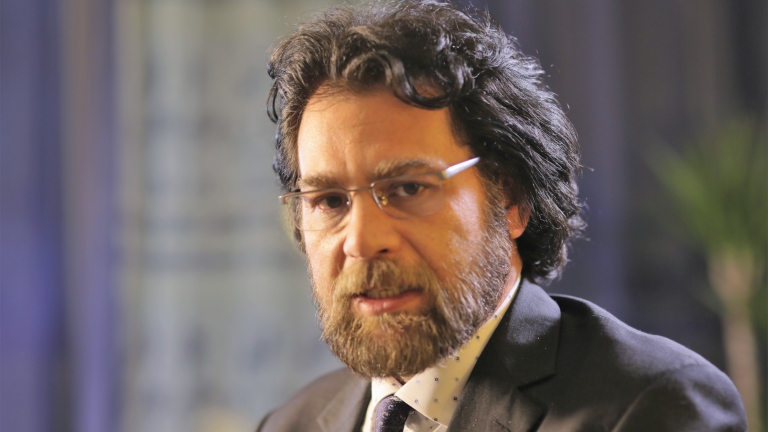
Syrian writer and journalist Ibrahim al-Jabin, in an exclusive interview with Rozana, speaks about the relationship between jihadist Abu Qaqaa and the Syrian regime between 2001—2007, and the origins of former al-Qaeda leader Osama bin Laden. He also reveals the reasons for which his program “Milestone”—presented on Syrian Television during 2009—was taken off air.
Ibrahim al-Jabin made a recent appearance in a documentary film on al-Jazeera, on the figure of Abu Qaqaa. The latter commenced as an Islamic advocate in Syria in 2001, continuing his work in the call for jihad, until his assassination in 2007. He remains a matter of debate, between those who see him as a regime intelligence collaborator; and those who see him merely as an Islamic preacher.
In an interview with the series "Circle of Death", al-Jabin spoke of his relationship with Mahmoud Qol-Agassi. During a meeting in Damascus after 2003, he was not under surveillance by the Syrian intelligence services; noting that neither was Abu Qaqaa who, at the time, used to visit the Ministry of the Interior. An entire floor would be booked for him at the the book has an entire floor, at the Barzeh Police Officers Club.
Al-Jabin adds: "The Syrian regime wanted to put a complete end to the Abu Qaqaa phenomenon in Aleppo. Qol-Agassi was incessantly telling me of his [Abu Qaqaa] fears—never returning to his former glories, or his constant fear of being assassinated at any moment. I was enchanted by his character, in addition to my feeling that he had actually been a dead man walking. A human link was thus created between us both, as if I were keeping a person on death row company—irrespective of this person’s guilt or innocence."
The Syrian journalist confirms that the regime wished to spring a surprise—comprised of Islamic and jihadist organizations—onto the world, and attempt to link these to the Syrian Revolution. He explains: "The regime has manufactured these organizations. The biggest proof is that of Abu Qaqaa, who was exploited by Syrian intelligence services: They gave him free rein to commence training and the dispatch Mujahideen to Iraq, in return for him handing their names to intelligence. They would immediately be arrested upon their return [from Iraq], and used as a bargaining chip with Arab and international intelligence services."
Bashar al-Assad Stop the Airing of a Program
In his program, “Milestone,” Ibrahim al-Jabin was in the habit of interviewing Syrian political, cultural, intellectual, and artistic personalities. Following the Revolution, his guests became split—between regime supporters and opposition thereto. After airing 25 episodes, his program was taken off the air. He was prevented from appearing on Syrian Television.
Of this particular instance, Ibrahim al-Jabin tells “Circle of Death:” "I later learned that “Milestone” was taken off the air at the orders of none other than Bashar al-Assad personally. He instructed the former Minister of Information Muhsin Bilal to stop it; nothing else could be done about this decision.” He adds that “since its inception, the program had carried the seeds of collision with the Syrian [regime’s] apparatus, with corruption, with security, and with centers of influence. It was expected to be taken off air after each episode."
Regarding his program’s guests—whether he still held them in esteem as “milestones,” even if they had sided with the regime; al-Jabin says: "The program was not a tribunal; it offered no conclusions, rarher a set of questions."
Bin Laden and Bashar al-Assad!
In 2001, Ibrahim al-Jabin researched a documentary film directed by Nabil al-Maleh, depicting the life of Osama bin Laden and his family's roots in the Syrian coast. This was given that fact that Osama bin Laden’s mother as well as his first wife were Syrian, from the Qurdaha countryside.
Says al-Jabin: "I proposed the title of the film as being “Osama bin Laden in Syria.” I looked at the psychological formation of the man, to attempt to find why he decided to forsake his wealth and fortune, and leave for Afghanistan to strike the United States’ most formidable economic symbol."
He adds that he and director Nabil al-Maleh visited the Ghanem family—Osama’s mother’s family, descending from Qurdaha—Assad’s hometown in the Lattakia countryside.
Al-Jabin says that he met with Layla, former al-Qaeda leader’s adoptive daughter. He adds that she sent several messages to her father, reminding him of her childhood days in Khartoum, Sudan. Al-Jabin notes that "Layla Ghanem was not wearing a hijab in front of the camera."
He adds: "I filmed the movie in both Lattakia and Tartous; as also in Tartous there was another of Osama’s father’s wives. In that city, I met with some elders who told me how, “in the late 1950s, a Yemeni trader called Muhammad bin Awad bin Laden came to town, and bought two girls—one from the Ghanem family, and another girl another family. He took them with him [to Saudi Arabia]."
Why Was the Film not Screened?
Al-Jabin confirms that, according to his film’s witnesses’ testimonies, Osama was treated as a domestic servant’s son; and that this created in him the sentiment of not being equal to the rest of his brothers, as well as a lacking sense of belonging [to the family].
He adds that, during the 1950s, King Faisal abolished slavery in Saudi Arabia. Bin Laden’s mother, thus, naturally became his father’s wife, as she bore him children. Following his father’s death, his mother remarried, and he lived with his maternal uncles in Syria."
He notes, however, that he does not know whether the family was currently living in Syria or not; but he confirms that they were "a decent family, with stature in Qurdaha, and who live normally and enjoy friendly relations with the townspeople."
As to the film not being screened, says al-Jabin: "After production was completed, we tried to market the film to allow its screening. We offered it CNN, who sent their regional correspondent Rula Amin. The channel eventually declined, stating that they were not interested in the film. Of course, at the time, the regime enjoyed excellent relations with all those countries that are its enemies now."
He adds: "I received the following query from Syrian intelligence: What interest do we have in having the number one internationally number one wanted terrorist being linked to [his Excellency] the President? The film's director Nabil al-Maleh was subsequently called to meet with senior intelligence officers, who confiscated his copy of the film."
In conclusion, al-Jabin confirms the existence of a second copy of the film; but he says that he does not know if or not it would be screened at a later date.
It is to be noted that Ibrahim al-Jabin has worked as a journalist since the early 1990s, and has published several literary works; in addition to producing several documentaries, television programs, and talk shows.