


Reports | 25 05 2020
By: Mohammad Habash
Syrians write of hope; yet a sequence of disillusionments renders any such writing of hope a type of naïveté and political dervishism. Can one this time, therefore, say that the Riyadh conference constitutes a departure from this script, and that it carries some modicum of hope for Syrians?
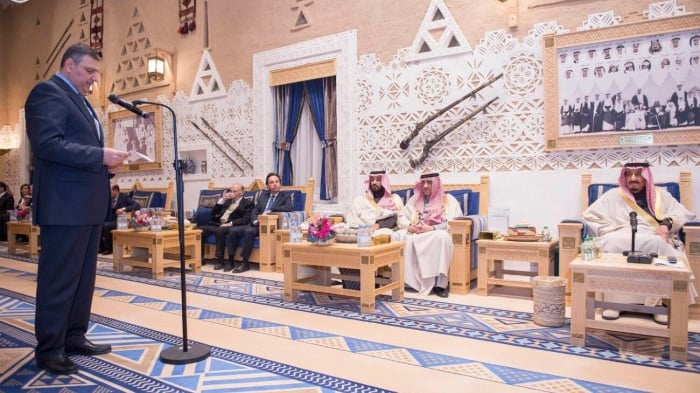
Although I only made it to Riyadh quite reluctantly, I believe that Riyadh represents a glimmer of hope for Syrians adrift. The conclusion of the meeting on Thursday with an audience with King Salman was yet another sign of renewed hope; the meetings have in fact been encouraging and impressive. Before we even made it out of our meeting, Secretary [of State John] Kerry declared that the seventeen countries [Friends of Syria group] will discuss the outputs of the Riyadh conference; that the impressions were quite positive. He said that Riyadh had succeeded in providing a genuine platform for the first time, in offering a platform for the most important political and revolutionary armed factions in Syria to converge under a single dome; where they successfully created a single body to oversee political negotiations on behalf of the rebels with the international community .
The Riyadh documents are no different from their predecessors, and it is my conviction that all of these documents are similar. The formulation of opposition conferences’ closing statements requires no more than a news editor; who would be tasked to rewrite all the repetitive information that shall reside in the final statements’ data bank, that has become part of the Syrian Revolution’s literature.
What is special about the Riyadh conference is that it comes in the context of international political process. There are major countries awaiting the outputs of Riyadh; as well as specific dates for international meetings that will be built on the results of Riyadh, and will determine the final negotiating table.
The fact that 117 countries had already met to support the Syrian opposition under the Friends of the Syrian People moniker notwithstanding; they had been of one color. Meanwhile, the forces allied to the regime simultaneously held other meetings in Moscow, Tehran, Damascus, Lebanon, and Iraq overtly aimed at combating the Friends of Syria programs. The fact that the Friends of Syria countries numbered in excess of one hundred countries notwithstanding; these were mostly of a hollow, cold, Facebook type of friendship. The regime, on the other hand, possessed two ferocious combat-active allies, the first of whom descended onto the scene with its battleships and fleets; while the other came with its sectarian battalions beneath the banners of al-Hussein, Karbala, and Labbayki ya Zainab [Here we Come, O Zainab—Call by Shi’a to the Prophet Muhammad’s granddaughter, as a sign of devotion to the Shi’a cause].
The Vienna meeting may prove to be the first meeting for breaking this rule, by allowing both regime allies and enemies the possibility of meeting in a single political process. It has, within a few weeks as well, achieved the “miracle” of unifying the Syrian Opposition in Riyadh—thereby paving the way for a new reality on the ground.
It is not to be said that these countries—with contradictory visions, interests, and political and religious backgrounds—have achieved a utopian form of unification for Syrians’ sake; or out of commitment to the United Nations Charter. Such a vision for be a cold dream, one that will shatter coming face to face with the cold realities of come to pieces when it faces the first moment of the reality of antithetical interests. Yet the mere act of meeting and agreeing upon a program to bring an end to the tragedy, renders the prospects for a solution realistic—at least to a certain extent, given the latest developments.
Surely, the choices made in Riyadh for the formation of the Supreme Negotiation Commission [SNC] were anything but infallible. I had personally written before the conference that it is difficult for such meetings produce integrity, wisdom, and righteousness—particularly under the overwhelming weight of the Syrian Opposition’s circumstances, lost as it is; and given the fact the they [the negotiations] are hosted by a country that does not claim to be the beacon of neither democracy nor political freedom.
Still, I am certain that the SNC comprises true Syrian patriotic leaders, following the hollowing—at the hands of the Baath, for fifty years—of the country of any national political leadership, and bringing about a devastating political desiccation; all in favor of autocratic individual rule. It is my firm belief that I am driven by my national duty to speak with respect and hope for these men, who have been entrusted by history with his enormous responsibility.
I did not nominate myself for the SNC. I was imbued with a mysterious sentiment, that people like myself were not deserving to assume the top ranks of the Revolution. We neither suffered or endured what they bravely had to suffer and endure—having to languish in the regime’s prisons; offering their children and families as glorified martyrs. We managed relatively successfully to avoid danger, despite the fact that the regime spares no one, hunting us down with its draconian and jaundiced legal provisions—that resemble anything but law. To sacrifice money and positions, however, is nothing compared to the sacrifices of the honorable ones.
Riad Hijab is the choice all participants agreed upon. He represents a symbol of the most brave and courageous position in taking the side of the oppressed people. His was the highest position in the state [second to the President]; yet he needed only two months to lose all hope in his ability to bring about real change in the regime’s bloodstained program. He realized that his role will not be more than to offer justification of other crimes and it was, in fact, a hazardous decision to stand up to the regime’s brutality and tyranny. Within days, he was showered with unjust death sentences by the regime; repeated denunciations by the regime’s “philosophers” of how supposedly his cover had been blown for some time, as an opportunist, a climber, an agent of foreign interests; and so on and so forth, a lengthy list of unending charges. All that, although one month prior he had been declared—by the same voices!!—the most patriotic and committed Syrian, chosen by the wise leadership, that heeds not to enemies, to become Prime Minister.
I speak not for the person of Riad Hijab. I have very limited personal contact with the man—mainly courtesy and protocol meetings. My personal impression of him is actually not that encouraging; he is but a man, and all men are erroneous; the loftiest among them are those who repent. Yet it is a genuine responsibility to desist from the childish and insouciant game of mudslinging that we are so wont to play, throwing charges at any new leader; whereas the others [regime adherents] offer their leader as a god whom they worship. We cast our leaders with stones, charges of treason, and slanderous accusations; and fail to reach any agreement over any leader.
I salute those men chosen by the Syrian Revolution to be its voice and conscience. I call upon all noble pens to write of these men, and oblige the world to respect them; so that they can regain the world's respect for all of us.
* Opinion pieces do not necessarily express the views of Rozana Media.