


Reports | 25 05 2020
In the most dangerous city on earth, death wears multiple faces: By shelling, by sniping, and under torture. A multiplicity of risks haunting most of Aleppo’s inhabitants of Aleppo, still clutching at straws and attempting to remain in their city—the lethal variables notwithstanding.
Danger spares no one. It has practically seeped into every small detail of daily life. Professions and businesses are no exception, each with its own attendant risks, each with its own ranking as per its risk factor. So, what are Aleppo’s most dangerous professions?
Death Thru the Lens!
Media work represents one of those most dangerous professions in the capital of the Syrian north; as journalists face injury to life and limb on a permanent basis, by mere virtue of their presence in the areas of shelling and clashes, trying to cover these events and transmit their images.
"There is no one seriously interested in the safety of Syrian Journalists—neither abroad or among the active factions on the ground. Syrian journalists are truly and literally running on faith," says Houssam Qattan, a photographer working in Aleppo.

Houssam received an injury while covering clashes in the Sheikh Saeed area in May 2015. That, however, did not prevent him from carrying his camera and joined the long list of his colleagues injured during clashes between regime forces and opposition fighters. This list includes the likes of Zain Rifai, photographer for Agence France Presse [AFP], the latest recipient of the British "Best independent photographer.”
The suffering did not end there. Aleppo’s arenas witness the slaying of numerous photographers. One such case is that of Joumaa Al-Ahmad, photographer of Shahba Press Agency [SPA], killed in the bombing of the village of Hayyan in the Aleppo countryside; another is Saleh Layla, photographer of the Anatolia Agency, who died in November 2015 in a Daesh bombing.
Bombardment is Not the Only Danger!
Not only do Aleppo photographers face explosions and bullets; they are also surrounded by the danger of extremists and militants. They have had more than their fair share of woes at the hands of Daesh, before its withdrawal from Aleppo at the end of last year.
Daesh claims the lion’s share [in persecuting photographers]. During its control of the eastern districts of Aleppo, more than 30 journalists and photographers were apprehended. Some managed to escape; while many remained unaccounted for. One prime example of the latter is Abdul Wahab al-Mulla, previously working for the Aleppo Today Channel.
Additionally, some hardline factions harass photographers. Such as what happened to photographer Fadi, for example, when he wanted to cover the moments following the falling of an explosive barrel in an Aleppo neighborhood of Aleppo; as well as help the injured.
The young man explains: “When the rescue teams arrived, I started to document this event with my camera. A woman appeared behind the children I was shooting; that is when one of the gunmen—who was already ordering me to leave—started attacking me. He took my camera and broke it, while those with him started to assault."
White Helmets and Paramedics in Peril!
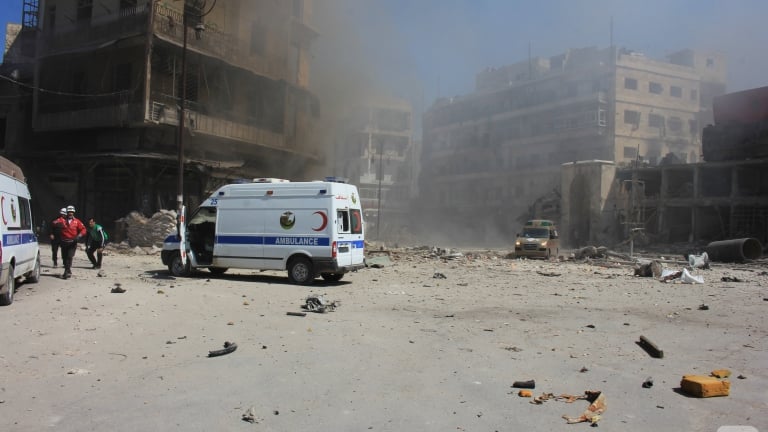
The work of civil defense volunteers is no less perilous than that of media workers. Their job demands their immediate dispatch to shelling areas—often vulnerable to repeated targeting by regime forces.
The presence of people gathered in the bombed building while civil defense are evacuating the wounded and the dead bodies, poses yet an additional threat. This congregation of crowds may lead to further collapse [of the building]; thereby threatening the lives of civil defense workers, as well as of the injured trapped beneath the rubble.

Mohammed Faraj, a civil defense worker in Aleppo, received wounds in a repeat bombardment while working to evacuate the wounded. "The [blast of the] barrel tossed me to the next street. When I returned to the site, I realized that three of my colleagues had died," Faraj says.
The danger is not limited to the White Helmets; it also affects the paramedics accompanying them, as well as the ambulance crews. They face several risks while transporting the injured from Aleppo to border area hospitals—particularly through the al-Castelo juncture, the city’s lifeline.
Saad, an Aleppo ambulance operator, says: "Our most dangerous work site is the al-Castelo road, targeted by [regime] aircraft with heavy machine guns. We have to rescue the injured immediately; and this brings us under direct machine-gun fire—especially at night."

The Risk of Death… Not by High-Voltage!
"We were forced to abandon many maintenance and repair work in clash areas, as a result of being targeted by sniper bullets; this, despite the Red Crescent pledging that neither party to the conflict would harm our maintenance crew," says Abu al-Ezz, an Aleppo Electricity Company maintenance crew member.
The lot of Abu al-Ezz, and that of his peers in the profession, seems to confirm that the high-voltage or exposed cables no longer constitute the biggest dangers faced by electricity maintenance workers. Maintaining the cables hanging from atop high poles exposes them to the risk of sniper fire by the Syrian regime forces, that maintain a watchful eye over most Aleppo regions.

In addition, these crews help repair that damages caused by clashes on the front lines, thus causing the injury and killing of dozens of their workers.
Regime forces have, additionally, arrested and liquidated the entire maintenance crew of Abdel Samie Afash, while it was working on repairing a damaged tower in the Handarat area, in October 2014.
The Roads of Death!
Passing through the fighting lines and the attendant threats, have become a daily reality for public transport drivers, who work between the various regions of Aleppo and its countryside; in which control is divided between Daesh, the armed opposition, and the Syrian regime.
Their vehicles come under repeated shelling by random bursts—collateral damage from the numerous clashes on the roads intersecting these areas.
These risks carry many annoyances as well—especially at Daesh checkpoints. These checkpoints hold bus drivers responsible to force women to respect their strict Sharia dress code. A driver may come under arrest simply for transporting a woman whose dress does not conform to Daesh’s stringent fashion standards!

"An organization [Daesh] member roundly scolded me when he saw a woman inside by minibus not wearing the niqab [veil covering the face]. He called me a “cuckold,” accused me of not fearing Allah. I dared not answer, of course," says Abu Mohammad, a driver on the Aleppo-Manbij line.
According to driver Abu Saad, working on the Aleppo-Bab line, merely talking back to those holding arms in the various areas, puts a driver’s life at risk.
He explains: "If you as much as talk to a Free Syrian Army [FSA] fighter, and Daesh caught wind thereof—through another driver, for example—you would be accused of being an agent, and arrested. At other times, the opposite may be true. The organization arrested a number of my colleagues for this very reason."