


Reports | 25 05 2020
By: Rami Nasrallah
Civil, urban, activity at the hands of organizations voluntarily operating outside the scope of primary communal relations and links; seeks to establish or activate the role of civil society—the space for freedom and the theater of history and interactions. The space that is “capable of providing innovative solutions to these interactions and conflicts, and of turning them into laws; given the extent of its presence in the political state, and its ability to direct its helm."
Civil society, therefore, has no role removed from the construction of the national political state—the state of the rule of law. That signifies the restoration of State to one that is a state of society; and the reintroduction of politics, as a sum total of all its activities and forces. There is no separation between civil society and its state, "that is—in essence—the state of civil society."
The ruling authority in Syria has assumed its power over both the center of society as well as its margins, via the[Baath] party and its organizations. It established its relations to collectivities that possess a vertical notion of communal awareness, in which individualism plays no role. It was always in the best interest of the community center, and established relations with the awareness of the authorities—extremely sensitive to any modicum autonomy displayed towards it—that individualism retrogress; in favor of invigorating the aforementioned links, particularly in times of crises. The few associations it actually did tolerate, were allowed only based on their religious and charitable character; those that help ostensibly alleviate poverty and its cruelty.
With the onset of the popular mobilization, the concept of civil society made an increasingly vigorous presence, following the severe trembling of the ruling authority’s pillars of power. This prompted Syrians to reconsider the existing social contract.
The popular mobilization thus heralded its clear political demands, for a restructuring of political power commensurate with the newly-found position of the people, and their increased awareness, as an expression thereof. It embarked on the shattering of the erstwhile vertical set of relationships in favor of a new horizontal one; between categories enjoined by collective interest in political change, and a re-opening of individual horizons, and civil assembly and collective action. Revolutionary activity thus coalesced with civilian activity—which in turn became the Revolution’s reserve, as much as it had become its carrier; and it helped enshrine its legitimacy.
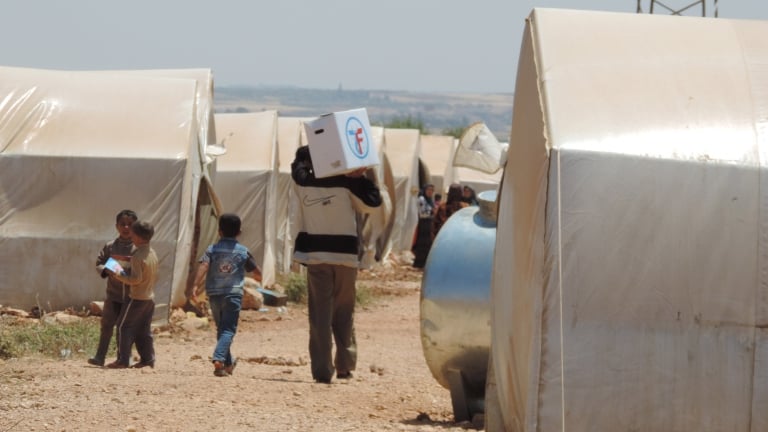
Then, however, violence incremented, the Revolution became militarized, and the country severed. Revolutionary work became confined, in the areas controlled by the opposition, to military activity. Almost all of the civil work was limited to relief and rescue work, psychological support, and the education of children whose schools were destroyed. In other words, the attempt to mitigate the effects of war.
Civil activity in the areas under regime , on the other hand, sorely lacked the presence of its instigators—taken out by the regime, either through murder, detention, exile, or by severely restricting the mobility of those few remaining. Activity, thus, was limited to relief work and psychological support, or recreational and educational activities that do not tickle the system’s sensibilities. Young people readily joined these activities, contenting themselves to such framework far removed from public political affairs; much to the regime’s relief, as it viewed these activities as a suitable outlet. It therefore allowed these activities, with either its tacit or active approval. Political activity, however, became confined within narrow categories no longer strong enough to coordinate with civil society, whose members simply receded and drifted into the background—sensing an existential threat. This constituted an additional obstacle in front of civil and political action that is based on horizontal relations.
Outside the country, where conditions were more amenable to mobility, activity, and organization; several political and human rights groups and media trends did emerge. Yet, their distance from the internal interactions [inside Syria] has actually conspired to weaken their impact. Not to mention the corruption, personalization, fragility—even fictional nature—of their organizations; as well as the obfuscated vision and work mechanism, spread too thin over too many simultaneous activities, between relief to politics. Additionally, their subservience to external ready-made methodologies or the previous experiences of other peoples. Freedom was replaced by emulation. These organizations prioritized the changing of the state’s legal framework, rather than targeting their societal partners—the true stakeholders in change—and catering to their fears; or the ties that bind these partners to the economic situation, to men of religion, all of which ought to be addressed, questioned, and influenced—rather than simply being considered as antagonists. “Society's culture is not merely one of ready-made texts and laws; it does not constitute, in its view, the standard of what is right and what is wrong.” It rather necessitates a new articulation based on a developmental and rights platform; one that attempts to determine its keys, to consult different ideas, analyze them to better comprehend their content, and interact with them on an ongoing basis to reach a comprehensive ideal—one that enjoys majority support.
Its media fora also remained aloof from the any profound cultural and critical social awareness.
The emergence of the concept of civil society in Europe in the seventeenth and eighteenth centuries, was combined with the reality of a genuine cultural revolution of thought; one that views man as an individual, and an abstract entity. Civil society in Europe today is founded in liberal democratic countries, wherein laws or political rights unify society. The function of laws or civil rights thereby becomes the maintenance of the social unity. Attempting, therefore, to project that onto Syrian reality will not be in line with the reality of a resistance to the policies of an unjust authority; the attempt trying to restore identity; to create an intellectual, cultural, and political plurality of intellectual, cultural and political; in tandem with the political activity in the struggle to achieve a democratic transition to the political state, that has formed its political existence and self-determination. “Democracy—in such case—represents the restoration of the political state to its actual content; that is its social whole.” Civil society cannot be founded or strike roots without a strong national state, "the political environment to foster democratic and civil development.” That is when civil society can assume its role in the expression of the full spectrum of political, economic, social, cultural and religious institutions; under whose aegis it actually operates in various aspects, as to meet the urgent needs of the society; and in relative independence from the authority of the state and the influence of capitalist private sector companies; thereby growing relatively independently in accordance to its own domestic laws. This, in turn, shall herald the transition from assuming a mere remedial or service-provision function—which threatens to dim the presence in the areas of public policy-making. This also helps it distance itself from the logic of mere catalytic challenge, or the so-called “throw a stone into the stagnant ditch” approach of raising problematic issues; in favor of working according to a comprehensive and uniting national strategy and vision, “one that employs civil tools such as boycott, normalization, pressure tactics, and negotiation. Politics are employed—rather than “resorted to”—as an art to score certain gains,” in line with the evolution of society and its increased participation in making its decisions.
Finally, the word “social” precedes the civil and urban, an adjective that does not here recipe does not reduce that which it describes. We should, therefore, strive to look into society, its manifestations, its interactions, and the course of its development for whatever is commensurate to the transition from “man, the son of nature” to man, the son of history; its creator; the writer of laws as the expression of public will; and the realizer of his human self—before all else.
* Opinion pieces do not necessarily express the views of Rozana Media.