


Reports | 25 05 2020
Russian soldiers in the Syrian coastal region do not seem to limit themselves to fighting alongside the regime’s forces; there are other activities in which they are involved!
Alexander takes out some dollars from his pocket, to give to Omran who brought him Arabic tobacco, the planting of which the coastal mountains are famed for.
Russian soldier Alexander, who has been in Latakia for no more than a few months, seems to have fallen in love with this type of tobacco; that has also become a source of livelihood for many residents of the Hmaimeem area, in the Jableh district, home of the recently erected Russian airbase, and a number of Russian infantry soldiers.
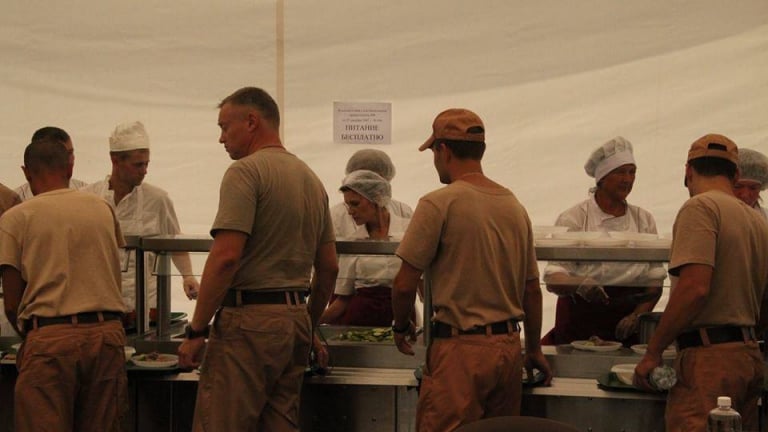
Russian authorities have not been derelict in providing its soldiers—numbering in the hundreds, with no precise figure provided—residing in Hmaimeem with their requirements.
Yet curiosity remains, and the desire to sample all things local prompts the Russians to purchase some items from their surrounding environment. These may include the winter supplies for which the coastal mountain villages are famed; as well as seasonal fruits—and a lot of tobacco, according to Omran, who explains that he sells them each batch of unpackaged tobacco for more than forty dollars.
“It is a big price, I know. But they also have big money," says Omran, pointing out that the sale of a tiny amount of tobacco for 40 dollars, cannot be considered fraudulent—according to him.
He queries: “The season has fallen sharply; and the General Organization of Tobacco in Latakia only buys cheap. What is wrong with selling in exchange for foreign currency and, thereby, cover our cultivation expenses?"
Fighter-Tourists!
The Russian mission in Latakia has not been limited to mere combat matters. It surpassed it to a side mission—predominantly of a touristic character.
One often sees them roam in civilian clothing throughout the city’s neighborhoods—avoiding opposition neighborhoods, preferring to confined themselves to either pro-regime neighborhoods, or those that remained on the sidelines.
They seem to display a great affection to the Southern [Lattakia] Corniche cafes, particularly those donning five stars.
Dirar, an employee in one of these cafes, confirms that Russians may come alone or accompanied by a Syrian friend wearing a military uniform, who would help explain them the menu items, and proffer advice as to what to eat best.
Says Dirar: "When they come alone, we give them the tourist treatment, in terms of prices, service, and payment in dollars—especially the tips, which I personally demand in hard currency. But when accompanied by local regime officers, we are obligated to commit to regulated pricing and to obey the officers’ orders. They refuse to pay in any other currency but Syrian, and bring their own drinks—thereby depriving us of any special profits.”
The young man sees that Russian visits to those cafes “actually help shake the stolid atmosphere a little. Getting paid in dollars remains a demand, in these difficult times. And they seem to have no shortage thereof."
Special Orders!
Russians’ lack of proficiency in the Arabic language remains a huge barrier between them and understanding the “conspiracies” being hatched against them. These include the [inflated] prices they are being offered, in a city that is in the throes of a rampant—and unchecked—pricing chaos. In many cases, there is collusion between their local minders and merchants, to sell them at artificially inflated prices.
"They often ask for items we do not have," explains Boutros, a shopkeeper in the Amerkan [American] neighborhood, who points out that the Russians are asking for types of foods that do not exist in the Syrian market—particularly special cold meats and fish.
Boutros adds: "I often secure them through a friend in Beirut, but at a high price that realizes a profit for both of us. They actually show up by the time agreed upon, or send one of their local minders to collect what they requested—no questions, no haggling. They certainly are great customers.”
What Role for Turkish Goods?
Russians generally are not enamored of the quality of locally produced goods available in Latakia. There is general lack of quality in all things local that have flooded the markets. At many occasions, the Russians fighters descend on the markets to purchase climate-appropriate clothing and shoes.
Yet they surprised by the low level of the goods on display, particularly with regard to fabrics. Haidar, who owns a shop in the Zira’a neighborhood, points to the fact that Russians have a huge demand for the summer cottons—even though that it is currently winter in the city.
Haidar continues: "For them, temperatures here are moderate compared to their Russian weather. We are trying to secure the best for them, but they refuse to buy local [brands]. They clearly demand Turkish goods, as they are available in their markets and they have become accustomed to their quality."
The sensitivity of dealing in Turkish goods in regime-controlled areas was not lost on Haidar, "I know that dealing in Turkish goods is forbidden in our markets. But I work on securing them periodically and clandestinely," confirms the young man.
He adds: “Not that they care about this detail. The country’s economy will not collapse at my hands alone. Living requirements are difficult—but I most manage to secure them."
Regime vs. Moscow Soldiers… What Difference?
Returning to Hmaimeem, converted from a civilian to a military airport at the hands of the Kremlin, one observes that many of the town’s residents implicitly agree on exploiting the Russians—without veering into reprisal, so to speak.
The residents of these regime-loyal villages actually like the Russians and welcome their presence among them. Like Majd, who sells them “slit” olives which they seem to greatly admire, and they always ask for this type of food.
Majd does not believe the Russian soldiers to be dimwitted; they merely do not seem to care how much money they spend, he says.
"Look at the difference between their soldiers and our soldiers. My brother fought on the north Latakia countryside front. His salary does not exceed 1500 [Syrian] pounds per month; he can only afford to eat boiled potatoes and eggs; sleep under the open skies and in the cold; and ultimately has to bow to the orders of the Russian officers." Majd concludes, as if to justify his actions to himself—even find them legitimate.