


Reports | 25 05 2020
By: Fadi Azzam
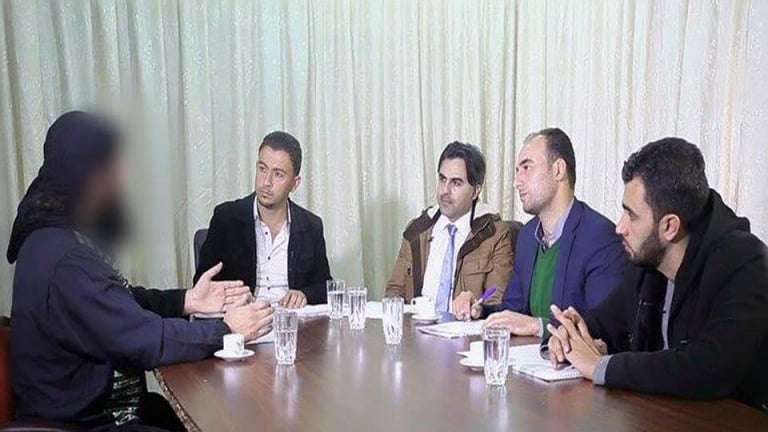
By lumping together four journalists from three different media outlets, The Nusra Front [NF] announced a press conference by its leader, Abu Mohammad al-Fateh al Jawlani.
The four invitees arrived into a house in an undisclosed location, and sat with the Sheikh—one of the most prominent warlords in Syria. The NF dined them before their encounter, then ushered them into a room for the so-called “press conference” to commence. In reality, however, what we saw unfold was neither a conference, nor even vaguely related to the press in any manner.
Since, when one is cooped up in the God-forsaken lair of some group; one knows not whenever a religious authority may jump up in one’s face, brandishing a religious text that may be interpreted in a thousand different ways; or one may—in an instant—even find oneself crucified and whipped in a public square, on charges of insulting religion, or for cursing the state of water or electricity.
At any rate, oceans of ink were spilled on Jawlani, and meeting him, as one of this conference’s objectives. One’s predisposition towards the NF, its objectives and mode of operation, notwithstanding; logic calls upon one to attempt to draw some conclusions from that which the conference had not explicitly pronounced:
First, a white blot obscured Jawlani’s face in the traditional way, used by al-Jazeera to obscure the slain Taliban leader Hakim Allah Masoud: With a white halo of light, that makes him look as if he were one of the Renaissance saints.
This is a qualitative development in terms of the visual presentation; as Jawlani’s visage was therefore revealed to the four journalists. This also represents a qualitative improvement the quality of Jawlani’s attire, if compared to the poor-taste shirt he wore during his interview of [al-Jazeera’s] Ahmad Mansour; where he look more like a character escaping a B-type historical series, with shoddy production. In this meeting, he wore a pair of Pakistani Mullahs’ Dhoti pants and Kurta shirt—ideal to hide his paunch underneath, after he put on several new centimeters of flesh; as a result of an increasingly sedentary lifestyle, lesser mobility, and more devouring of tasty food and meat—courtesy of the delicious Syrian cuisine and bounties.
Even the table around which the guests were seated was different that the chair from his previous interview, stolen from the Idlib province. An image of austerity and simplicity is intended, following the barrage of criticism for NF’s pillaging of the Idlib provincial government building furniture.
Second, the stated objective of this conference, as declared by Jawlani himself, was to thwart any attempt at a political solution—and at all costs. One of the means to achieve such is this meeting itself.
Jawlani’s technique to characterize the current scene’s current situation boils down to a single phrase: It is "a conspiracy on the scene."
When any militia commander starts by speaking of a plot, one immediately finds oneself confronted with a new Bashar al-Assad or Hassan Nasrallah clone; a mere byproduct of the washed out revolutionary left and the hybrid powers of tyranny, swamped in their hollow rhetoric. In jihadi jargon, this is nothing short of the imposition of qiwama [protection of men for women, from Quran 4:34] with the coercion of the Sharia and the authority of the sword—following the forced “marriage” with the Syrian Revolution.
All analyses thereof—whether complex or simple—do carry a grain of truth; yet there remains an idea that seems all but neglected; an idea all know, yet no one grants enough serious thought.
Any potential for a political solution in Syria would, as a consequence, desiccate a fertile land for Jawlani’s—and his companions’—project; a nebulous and obscure project that is based on nothing but war in and of itself. Were it not for the swampland that broken countries like Syria, Somalia, Iraq, and others seem to provide; Jawlani would be unable to recruit anyone other than merchants of death or outlaws of his ilk. Their lives and ideals are not only diametrically opposed to the spirit of true Islam, but also to the laws of evolution of life itself. They, therefore, only seem to propagate in regions afflicted by the hatred bred by dictatorship and lacking in any hope. It is there where they claim themselves, and their ilk, glories and laurels; and govern according to their own twisted desires, which they claim are the desires of God himself.
Thirdly: The last two to desire a political solution in Syria, and who seek with all their might to abort it, are both Bashar al-Assad and the Abu Mohammad al-Fateh [Jawlani]. Simply because once the wheel of a political solution is set in motion, the countdown for their dissolution—much like a poisonous jellyfish taken out of water—will commence..
Any observer of the tone of rhetoric of both regime President and al-Qaeda’s Syrian militia leader will find them almost wholly compatible. Both consider freedom a frivolity; both despise the Free Syrian Army [FSA]; both consider the Americans to have been defeated in Iraq and Afghanistan, and that the mass destruction in both these countries means nothing. Both possess the baseness of he who arrogantly views others with contempt; both possess smugness and insolence, fraudulently claiming to represent a just cause; and both are part of the disaster and cannot, therefore, be part of the solution. Both have the power, in their tiny respective pigeonholes to decided on life and death, and apply terrifying sanctions on the people under their control; both only understand the language of force; both feed on destruction, revel and grow in it, create their “glories,” and have their shabeeha [thugs] who justify all their excesses. Both remain unscathed leaders, using others as fodder for their fighting with others. Both—when asked about their popular incubator—claims to offer his soul and blood, and that they are merely collateral damage in the battle. Both only engage in prisoner exchanges if they help polish their own image, or return with benefits to their organization. Both claim a plot [against them], both see the peaceful Revolution as trivial... etc.
One may continue to enumerate similarities between both, to the point where one may be justified to thinks one is talking about the same person in depth—with a mere difference in outward appearances.
Fourthly: Jawlani’s political action tactic, his position vis-a-vis truces, and the lethal weapon he alone wields, that no one dares reply to—that which he calls, the Sharia issue. He wields battle with a religious fatwa, enters a truce with another, and withdraws from am area under the same pretext. Any critique of his own actions will be akin to a criticism of the Sharia—even sacredness itself; invoking the scourge of apostasy that is thrown about with the same simplicity of a whiff of air!
Even the Taliban themselves, whose attire Jawlani seems so keen to don, did eventually negotiate with the Americans; they opened an embassy in Qatar; held talks with Saudi Arabia; and dispatched representatives around the world to explain their case, without anyone accusing them of apostasy. We are facing a revolting pragmatism, wherein it suffices that the Sharia vision visit the good Sheikh Jawlani in a dream, for the fate of a city or the future of a country to be altered.
Fifthly: In his justification of Ghuta’s hunger, he tells its residents that he and his companions are paying a toll in blood and lives, as if their problem only were their hunger. While it is true that it requires the weight of four men besieged in Ghuta to equal Jawlani’s own weight; the more serious issue is that he simply fails to see the martyrs of this siege—the children, women, and common folk. To him, they are mere collateral damage; their rank as as martyrs inferior to those who descended upon them to spread jihad, and establish the State of the Caliphate—the meaning of which only God knows.
Kill them on a daily basis helps him sustain his war against the infidel West; the Rafidha [Rejecters, a pejorative name given by extremists to the Shi’a]; the Nusayris [pejorative name for the Alawites]; apostates and traitors—to the last child among them.
Sixthly: Jawlani justifies his own subordination to external forces, and his subservience to the Emir [Qaeda leader] Ayman al-Zawahri in the mountains of Tora-Bora; is that he simply does not believe in regionalism. A pious negation link, one that cannot be compared with any other liaison. Sheikh Jawlani has, in reality, a reserved spot in the caves of Afghanistan and can, at any moment, make a refugee claim; he and his family would gladly receive social security and health care there. He is not truly that concerned in what he does in Syria, Somalia, or even Khorasan [Iranian province with historic significance in Islamic history].
Seventhly: There will be much talk and riding roughshod. Yet despite any attempts on behalf of the four journalists to portray the meeting as a “dialogue;" there was one question that had not been—and that cannot possibly be—asked of the historic leader, may God protect him: Could even his finest scholars and Sharia experts how he justifies the high levels of coordination, dialogue, and negotiation with the Zionist entity?! This is a coordination that no longer is a secret, nor a source of embarrassment to either Netanyahu or his people!
Is anyone capable of directly asking him—in his so-called press conference—about this issue? Or do fatwas, when it comes to Israel, transform into Sharia desires that turn the sword-wielding fighter into nothing more than a masseuse for Netanyahu and his state?
Awaiting Abu Mohammad al-Fateh [Jawlani’s] upcoming media interview we will, most likely, see his more of his face. The extent of his visage that he reveals seems to be proportional to the true nature of his organization that he reveals. This truth promises to be even more lucid—most probably to be translated in a return into the family fold of its brethren in ideological bent, and a reconciliation with Daesh. Or it will be signalled by a bloody all-out war with the other factions of the Syrian Revolution—especially the Islamic ones, and more precisely the Ahrar al-Sham. That collision is inevitable has became quite clear. Hope for a near solution plunges, yet again, in the mysterious sea of Syrian blood. A man such as Jawlani has no fear of God in Syrian youth who entrusted him to rid them of the murderous regime; only for him to plunge them into a crematorium of “liberating” the lands of the Caliphate—from the Andalus [Muslim Spain] to beyond Khorasan.
* Opinion pieces do not necessarily express the views of Rozana Media.