


Reports | 25 05 2020
By: Rouhada Abdoush
Nine-year-old Souhaib is hesitant to write a sentence of his own, making several excuses, to finally say: "I do not know what should I write.” When told again he is to write anything that comes to his mind, he will write: "Cleanliness is Godliness!" We change the request, then, asking the children to draw from their imagination the school they dream of; “an imaginary school, a figment of your dreams!” Only one single girl painted a school—the regular school—but atop a cloud. The rest of the children painted schools as they are in reality—starting with the steel gates. The only difference with actual schools in [Syrian] reality, being that the gates in their paintings were colored!
The aforementioned comes from an actual training session we, at the Bahr [Sea] Society for Child Protection Against Violence [under incorporation], for twenty young school age girls and boys—from different schools and social environments, as well as different areas of Damascus—under the title "How to Make Education More Beautiful and Safe."
Common to all of these children, was that they all have come directly under the weight of the war—leading to their displacement to different places inside Damascus. They were forced to change several schools, depending on their places of shelter during the three past years. They too—much as all other school children in Syria—are prisoners of a black steel gate; a stringent curriculum; dark [school] uniforms, that only received a shade of color much later; and teachers with a singular style, a singular face, and a singular slogan.
It is only normal for the war to adversely affect a child's imagination and dreams. But our children’s imaginations have always been this dry—much earlier before the war. For decades, the dreams of the majority of boys were to become future doctors, engineer or pilots—at best; whereas the majority of girls would dream of emulate their teachers and become future teachers themselves—fulfilling their parents’ dreams, and their visions for the future.
In an unpublished 2009 questionnaire, a volunteer in children’s association in Latakia asked children to write or paint their dreams. The painful and shocking realization was, that none of the children could draw anything fanciful, fantastical, dream-like, or far from reality! The experiment was performed in more than one school with convergent results, and a single image: "Our children live without imagination.”
Entire generations have grown up today—some carrying weapons, some emigrated, and some still struggling for survival. All underwent similar circumstances, wherein education was horizontal in the post-“Corrective Movement” era—designed to arrive at mandatory, compulsory, and gratuitous education at the expense of quality; as well as locking generations of children into the unique mission of achieving the slogan, parroted every morning: “One Arab Nation, with an eternal message.” We and our children lost the very purpose of education and its objectives—later codified into the Convention on the Rights of the Child in the 1980s; and which all human rights’ conventions that preceded it, exhorted and emphasized: the idea of freedom of expression and thought.
During the social market economy phase during the mid-2000s, extravagant private schools tailor-made for the ultra rich spread, following non-traditional educational methods imitating European schools; such as use of play in education, the promotion of music, sports and foreign languages as major curriculum items.
These were followed—by several degrees of difference—a second tier of children enrolled in erstwhile traditional private schools, but that have [since the late 1960s] been subject to official state curriculum. These operated within a restricted [and restrictive] space of educational freedom; mainly manifest in foreign languages, school transportation, and uniforms.
These two models have not caused any discernible difference—but only individual changes. This is due both to the limited number of students who actually frequented these schools, and because the experiment was not spread any wider.
During that phase, government schools’ uniforms were changed, from military fatigues to pink-and-blue colors. The former dread tied to military training and the "Vanguards of the Baath” was toned down—almost completely negated. Yet all of these were ostensible, cosmetic measures that changed none of the essential structures of the education process, or its objectives—namely, indoctrination and producing ideologized and vapid generations.
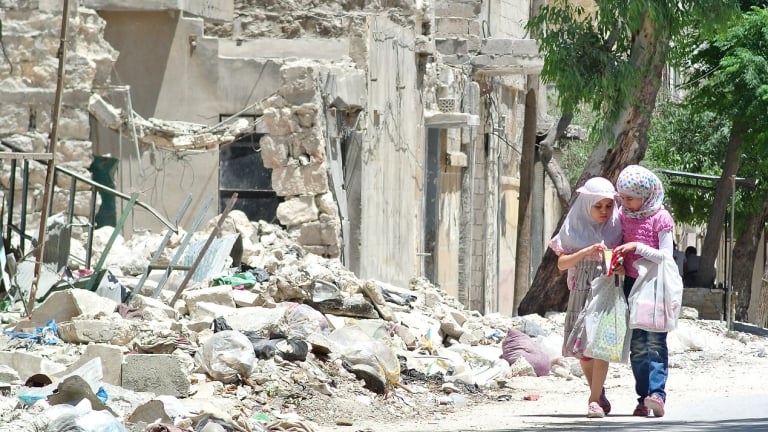
Then came the war and destroyed many schools in the Damascus countryside, with many schools in Damascus converted into shelters for displaced people. The remaining schools became jam-packed, thereby increasing students’ burden, and exposing them to various kinds of violations of their rights. The horror of shells now accompanied their daily trip to and from school, or followed them inside their classrooms or schoolyards. This affected their moral, physical, and mental health.
That is how the outside world suddenly morphed—from being an enticing world, full of attractions and enriching their personalities; to a threatening, menacing world replete with danger. That was especially tangible, as no institution or organization shouldered the real responsibility of child care. Care was minimal, and as permissible by the competent authorities—thereby dwindling the realm of children’s fantasies and dreams, and replacing them with the grim and tragic reality overpowering their souls, minds, and creativity. The gun, the fighter jet, and the missile became the most frequently-used tools of expression. The role of the school dramatically declined to the mere function of creating ideologized children; living the culture of obedience and repression; receiving education within fragmented and untenable approaches; and through teaching methods perfected by teachers themselves also suffering from crushing living conditions—notwithstanding that they belong to the 1970s or 1980s generation, which lived and grew up in the same manner. The prevalent culture among family, community, and the school thus remains intact; and contributes even further to the de-fantasizing the children and castrating their dreams and ways of thinking. It, at best, sends them out into a world firmly nestled within the confines of “colored gates.”
* Opinion pieces do not necessarily express the views of Rozana Media.