


Reports | 25 05 2020
Several field hospitals suffered the direct bombing of Air Syrian regime and its Russian ally, in areas controlled by the opposition of the Idlib and Hama countrysides. This led to some of these hospitals being forcibly decommissioned; while others were taken underground to cellars dug beneath ground level; with the killing and wounding of doctors and medics during the shelling.
Adel, a citizen from Maarat al-Numan from the Idlib countryside, suffered an injury resulting from an aerial bombing attack. "People rushed me to one of Marra’s hospitals. Despite the lack of the hospital capabilities and penury of [proper] equipment; they treated me and the rest of the civilians,” says Adel.
The importance of field hospitals is manifest in opposition areas, as residents there mainly depend on them—especially following the collapse of the infrastructure of most government hospitals.
The Syrian Regime's Sworn Enemies!
“The Medical profession was the regime’s bitterest enemies; the crime being providing immediate medical care to any demonstrator or regime bombing casualties," says doctor Hussein Al-A’raj, director of the Hama Health Directorate under the opposition.
In an interview with Rozana he adds: "We now have several field hospitals in Hama, three of which were decommissioned—namely those of al-Aqiarabiyyat, al-Wissam, and al-Qala’a. There also are other hospitals that suffered partial damage to their structures, and which we were therefore forced to move into other buildings."

Protective Solutions
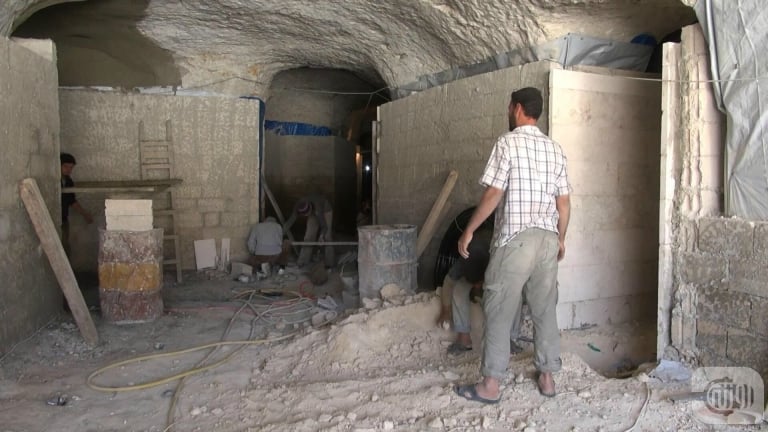
The Hama Health Directorate lost more than 15 individuals—doctors and nurses—to frequent regime bombardment of field hospitals; thereby forcing hospital administrators to choose underground cellars as their new locations. This is with the aim of protection from the shelling, and to offer a safe place to treat the injured. Al-A’raj confirms that the use of basements in the Hama countryside came in two stages. First, through the transfer of hospitals to mountain caves; second, via [literally] digging a hole [in the ground] to which the hospital was subsequently transferred—the hole is then filled, so as to secure it. He adds: "We now have three projects of this nature, in order to preserve the lives of our medical staff."
So, How is the Situation in the Idlib Countryside?
Field hospitals in the Idlib countryside were exposed to intense bombing, thereby putting some of them out of service. Medical equipment was damaged, whereas hospitals lost a number of medical cadres as well as a number of the injured who were receiving treatment. The Sermin hospital suffered the bombing of regime warplanes that led to the killing of 12 civilians, including two medical staff. Doctor Mohammed Tanari, Sermin Hospital Director, describes the details of the hospital’s bombing: "The hospital suffered two air strikes, with a difference of ten minutes between them. This led to the deaths of 12 people, including physical therapist Hassan Taj al-Din, guardsman Khaldoun abu Dan, and a Civil Defense paramedic. The rest were civilians, including children" He adds that the hospital sustained major damages, including some equipment that was destroyed, as well as several walls that were damaged.
Russia: Hospitals in the Crosshairs!
Young man Mohammad, wounded in a popular market following bombing by a regime missile, confirms that he was taken to a field hospital after his injury. He remained there for six months, and underwent surgery. Doctor Munther al-Khalil, director of the Idlib Health Directorate, accuses the Russian air force of targeting field hospitals in the Idlib countryside. He adds: "The Russian air force bombed the Taman’ah health center and the Orient hospital in Kafranbel; in addition to bombing the Sermin hospital.”

Difficulties Facing Doctors!
Doctors face great challenges, following the loss of some medical equipment, damaged due to the bombardment of field hospitals in the Idlib and Hama countrysides; putting some of them out of service.
Media chronicler for the al-Latamnah hospital, Obada al-Hamwi, says: “For the second time now, the hospital was put out of service due to warplane bombing. This caused the deaths of five patients who were receiving treatment, as well as the wounding of six members of the hospital staff."
Hamwi additionally confirms that the bombing caused the destruction of the radiation device, the operating room, lamps and lighting, and power generation—thereby putting all of them out of service.
What are the Priorities?
The securing and protection of field hospitals from bombing have become the most pressing current need of the Health Directorates of the Hama and Idlib countrysides, according to Dr. Ahmad Dbeis, Hospitals and Trauma Program Director at UOSSM [International Union of Medical Care and Relief Organizations] for the northern territory.
Dbeis confirms that the Russian airforce recently targeted more than 13 medical points—such as al-Latamnah and Kfar Zita in the Hama countryside; in addition to Kafranbel and Sermin, in the Idlib countryside.
The biggest problem faced by people in areas controlled by the opposition, remains the lack of field hospitals’ ability to cover and treat all the injuries they receive; following every aerial bombing that targets civilian gatherings. Field hospitals have, on the other hand, proved themselves as worthy replacements of the [completely absent] government hospital—albeit only partially so.