


Reports | 25 05 2020
By: Rateb Shaabo
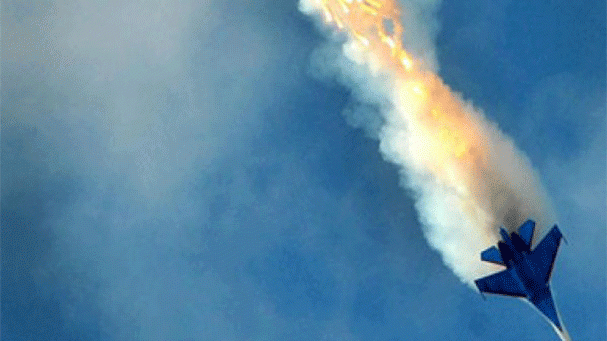
The downing of the Russian fighter plane by the the Turkish Air Force, throws into confusion what had settled following the Paris attacks that occurred on the night of November 13, 2015. These attacks carried a clear message to those countries actively involved in Syrian events—namely that Daesh are at their doorstep, and inside their own countries; and that the Syrian fire is steadily spreading into their own home turf.
A senior European counter-terrorism official commenting on the attacks says: “Europe was taken aback by Daesh’s ability, determination, and intention to carry out attacks of such level of violence and coordination—outside the territories it controls; rather than focus its energies and attentions on the attempt to spread its so-called ‘Caliphate.’" Europe never anticipated that Daesh would target it so soon.
The "Syrian" effect of this message manifested itself in a French tendency towards Russia—via direct military coordination—as well as the subsequent talk by [Russian Foreign Minister, Sergei] Lavrov of the need to "respect the privileges enjoyed by the Syrian leadership." In the same statement, he advised that “[Syrian regime president, Bashar] Assad represents the interests of a large part of Syrian society." It is clear that the Russians are taking advantage of the European wound, with which the Americans also showed their solidarity with Obama also telling the French president: "We are all French."
France—the European country most stringent vis-a-vis the Syrian regime—thus is approaching Russia, the virtual caretaker of the Syrian regime. This is the result brought about by the recent Paris attacks. In fact, all the events of Paris did was jolting the European position out of its stasis. The Arab-international coalition has been bombing Daesh for over a year now, yet Daesh continues to expand. There is something quite uncanny about this. Following the aforementioned Paris attacks, the U.S. presents France with a bank of targets in Raqqa for it bomb—without anyone knowing why they had not hitherto been targeted by the coalition’s jets yet. Then Russian planes commit a massacre against Daesh tankers transporting Syrian oil to Iraqi refineries, destroying 500 of them, according to the news. Where had these tankers been in the international bombing campaign’s target lists over the past year?
Between the need to eradicate "terrorism" and the necessity of preventing such from empowering the Syrian regime, and given the lack of willingness to work against the Syrian regime at the same time; the U.S. and European position has entered into a virtual state of inertia. It is obvious that U.S. bombardment necessitates forces on the ground, if it were to be translated into actual military gains. Yet the U.S. has taken not one step towards the formation of such a force; it has equally failed to build what it called the a “moderate Syrian opposition force.” It relies today on the Kurdish People’s Protection Units [YPG]—the foremost opponents of [Turkish President Recep Tayyip] Erdogan, the major ally of Washington. This further increases the scene’s complexity.
Russia's position—from the outset—was more effective: It supports the [Syrian] regime, and seeks to enforce only pro-forma adjustments to the regime’s structure. It aims to thereby circumvent the core of the conflict in Syria—manifested in Syrians’ aspiration for salvation from the Asad tyranny. On the military side also, the Russian intervention was more effective; as it is based on coordination with the military units on the ground—namely the factions operating on behalf of the Syrian regime. With time, the internal contradictions in the Western position started to paralyze Western efficiency; for the benefit of Russian action, that is in fact nothing more than the salvation of the Syrian regime. The Paris attacks only helped nudge Western attitudes closer to the Russian position.
Against this backdrop, one may understand Turkey's “resoluteness” vis-a-vis the Russian jet fighter’s violation of Turkish airspace. From a military point, the Turkish narrative looks unconvincing. According to The New York Times, Russian aircraft entered Turkish airspace for no more than 17 seconds; whereas Turkey claims that its fighter jets directed ten warnings to the Russian jet—for 5 minutes. This has a whiff of fabrication in it. But it is clear that the Turks—sheltering themselves behind NATO—wanted an excuse to slap the persistent Russians, brazenly pursuing their mission that seems to have received a broader political cover, following the Paris attacks.
Whether Turkey downed the Russian jet following prior coordination with the United States, or whether this was a purely-Turkish initiative; the Turks did not embark on such a step without a shrewd reading of the American position. American disposition was uneasy with what it sees as outright Russian bias in favor of Assad. It is clear that the U.S. supported Turkey immediately—as per the statements by both the US Army and President Obama. The U.S. then followed the incident by imposing sanctions against the Syrian regime, that also affected a Russian bank [Financial Alliance] for its role in financial transactions with the Syrian regime.
Thus, it seems that the downing of the Russian jet has put the breaks on the effects of the Paris attacks, and has forced Russia to take to look at what surrounds her; and realize that there are interests, other than hers, in the neighborhood.
Opinion articles published do not necessarily reflect the opinion of Rozana.