


Reports | 25 05 2020
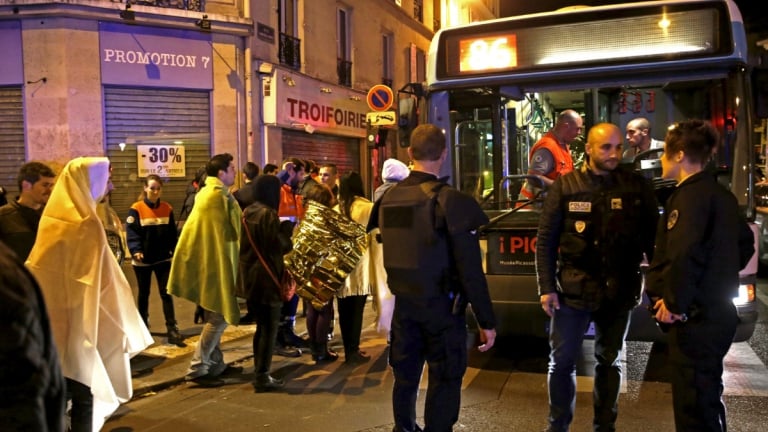
Rozana polled the views of some journalists and analysts; following the terrorist attacks on the French capital, Paris, on Friday evening, that had claimed the lives of 128 people and about 200 wounded. French President Francois Hollande has proclaimed a state of emergency in the country and the closure of its borders. Meanwhile, Daesh [ISIS] proclaimed its responsibility for the attacks.
In a telephone interview with Rozana, expert on Islamic groups Hassan Abu Haniya, saw a "shift in the behavior of Daesh since the Russian intervention. The organization no longer contents itself with operations within the areas under its control; it now undertakes reprisal operations that have included the Russian plane [felled by an explosive device over the Sinai peninsula], the southern district [of Beirut, a Hezbollah stronghold] and now, Paris.”
In response to a question about the significance of the Paris attacks, Haniyeh in his interview with Rozana said: "Daesh possesses logistic capabilities in France, which has the largest number of its nationals as Daesh members." He adds, "No matter how great the state, or how fortified against attacks of this kind it may be; one must still contend with the fact that such an attack took place—tight security measures notwithstanding. It is clear that it this attack was planned in Syria and Iraq, and therefore we expect to have more such attacks to strike European security.”
Haniyeh points out that "the organization is gambling for—and is actively attempting to provoke—a ground intervention [by Western powers, France included]. It actively desires it. But I believe that there is an opportunity in Vienna, to achieve a political solution to the Syrian crisis; because talking about Assad staying in power, will only encourage and fuel extremism in the region. It is therefore imperative to treat the deep root causes."
In turn Khattar Abu Diab, Professor of political science at the University of Paris, tells Rozana that "Paris following the thirteenth of November will not be the same as it had been before it. Since the end of last summer, France espoused as its strategy the war on Daesh said. He adds: “I believe that it will continue its bombardment of the organization’s sites.”
The Middle East affairs says “Is France, however, going to change its position towards the Syrian regime, politically? On the contrary. There will be a reemphasis on a political solution. All powers have taken a step back from their erstwhile demand of an immediate departure from power by Assad. This was a point of controversy in Vienna, and this issue will undoubtedly shed its shadow over the French position.”
He adds: “[French] representatives of right wing parties who visited al-Assad, will now unleash a new campaign to attempt to change French priorities, and rebuild a link with the Syrian regime—at least in terms of security. Will they succeed in their efforts? We will be monitoring this."
Abu Diab explains that "the French position up to this point considered Assad’s [explosive] barrels and his presence as nurturing Daesh. It considers him responsible for the release of Daesh’s leaders," pointing out that "this French conviction of an inevitable confrontation with Daesh, does not coincide with the willingness to sit [and talk] with Assad. It also considers maintaining the regime, while attempting to find an alternative from within problematic. I believe that France will, in the end, have to grudgingly assent to Assad remaining [in power], albeit for a limited period.”
For his part, Syrian journalist Ali Eid speaking to Rozana says that France has firstly taken an unambiguous stance vis-a-vis the Syrian regime's crimes; as well as clear position at a later stage in rejecting the terrorist organization [Daesh]. This firm French position has had a clear impact on the Syrian situation.
Eid adds: "Consequently, there are two points to be noted. First, France aims to remove the regime and the intricate relationship to the Daesh organization and its adherents. I think there will be a new dealing in Paris’ external relations, as being the cause of what happened in the French interior. I do not think, however, that they [the French] would give up what they had begun—supporting the moderate [Syrian] opposition."
On the other hand, Syrian journalist Sakher Idris, considers that “the terrorism that struck France, is intimately linked to previous statements by the regime. [Syrian regime Mufti] Ahmad Hassoun, quite seriously, vowed to launch “martyrdom operations” in Europe—adding that its perpetrators would not necessarily have to be Arab or Muslim. This was then followed by comments by [Syrian regime Foreign Minister] Walid al-Moallem and Bashar al-Assad that Europe will pay for having armed the Syrians."
Idris concludes: "I believe that it has become clear that the Syrian regime has ties to terrorist groups that carried out this kind of terrorist operations."