


Reports | 25 05 2020
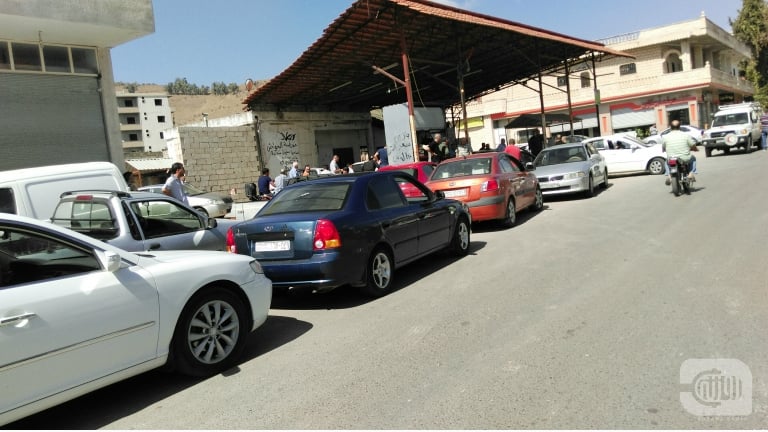
“The wait could go on for more than seven hours sometimes. If you have no other alternative, you will await your turn in silence—notwithstanding the fact that, even at the gas station, there are those who receive more favors than others," says Edmond, a taxi driver in the Wadi al-Nasara [predominantly Christian area northwest of Homs, central Syria]. He is describing a daily occurrence, whenever the Wadi’s gas stations have gasoline.
The most oft repeated conversation every week or ten days runs as follows: “I heard that the Anaz, Nasrah, or Hwash gas station have gasoline… Go, get yourself some.” It should be abundantly clear to all and sundry, of course, that three functioning gas stations cannot meet the needs of an entire region, whose population has doubled by more than half with the influx of many displaced people from other Syrian regions.
On Awaiting One’s Turn
You might think you are about to fill your car with gasoline, and that your troubles are soon going to be over. Suddenly you see a car, whose driver has the "favor" of the gas station’s owner; or another tinted glass car cutting you out and taking your turn. Someone may even brandish a full round of ammunition shouting over everyone’s head: “Make way—we have a [security] mission!" which raises the indignation and ridicule of some. Edmond comments sarcastically: “What security mission is so urgent in a safe area like this?!”
As to awaiting one’s turn and the favoritism that seems to disgruntle so many of those waiting for gasoline, one of the workers at the Hwash gas station says: “It really is not up to us, sometimes. Just last week, a man pulled the safety pin from a hand grenade and threatened to blow up the entire station, if we did not fill his tank with gasoline on the spot. You can imagine the chaos and panic this caused among those waiting."

“If You Don’t Like it, Go Buy on the Free Market!”
Edmond—with his local dialect—tells of yet another situation one may encounter while filling one’s car up: "If your bill amounts to 3,700 [Syrian] pounds, they will take 4,000 pounds without returning the remaining amount. If you ask for it, they will chide you for not thanking God for the blessing of filling up with gasoline. ‘Go buy on the free market, if you don’t like it here!” In such situations, you may get angry and exit the snaking and long queue—preferring to buy gasoline on the free market [at higher prices] than suffer humiliation at those [government-run] stations. Abject humiliation such as being told, after a lengthy wait for hours on end, that they suddenly ran out of gasoline!
Free Market Gasoline
When and if available, the price of one liter of gasoline at the pump can reach as high 160 [Syrian] pounds; while the free-market gasoline ranges anywhere between 300 and 400 pounds per liter. But, where does the free-market gasoline come from? “From the Wadi’s [state-run] gas stations, of course!” answers grocery shop owner Jamil, an earlier trader in free-market gasoline. The man appears quite familiar with the mechanism followed by the free-market gasoline traders. He explains: “Gas station owners and free-market traders agree that the former sell the latter almost half the gasoline they receive. This explains why gas station suddenly sale to the long lines of cars waiting. Then at night, these gas station owners sell their gasoline to the agents, at 100 [Syrian] pounds higher per liter. He adds, "The agent then in turn, increases the price of gasoline in response to demand and availability in the region. The longer the period of gasoline interruption in the Wadi, the higher the price that the free-market gasoline will fetch." According to Jamil, some free traders obtain their gasoline at the normal price [160 pounds]—purchasing from gas stations on the Homs-Tartous Highway. They then sell at a higher price, compounding their profits. He concludes: “This has prompted many to jump on the bandwagon of this lucrative trade."

Is Anyone Accountable?
Some are surprised to learn that all these things happen at the Hwash or Nasrah gas stations, close to the town municipal headquarters.
Where are law and order? Edmond says, in his local accent: “You wanna complain? Go complain—nothing will come out of it, anyway. They have the Head of the Municipality in their pockets, and everything is under control.”
“So, why all this mess?” A question to which the gas station attendant replies whispering under his breath. He fears the presence of the gas station manager as well as some policemen—under the guise of maintaining order—but says: “What can I do? So-and-so is the son of the manager’s friend; so-and-so is this municipal policeman’s brother; so-and-so is the other policeman’s son-in-law—and so on, and so forth…"
This is how things run in the Wadi’s gas stations—favoritism by the station’s manager here; ammunition and hand grenades there; peddling influence by the Head of the Municipality and his minions from there. All the aforementioned have become aspirational routes to try and take by the Wadi’s residents, grappling with their gasoline crisis.