


Reports | 25 05 2020
Representatives of the Free Syrian Army [FSA] displayed their willingness to negotiate with Russia in Cairo, after an initial rejection on the grounds of the Russian stance supporting the Syrian regime’s government, as they put it.
FSA legal adviser Osama Abu Zeid in a telephone interview with Rozana considered that “there are now more than two hundred thousand Syrian refugees in Europe, anyone of whom can present themselves as being the leader of the Syrian Revolution.” He adds that “news agencies supporting the statements of Russian Foreign Minister Sergei Lavrov, were looking for anyone who could offer them a way out of the Russians; awkward predicament; following the fierce battles that took place and in which the regime lost a large number of its equipment.”
Abu Zeid adds that "Fahd al-Masri does not represent the FSA. Anyone can claim to be the representative of the FSA;” noting that “the conglomeration of the seventy factions that signed rejecting dialogue, are alone concerned with their rejection or acceptance of dialogue with Moscow, and they alone express the position of the FSA. They are not bound by any pledges of the National Salvation Group. The statement issued by the seventy factions should be consulted in this respect."
Fahd al-Masri: “The FSA is not a regular army institution—but a number of groups which have not been united to date."
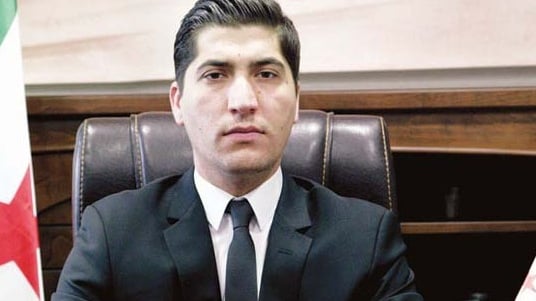
On the other hand, Fahd al-Masri, coordinator of the National Salvation Group, tells Rozana: "Major Osama Abu Zeid, speaks on behalf of the Southern Command. The National Salvation Group comprises a number of dissident senior officers not to be underestimated,” and that he spoke in his capacity as one of the founders of the FSA.
Al-Masri says that "the FSA is not a regular army originating in the Syrian Revolution. It rather is a grouping of various factions that have not—to date—united under a unified command.” He refers to the Unified Command crisis of early 2012, which broke down as a result of lack of support due to an international objective of “floating the Islamists,” as he puts it.
The coordinator proposed that "all military action requires political action. If Moscow expresses flexibility in developing a solution in Syria, all factions of the Southern Front leadership will, eventually, join it. The Southern Front has a national agenda, seeking to put an end to the bloodshed and reach a solution satisfactory to the various parties."
He adds: "the FSA ought to think carefully about how the war on terror is to be waged; one ought to remove the causes before dealing with the outcomes. Most salient would be the removal of Assad and 53 of those around him, in order to reach a national solution. This will defuse terrorism."
Al-Masri stressed "the need to establish a national army, after the regime army has been fragmented and destroyed; and after the FSA has been severely weakened. There is a need for the establishment of a professional national military institution, adopting a national agenda, comprising elements of both the regular [regime] and Free armies—those who did not participate in the killings and destruction. "
As to the size of the military forces on behalf of which Fahd al-Masri speaks; he responds that “while there is no exact figure—they are present in different areas, from the coast to the north, and in Homs."