


Reports | 25 05 2020
By: Ali Mulhem
Some time ago, I had the opportunity to visit the Sabra Palestinian refugee camp in Lebanon. I refrained from taking any pictures; Sabra is not a tourist attraction; yet what motivates one is rather the desire to share of these emotions that can only generate from interaction with people here. The true essence of Sabra is ambivalent—a truly beautiful yet also sad experience at the same time.
Walking through the camp, one cannot help but stumble into the crowds filling the streets. Noisy shops stocked with goods—from children candy boxes to fresh fruit. There people will be shouting, conversing, drinking tea, smoking water pipes, playing, fighting over something, singing, and looking in amazement upon seeing a stranger walking in their midst. The foul stench of the Lebanese garbage crisis still fills their noses. The stench is usually worse in the slums, upon which the richer classes dump their garbage—over the poorer people’s heads—until it surpasses their breaking point. Only recently did this stench find its way to the middle and upper classes, when the poorer neighborhoods—like Sabra—had no more space to take it anymore.
Upon one’s entry to the camp, one is struck by the presence of the Lebanese army. They are not here to protect the camp—as one might naively think, at first glance; they are rather hard at work to prevent the Syrians and the Palestinians from leaving it. A variety of groups, ranging from Hamas and the Amal movement to the Fatah movement, control the camp. In reality, there is a pitched conflict with Hezbollah over who will take over this alleged task of “protection;” one that usually comes at the expense of other secular groups because of the privileges that come with the acquisition of power. It only reminds one of the similar danger now in Syria associated with both Assad and Daesh [ISIS] alike. All and sundry claims for themselves the right to take over, based on their alleged capability of offering "protection." The question, however, remains: can this massive authoritarian violence they pose truly provide such “protection?” In the end, this terror shall only bring destruction upon both Syrian and Palestinian civilians here—whether it comes at the hands of Islamists or secularists notwithstanding.
When one delves deep into the streets of Sabra, they become more and more crowded and roads turn into muddy pathways, especially with the onset of winter. For, every winter several storms ravage the camp and forcing it to endure daily unbearable disasters. The United Nations High Commissioner for Refugees (UNHCR) teams have a mostly bad reputation in this regard; they are wont to quickly pack up and leave the camp, when the cold and rainy conditions take hold of the refugees here. Local activists, on the other hand, struggle to provide food, water, clothing and blankets; but are often hampered by the general refusal of Lebanese people to help or make donations—thereby leaving the crisis “floating” around until it eventually extending to reach their own homes. Only then, they are quick to find solutions; albeit spontaneous and without any proper prior planning. This is, without doubt, closely linked to the political intentions that make the Syrians and Palestinian refugees scapegoats for many of the endemic problems facing Lebanon.
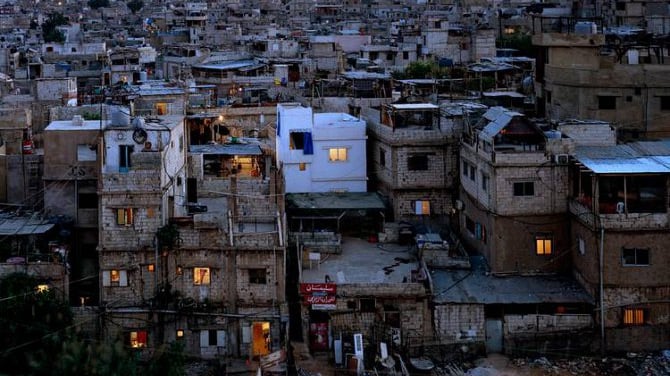
There is no infrastructure to speak of inside the camp. This drives people to perform all their daily life activities within the limitations of the few meagre means available to them here. The streets and alleys, for example, are chock full with thousands of wires that slide over one another—a veritable spiderweb of lines that deliver electricity to homes. This intricate and overflowing web of wires snaking in between buildings here, do not merely bring electricity into homes; they also metamorphose into a network that turns the spiritus locus into a fascinating phenomenon, that intensifies social relationships and links between the Syrians and the suffering of Palestinian refugees, in a convoluted isomorphism of tragedy.
Despite Sabra’s huge population density, the construction of buildings is permitted only to a strict height limit. All houses here start with one or two floors, but soon are layered upon with slums of mortar, cement, or tin roofs even… Fortunately, many Palestinians and Syrians have become quite skilled in matters of electricity and construction; but the lack of necessary materials limit their expansion—a veritable collective punishment meted out to them, for their decision to leave en masse their own they had been evicted out of by the onslaught of the Israeli occupation and the Assad regime’s war machine.
People there joke and share short street conversations with you. One often sees them protesting issues of displacement and ill-treatment. Despite the presence of many Palestinian—and, recently, Syrians—struggling amidst difficult living environments and harsh security conditions to defend fundamental refugee issues. The vast majority of the camp's residents are but ordinary civilians, struggling to earn a living and a modicum of dignity amid these difficult living conditions. This camp dates back at least 60 years, and given the public denial of the Palestinians’ right of return to their land; they are still legally treated here as refugees, despite the constant growth in their numbers, generation after generation. This confusion surrounding the concept of their identity has reverted to the fore, to be faced anew by tens of thousands of Syrian new arrivals to the camp.
What strikes one’s attention here is that, due to the complex and dynamic nature of the Lebanese political situation, many Palestinian Christians—but by no means all of them—have the ability to obtain the right to reside in Lebanon proper; rather than being forced to enter the camp. Despite this, the majority of Syrians here have no other right but to remain in this or the other camps scattered around the north and south of Lebanon, bereft of any [legal] right of residence.
In spite of all this tragedy, a beautiful life is still possible in Sabra. Here, one will find a host of libraries run by civil society organizations, as well as a bevy of support networks managed by local activists. Sabra camp has become a veritable hub of many effective and progressive movements in Lebanon. People here are overly hospitable. No sooner do they lay eyes on a stranger exploring the place, Syrians and Palestinian children will run around them, showering them with greetings in English; only to rush away when answered in Arabic, with laughter filling their chests.
Opinion articles published do not necessarily reflect the opinion of Rozana.