


Reports | 25 05 2020
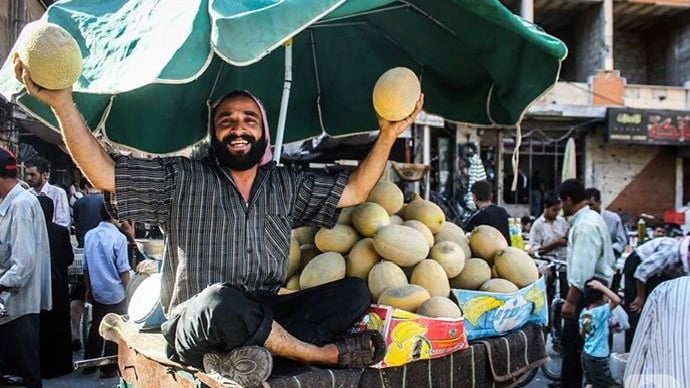
“Eating a whole fruit has become a fantasy—much like the first man on the moon,” says Abu Mahmoud, a fruit vendor in the city of Douma in the Damascus countryside.
The man sits on the ground on a small red carpet, a true Basta [street stall]. On it, he placed a minute ruler, a sharp-edged knife, and five individual bananas; which he carefully cut per centimeter, into 2 cm parts
"I do not do this work for profit only—I make only very modest profits," explains Abu Mahmoud, adding: "People cannot afford to buy bananas, as one single banana can cost as much as 400 Syrian pounds—even up to 500 pounds at times. I therefore purchase only a few bananas, divided them into smaller pieces as per request; so that anyone can eat at least a little piece of banana, at least."

Bananas For All!
After 21 year-old Ahmed finished working in the market in the center of Douma, he swiftly makes his home racing his steps, his eyes sparkling with glee, involuntarily gripping his pockets to a great ecstasy: He’d just managed to purchase himself a full banana from Abu Mahmoud’s Basta, paying 450 Syrian Pounds in return.
Says Ahmed: “Just before reaching home, I run into my neighbor and his son. They were dressed in tattered rags—despite the fact that my neighbor had been well-to-do, prior to the start of the war in Syria. I saluted them, touched my pocket, and after an instance of hesitation, took out the banana.”
Ahmed divided the banana in half, put one in his pocket, and gave the other to his neighbor’s son; who grabbed it and looked at it with amazement, for more than five minutes. "The child could not tell what exactly it was that he held in his hands!" Ahmed says, smiling bitterly. He concludes: “He though it had been a toy—he had never seen a banana ever before."

Siege and War Merchants
"When the Douma-Wafidin camp [camp near Douma for the 1967 Six-Day War refugees] road became opened, people flocked to buy whatever they could buy—essentials and foodstuffs—at affordable prices, when compared to market prices inside Douma," confirms Abdullah, a volunteer medic, in the Damascus countryside’s largest city.
The medic adds regarding the latest events: “The very next day, the road was quickly closed completely; with prices not only returning to their previous levels the day before—but even becoming more expensive."
This seems to have become the city's status: A large urban center, deprived of water, food, medicine, electricity, gas and fuel oil due to the blockade. It has been relegated to the status of a distant, remote suburb par excellence, in which food prices have become exorbitantly expensive.
Abdullah explains that the problem has deteriorated with the passage of time, saying: "As some warlords—who managed to enrich themselves at the expense of the Revolution and its martyrs—were entering food through the Barzeh-Harasta tunnel, storing it and later selling at ten times the price minimum. They will sell a gallon of Samneh [butter ghee, indispensable for cooking in Syrian cuisine] for example costing them 4000 [Syrian] pounds at a price of 56,000 Syrian pounds inside Douma.”
Abdullah also points out that sometimes aid provided by the Red Crescent—and approved entry by the regime into Douma—is sold directly and at exorbitant prices to those who can afford it. People do not have any other alternatives or sources saving them from starvation, as he puts it.

So, Whose Responsibility is it?
It seems that fear is what prompted some of the people of Douma—controlled by the "Army of Islam”—to avoid talking about the identity of the beneficiaries and the merchants of war; whereas others preferred to commit themselves to complete neutrality on the subject.
When medic Abdullah was questioned, his face became red with rage, saying: "All the people know who is responsible for this; yet no one dares to reveal it in public."
He adds: "The siege has exhausted everyone. Instead of exploiting the Harasta-Barzeh tunnel and the Wafidin camp road to alleviate people’s suffering, it was rather quite the opposite: The tunnel has become a dirty tool to make a lot of money by some war merchants” and, of course, the tunnel links up Harasta east of the capital Damascus, to Barzeh, in the city’s north-east.
It is worth mentioning that—according to some Douma activists—the victims of the siege imposed on the eastern Ghouta by the regime forces, amid a shortage of food and medicine, reached more than 44 victims since the beginning of this year. The suffering of the people, due to the blockade and war merchants, persists; not to mention the massacres committed by the regime’s air forces—the latest of which being the main Douma Suq massacre last August.