


Reports | 25 05 2020
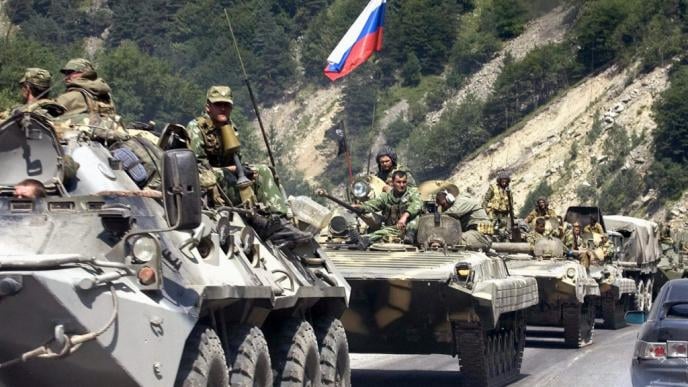
The Russian intervention has of recent become a full and direct Russian occupation. There are now in Syria dozens of aircraft, taking off from several airports, flying sorties over more than one city, and performing airstrikes over all of Syria. This occupation has imposed itself after five consecutive years of Iranian intervention had failed, added to a failure on part of Iranian proxies and tools—Hezbollah and similar militias—had met with failure as well. The regime’s failure is translated by its insistence nowadays upon the rhetoric of focusing on the “useful Syria.” Syria now lies out of the regime’s control, as it is now critically lacking in manpower. Needless to say, the regime has utterly and dramatically failed militarily—particularly starting from April 2015. The occupation, therefore, comes in an attempt to rehabilitate the regime, halt its accelerating deterioration, and attempt to present the regime as an essential party to any negotiations to resolve the Syrian “crisis." Hence the widespread military deployment and the multiplicity of strikes in more than one Syrian city.
The start of an international moves to embark on a political process has struck fear into the Russians. The regime’s weakness of the regime forms a strong argument against it; thereby putting pressure on the regime to succumb to the condition of Assad’s ouster before the political process can even commence, and that his role in negotiations preceding this [political] process be strictly limited. Russia, therefore, wishes to maintain the regime throughout the transition process, and employ such a move within the broader context of the war on terror—farther still, Russia wishes to maintain the incumbent [Syrian regime] president, even after the process is concluded. This is the Russians angle. Russia views all forces in Syria—save for the regime, and the forces of Salih Muslim [head of the Kurdish Democratic Union Party militia in northeastern Syria]—as being nothing more than Islamist, ISIS-affiliated forces.
What Russia seems unable to grasp is that her current war will precisely cause many of these forces to become more stridently Islamist and ISIS-like, and will only bolster jihadism—if she fails to agree to a political solution in accordance with the Geneva I Declaration. This problem may remain unresolved for several months, and Russia will certainly fail. The bodies of many fallen Russians will start reaching their loved ones, and then the political process will inevitably recommence. Many analysts, given this context, are not optimistic vis-a-vis this talk of a political process, considering it nothing more than a pastime.
Russia wishes to make clear to the United States that all of Syria is hers alone, while Iraq is the Americans’ share in the international carving up of our region—all achieved under the pretext of the war on terror. Russia has unequivocally requested Syrian airspace to be freed for her to perform her airstrikes. Let the Americans go to Iraq, then! Russian strikes were not directed against Daesh [ISIS], but rather to Syrian cities; this means that the argument of war on Daesh is invaluable within the context of [Russia’s] combat against the remaining [anti-regime] military forces, and the rehabilitation of the regime as a partner in such war. Russia has not at all been equivocal about such intention, rather repeating it regularly; particularly when stating its view regarding the need to form a regional alliance to fight Daesh. There now is information that Russia has begun to compete with the US in Iraq itself, in fighting Daesh. There is talk about tripartite Iraqi-Russian-Iranian military and security meetings to discuss the situation in Iraq.
Russia will undoubtedly meet with failure. Syria is not Chechnya, it is not a geographically isolated area. it has almost become subject to the settling of regional accounts. This means that all military factions have state-backers with their own interests in Syria, who will not stop their activities before an agreement ending the war is reached and a transitional period commences—namely, Turkey, Saudi Arabia, Qatar; as well as the United States, France and others. Notwithstanding a large number of extremist political organizations and and political money supporting the jihadists; in addition to Syrian national powers with their own project rejecting all forms of occupation—starting with the Iranian and not ending with the Russian—as well as all forms of international and regional intervention. The war to rehabilitate the regime is, therefore, a failed war; and will only serve to push the transition process farther for a few months.
The regime will become more stringent, the Iranians will catch their breath, while Hezbollah will become more and more entangled. But this are all mere illusions. The Syrian war must end. Neither the countries of the region, nor the US and its allies can allow for more; as the war has become a costly affair, and a direct danger to both Turkey and Jordan. America and its alliance clearly comprehend what a continued deterioration would mean, given their own experiences in Iraq and Libya. They will, therefore, not cease to desist the Russian mafia, in order to seriously engage in a transition process. Thus, Kerry’s recent criticism in which he said that with his current war against the armed forces—other than Daesh—Putin would antagonize the Sunnis, and that he no longer rejected Assad remaining during the transitional process; aims to offer Putin a way out to abstain from the current Russian foolishness, and put an end to this futile and destructive process.
One facet of this Russian intervention is to put pressure on both Iran and the regime, and implicates the message that it is Russia which is their savior in Syria, and that Iran’s—as well as the regime’s—role has utterly failed. There therefore seems to be a Russian objective that concerns both Iran and the regime: that they do not oppose negotiations with the United States regarding Russia's interests in Syria. Russia’s “holy" war—as the [Orthodox] Russian Patriarch, in support for this war, had termed it—is designed to help Putin impose his control over Syria in the future. Russia wishes to make clear, not only Iran but also the world, that Syria is Russia’s share—and that she will be the one who will determine the shape of its coming political system. A system that will mean a change no more radical that entering a tiny “sprinkle” of opposition—which welcomed a Russian intervention, namely Hassan Abdel Azim, Haytham Manna, among others, who repeated their rejection “external interference,” ad nauseam; clearly demonstrating their hypocrisy and dull-wittedness in their misapprehensions of Russian imperialism, and of America; and shows the depth of their opportunism, as they await a share in the coming [political] order cake for themselves.
As much as Russia can be accused of failing to understand that Syria will not be another Chechnya, so can those groups welcoming the Russian occupation. The Americans are warning of the jihadist growth and [Russian] involvement, and that this will lead to Syria’s Afghanization, with a Russian defeat almost inevitable. Those political groups welcoming [a Russian intervention] fail to read events well at all, and should perhaps await a fate similar to that of Afghanistan’s [Soviet-backed president, later executed by the Mujahedeen] Najibullah.
What we can confirm, is that there is no solution to the situation in Syria outside the context of the political process and in accordance with the Geneva I Declaration; and not according to the recent trickery of either Di Mistura or Kerry. A process that will leading to a transition process, ushering a new political conflict in Syria within the framework of a State representing all Syrians, and against all forms of regional or imperialist intervention at the expense of Syrians.
* Opinion articles published do not necessarily reflect the opinion of Rozana.