


Reports | 25 05 2020
Despite the Russian intervention casting a dominant shadow over the Syrian scene in recent weeks, as well as helping to impose a new reality in the conflict unrelated to the sectarian equation; it remains far too early to speculate on a decline of the sectarian war. This is especially salient following repeated negotiations between the [Islamist anti-regime faction] Ahrar al-Sham and the Iranians regarding [the towns of] al-Fuaa, Kefraya, and Zabadani; as well as the commitments to truce—all of which are hinged upon a complete halt of sectarian massacres.
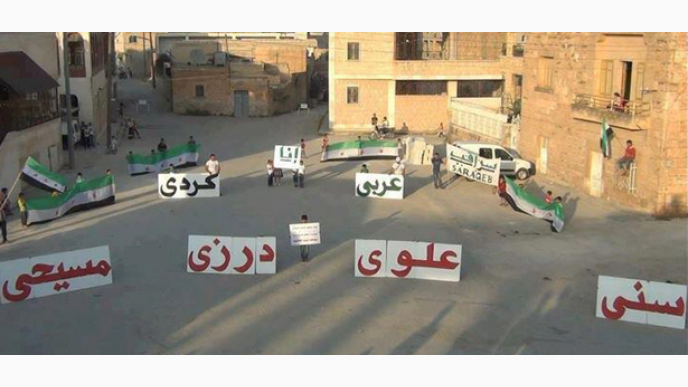
The Sectarian issue looms large as the most disastrous of all the issues brought about by the regime’s brutality—coupled with the opposition’s puerility. Today, an exclusionary teleological rhetoric prevails, one that leaves no room for any language of tolerance or coexistence; after this sectarian rhetoric managed to push arms holders to the intended result, throwing oil on the fire already raging inside this human crematorium.
Even the official discourse of both the opposition and the regime has become extirpatory, in the very strictest sense of the word—despite overtly attempting to steer clear from the actual use of any sectarian verbalization. It still is perceptibly present in the spirit of every statement in which the regime vows to the fight until “the death of the last terrorist;” and the opposition’s insistence on fighting until the death of the last Shabbih [regime thug]. Victims from both sides are “trampled” on a daily basis over the pages of social media. The spiteful sectarian image of both “terrorist” and “Shabbih” is, thus, immediately consecrated in people’s minds. Thus, armed factions imported from abroad made up, without exception, of Shiites jump to support the regime and bolster its position; while the opposition is simultaneously supported by foreign armed factions, whose makeup is, invariably, Sunni. The calamity this situation produces is directly reflected through the plethora of leaked violent video segments of both warring sides. It would be naive to believe that the blood-lusting desire of absolute sectarian extirpation is unique to one party and not the other. It has to be said that both sides holds the same blood-thirsty desires for sectarian liquidation, revenge, and vendettas.
Despite personally not being an advocate of or believer in war altogether; that I think that there is no honor in the gun nor glory in war; that I think that all fighting represents nothing more than yet another strand of brutality and the law of the jungle—it still does not mean that the belligerents do not have a cause, nor that they do not have their compelling reasons to rush into the repugnant quagmire of death.
In Iraq, Syria, and Lebanon, live circa 60 million people, more than 40% of whom are Shiites. If we were to exclude the Kurds—who possess their own national, rather than sectarian, concern—then one would conclude that Shiites make up almost half of the population in this region. That is also if one were not to mention the spread—from southern Iraq towards Kuwait, Al-Ahsa, and Bahrain; as well as the Alawite spread into secular Turkey, via more than ten million Turks. All of this indicates that a sectarian conflict would be devastating, with no hope of victory to any part therein.
Although Syria’s sectarian structure is not built in this manner, with some believing the modelling both the Syrian and Lebanese situation as per the Iraqi model would be erroneous; yet events have proven otherwise. Lebanese Hezbollah fighters, as well as Iraqis have smashed borders, and broke into Syria with their fighting brigades; thus proving that—when they wish to—can be more fervent than even the Baathists in their rejection of the Sykes-Picot Accords, and their attendant outcomes.
And despite the doctrinal and fundamentalist between Shiites and Alawites being immense and deep—with famous Fatwas by noted Shiite religious authorities, expiating the followers of Mohammed Bin Nusseir, the founder of the Alawite sect in the third century [Hijra]; all of these differences are shunned in an hour of common threat. People will converge around the warrior-savior, and within a few weeks of the conflict everyone suddenly became Shiites—the Nusayris, the Druze, the Ismailis. Even [Lebanese Christian Maronite Political Leader and Hizbollah ally] Michel Aoun, as well as those speaking in his name, all started to talk about the advantages of the Vilayet-i-Faqih, and the necessity to protect the “wretched” minorities!!
There is no hope either, on the other hand, in any separation on a sectarian basis. Sunni and Shiite proliferation in Syrian, Iraqi, and Lebanese cities is overwhelming, large, and overlapping. It would, therefore, be impossible to secure any separation on a sectarian basis. Any division on the basis of separating of majorities will produce hostile warring nations as well as crushed despised minorities. Both scenarios are equally—and assuredly—catastrophic. The people’s only real option remains to coexist.
The regime is disintegrating, but sectarianism remains firmly entrenched. The despot may soon exit the scene, but the sect remains and no one can eradicate it. We will have to continue living alongside one another as we have continued to, throughout our long history.
The sectarian scene in Syria is, in essence, not an external matter; but it has become today governed by external diktats. The truth of the conflict today is that there exist two separate, distinct, and hostile communities equal in number and influence. The first is supported by the full might of Iran's nuclear arsenal and strategic weight; whereas the second is supported by the [Arab] Gulf countries with their considerable financial and political capabilities. Neither alliance can contemplate a retreat; both consider the battle in Syria and Iraq an existential battle—one that must be resolved in a manner ensuring the strategic interests of each party. The hapless people caught in the midst of war with no alternative, are the ones who bear the cost of this entire confrontation.
Will Syrians realize that sectarian and religious diversity that characterized their lives is their inevitable and inescapable fate? That their war against sectarianism does not translate into a war on the sect? That the eradication of the sect on a faith or communal level is nothing less than an extermination project? That any gamble on one specific sect over other sects, or one particular doctrine over other doctrines, is nothing less than national suicide of the entire society? And will they, finally, realize that what is needed is a doctrine among doctrines, a party among parties, and a sect among sects?
* Opinion articles published do not necessarily reflect the opinion of Rozana.