


Reports | 25 05 2020
An overwhelming illusion positing that sectarianism is the only system capable of salvaging the country from dictatorship, has for some time been prevalent—particularly in both Syria and Iraq. The foundations of the sectarian system in Iraq were laid at the hands of US administrator [Paul] Bremer in 2003; Many opposition figures in Syria also argued that the Lebanese example is the example the Syrian Revolution should hope for. This proponents of this view mean to say that Syria needs a sectarian system; they supported this miserable argument with the justification that the regime had been an Alawite regime, some even calling it sectarian; and that to re-balance matters, that such choice was imperative. In their view, society will rebound as soon as the power is returned to the religious majority, and consequently every sect would [automatically] acquire its political rights commensurate to its numeric presence. This certainly has been the theoretical bent of many liberals; that it is uniquely thus that the regime’s damage can be undone, while simultaneously maintaining silence towards the minorities which had supported it!
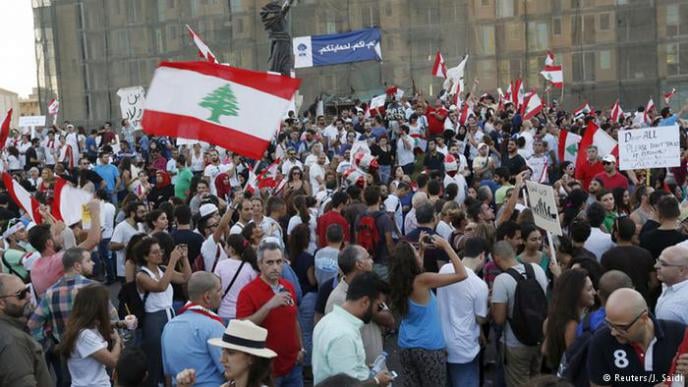
A sectarian logic par excellence: The people are reduced to nothing more than a pure conglomeration of sects and communities, and power is axiomatically reserved for the numerical majority. This logic has been thoroughly belied and repudiated by both the Lebanese and Iraqi uprisings; the slogans both have raised condemn authority and call for the felling of the sectarian regime, that neither truly represents nor is becoming of any human society. Demonstrators in Iraq—into which seas of ink and blood were poured by the United States and Iran, and their respective proxies, to “sectarianize” the country—unequivocally said they want a civil and democratic state; that Iranian hegemony must come to an end: ”Baghdad is free… Iran should get out!” In Lebanon, the uprising called for both the 8 and 14 March regimes [pro- and anti-Syrian currents] to fall. They raised posters representing all of Lebanon's leaders squeezed in garbage containers.
It then comes to pass that neither Lebanon nor Iraq represent a model for Syrians anymore; those Syrians who, at the beginning of their revolt clearly came out with the desire to construct a state for all Syrians, that the people were one—i.e. that they want a civil state representing all.
Both liberals and Islamists stood against this goal; the regime for its part also spared none of its trickery to attempt to divert the Revolution from its goals. Its “noble” and “virtuous” endeavors have borne their poisonous fruit with an increased growth of jihadism and its expanded control. The liberals’ dreams of a sectarian State have now come an abrupt end; the jihadists’ illusions will not meet their fruition either—they are, after all, mere political tools of external state players. The political game played employing the Nusra Front, Daesh [ISIS] and, more recently, both Ahrar al-Sham as well as the Army of Islam and others, will not lead to a sectarian solution for Syria; it runs contrary to the dreams and aspirations of Syrians. The political solution currently at offer—in accordance to the four tracks proposed by Di Mistura is far removed from such option. If it were to be adopted, it will place the head of takfirist groups on the table; the jihadists know it, as well as do the nations intervening in Syria, and so does the regime. A solution becomes, therefore, complicated. The Syrian People, in its turn, awaits for the arrival of the moment when [explosive] barrels stop dropping, and when they shall return to their towns to brush both the takfiris and the regime out as well.
The People who refused sectarianism as a model for their Revolution since 2011, once again reject the fundamentalist and jihadist projects. The latter project exercises its criminality in the name of God and the Prophet in a totalitarian vain, and the people discovered that it is even more reprehensible and dictatorial than the regime itself. Sectarianism is, therefore, not a suitable model, and the Lebanese regime has itself come under threat in Lebanon proper.
The situation in Syria is very complicated, with Iran—for whose departure from Syria work is afoot—is clutching at straws to hold on. It finds the most appropriate card to play to achieve this end as being the sectarian card; as well as pushing to the fore the option of an Alawite statelet—starting from Damascus and the Qalamoun, to Homs and Latakia—as a political card to be used in the final status negotiations and, thereby, protecting Hezbollah in Lebanon. Iran both entertains generous illusions and extends fervent efforts towards achieving a sectarian regime, similar to its and the Lebanese regimes. it is precisely at this juncture where it and the Syrians liberals converge—albeit not with the identical desired model. Convergence is merely upon the imperative of sectarianism, and not upon the actual quota allocated to each sect!
Di Mistura's scheme does not comprise a sectarian system; rather a system that, while not ignoring the sectarian distribution, is not sectarian. Sects will continue to be represented in the structure of power—much as they have been under the incumbent regime, with sects receiving specific quotas in power but not in a sectarian system. Russia will also not accept the partition of Syria and merely contenting itself to supporting a vassal mini-state in the capital, Latakia, and Tartous; it wishes to invest in all of Syria. Turkey additionally is quite content that its weak currency has started to become the currency of trade in Idlib and Aleppo, and is working on the establishment of a buffer zone and and a military intervention; it therefore is eyeing a large stake in an integral Syria, as well as seeking a compensation for its losses prior to 2011. Saudi Arabia, all but shunted from its special relations with the United States, is also eager to secure itself a share as a compensation for the nuclear deal, which helped Iran maintain its nuclear infrastructure intact.
The resolution all of these issues requires a political transition in Syria, under Russian supervision; but the success of such solution is hinged upon adopting the Geneva formula. Di Mistura’s attempts to distort the Geneva document and his efforts to preserve the regime in its current form are bound to fail. Here, one encounters a Saudi-US rhetoric insisting that [Di Mistura’s] tracks conforms to the Geneva Accord, which include the formation of a fully authorized ruling body. A flurry of international meetings tackling the Syrian issue are now under way; which will include a solution stemming from neither the failed Lebanese model, nor from the Iraqi model—which has proven disastrous to American interests. One may also add that it would certainly not be based upon the Iranian model, announced almost one month ago; nor will it be to Russia’s desire of maintaining the Assad regime. It will be a solution in line with the Geneva document.
The aforementioned revives the basic question once again: Has the Syrian situation reached a stage where a political solution has become necessary? We are of the an affirmative opinion. For despite that fact that the features of a political solution remain largely muddled for the time being; the only feasible options remain the ones mentioned above—and they cannot be sectarian. Otherwise, it will lead to yet a new failure, with the future of both Syria and the region beyond it open to worst-case scenarios—i.e an expansion of jihadism to regional countries, and its escape from the confines of international control.
* Opinion articles published do not necessarily reflect the opinion of Rozana.