


Reports | 25 05 2020
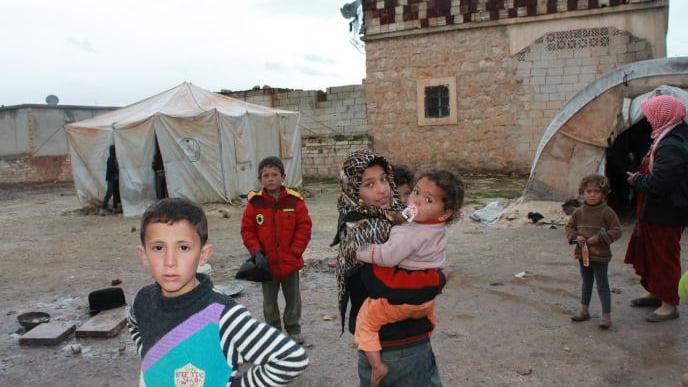
In the Syrian camps scattered along the border with Turkey, cases abound of Syrian childbirths who do not receive any document to prove their right to acquire the Syrian nationality; especially given that the number of these camps' residents has reached circa 250 thousand people.
Raghad, is one of the tens of thousands of children born in the camps. Her story began three years ago, when her family was forced to escape the heavy shelling to which their native Aleppo was exposed. After a warplane targeted their home with an explosive charge, the family lost all their documentation.
The girl's father tells Rozana: "After we had lost all our identity documentation, we were no longer Able to register our daughter Raghad. There is no registration center for children born in the camp; every child born in the camp becomes a burden onto their family, and there seems to be no solution to this problem in the horizon."
Problems in Neighboring Countries
Refugee children in Syria's neighboring countries seem not to fare much better than those displaced inside Syria. In Lebanon, for example, figures from the UN High Commissioner for Refugees [UNHCR], show that circa 70% of children born in the Lebanese territory since the start of the Revolution—an estimated 50 thousand—do not have proper documentation or birth certificate. Therefore, they have no rights—whether to education, or health, or even mobility; as confirmed by activist Mohammad Ibrahim, residing in Lebanon.
Ibrahim speaks of the most significant obstacles preventing Syrian refugees from properly registering their children, saying: "Numerous families do not have access to the regime's Embassy in Lebanon, for fear of arrest and the large number of roadblocks. The biggest reason, however, is the expiry of their documentation."
In Turkey, Too
Turkey is home to the largest number of Syrian refugees—estimated at nearly two million people—one of whom is Hussein, a young man who got married in the city of Gaziantep. When his first child was born in a Turkish hospital, the only document she was granted was a certificate of birth.
The young man tells Rozana: "I cannot register my daughter as I do not have a copy of my marriage contract; nor can I travel to Istanbul to the regime's consulate and obtain new documents, as I am in opposition to the Syrian regime—not to mention the high cost of travel."
Hussein works as a translator in Turkish hospitals, where he helps his fellow Syrians. He adds: "The number of Syrian children born in Turkish hospitals is estimated at 28 thousand children; all of whom are granted nothing but refugee identity papers. This is highly detrimental to the future of our children."
What About Daash [ISIS] Areas?
Areas that fall under the control of Daash in Syria seem to be the most hazardous to children. There are no accurate statistics about those born to jihadist [fighter] parents, who entered Syria illegally; most marriages are performed without any official documentation; the lineage of children born of such marriages cannot be properly documented—in the event these militants should leave Syria, or should be killed in the fighting.
Journalist Adnan Hussein recounts to Rozana his observations of a large number of marriages in the Eastern and Northern areas of Aleppo. He explains: "I counted many childbirths in the areas of Jarablus to Daash fighters; one of whom was the Amir [Leader] of the organization called Abu Hafs al-Masri who had fathered a child; as well as an Emirati fighter who married a girl from the area around the city of Jarablus."
The Role of the Syrian Opposition
The interim government announced the opening of a Civil Registry Directorate in Aleppo and Idlib, in order to help issue marriage documents, certificates of birth, and personal identities for [Syrian] civilians.
Lawyer and human rights activist, Kamel Atli, is of the opinion that the Syrian interim government is complacent, in its efforts to secure international legal recognition of the documents issued by the very directorates it had established.
Says Atli: "All employees of the civil registry centers are volunteers, mostly out of the Aleppo Free Lawyers' [Association]. We need to document [people's] civil status, so that there is a legal case to protect the rights of Syrian families in the future."
Many believe that the problem of [Syrian] stateless children may even exacerbate; especially in the absence of a solution to the situation in Syria, and the continuation of the war. Syrian children seem to be the conflict's biggest losers, thus prompting activists to demand the United Nations and various human rights associations to show an increased interest in Syrian children who, if not killed by missiles or explosive barrels, will be forced to embark on a lifelong journey to find their identity.