


Reports | 25 05 2020
"The Turkish smuggler jumped into the sea and escaped, leaving us alone to grapple with the waves. Our boat capsized, and I held on to my son and wife while we tried to cling to the inverted boat for an hour. My children were still alive, then."
"Not only my son died; my other son and my wife died, too." With these sad words, Abdallah al-Kurdi [or Abu Ghalib, as he is known] sppoke to Rozana.
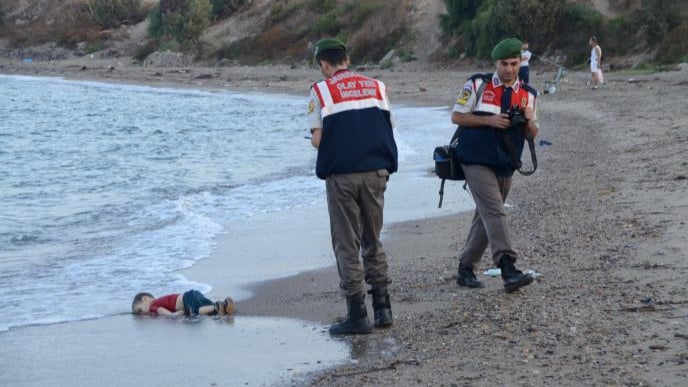
Abdallah, a native of the town of Ayn al-Arab [Kobanî]—who worked at a men's barbershop in the Damascene Rukn al-Din neighborhood—like most Syrians, left his country in search of a better life. He took with him his two-year old son Alan—whose images was widely disseminated in social networking sites, as well as Arab and international newspapers—and his other son, the four-year old Ghalib, and their mother Rihana; with the hope of giving his small family a new opportunity far removed from the conflict and the horrors of what is happening [in Syria].
Abdallah continues, with the voice of someone yet to come to grips with the horrific shock of what happened: "I came to Turkey, and had to work in the field of construction for a pittance of 50 Turkish liras a day, so as not to have to beg anyone for charity. This amount was not enough for us, so my sister helped us with the rent." He adds: "My father and my sister secured me a sum of money in the hope of getting to Europe for a better life for my family, and a home—or even a [refugee] camp to give us shelter—no difference. I tried many times to get to Greece, but all previous attempts failed. Before too long, however, I met two smugglers—one Turkish and the other a Syrian—who offered to take us at a cost of 4 thousand euros for my wife and I. They wanted to charge me two thousand additional euros to take my children! I told them tht this was all I had."
After a long sigh, Abdallah says: "There were 12 of us on board the small fiber fishing boat, which was only about five meters tall. Only a short while into the trip, waves became significantly high. The Turkish smuggler jumped into the sea and escaped, leaving us alone to grapple with the waves. Our boat capsized, and I held on to my son and wife while we tried to cling to the inverted boat for an hour. My children were still alive, then. My first son died because of high waves. I had to leave him to save my other child." Abdallah bursts into tears, and continues: "My second child died, and I saw foam coming out of his mouth. So I left him to save their mother; but I found that my wife had also died. I remained in the water for 3 hours, until the Turkish Coast Guard reached and saved me. "
Abu Ghalib concludes by saying: "I have a few words for all the world: Look at Syrians' plight. Have mercy on them. Help them, and lighten their load—particularly Syrian workers in Turkey, who take in only a quarter of what a Turkish citizen earns. I wish that my little [son] Alan becomes a symbol of the suffering experienced by all Syrians."
Waiting for the Remains of His Family
Family friend Ahmad recounts to Rozana the events of that fateful night: "The trip started yesterday at three o'clock in the early morning, on a small fiber boat usually reserved for fishing. At around four o'clock in the morning, we received the news of the sinking of the boat that was carrying about 12 migrants. Two young men were able to swim to a nearby island and ask for help; in the meantime, the body of the child Alan washed up on the beach. The father was rescued, while the bodies of his son Ghalib and his wife Rihana were recovered. They now lie in the morgue's cold chamber, pending the arrival of the father to collect their bodies, for burial."
The boats of death continue to drown Syrians off the Turkish coast—while Europe wallows in the mire of political confusion, caused by the fear within the European Union and of some politicians of taking in more refugees; while on the other hand many European citizens are welcoming their new guests.
To listen to the audio, kindly follow this link: http://rozana.fm/ar/node/14604.