


Reports | 25 05 2020
Much like other areas of conflict in Syria, Idlib's southern countryside is lacking in rehabilitation centers for bombing and battle victims; thereby forcing people to travel for treatment to neighboring countries, and making their movement an additional aggravating factor of their conditions.
Mohammad Khatib, a native of Kafr Nabl, received injureies to his hand and leg during the regime forces' bombing of the the city. He attempted to receive physical treatment for his condition in Turkey, but could not afford the treatment's costs.
Mohamad tells Rozana: "I am in dire need of physical treatment. Had there been a physical therapy center in Kafr Nabl, I wouldn't have stopped treatment of my case."
So, What is Physical Therapy?
Physical treatment, or what is known as physical therapy, is a unique medical specialty in itself. It aims to offer treatment to patients for whom surgeries and medications are not suitable, through several methods and devices used for each organ of the body.
Physical therapy encompasses several cases, such as paralysis and various injuries—muscular, bone and nervous.
Unsuccessful Attempts!
Given the importance of this type of treatment, medical activist Ahmad Hamido attempted to found a physical therapy center, to provide services to more than two thousand injured in and around Kafr Nabl. His attempts failed, however, due to lack of funding.
Explains Ahmad: "One of the medical organizations agreed to offer financing for the project, but they asked for it to be located on the Syrian-Turkish border. I refused to work on this project, because it will not offer a solution. Border centers will be be identical to [visiting] neighboring countries; far removed from the victims in the area where I am working."
Doctor Yasser Al-Ghannoum Kaf Nabl Local Council justifies the Council lack of support for the idea of establishing a physical therapy center in the city, by the weakness of its [the Council's] means, in addition to not receiving assistance from the interim government.
He believes the duty of the Council is to provide citizen's basic needs, before turning its attention to securing "secondary issues, such as physical treatment," as he put it.
He adds: "We tried to communicate with the [interim] government to support us in all areas, but we have not received any response from them."
The Ministry of Health Does Not Know Physical Therapy!
Deputy Minister of Health in the interim government, Abdul Karim Ghali, confirms that the role of the ministry is not based on supporting medical or other centers in the Syrian interior; but is rather limited, to building a management structure and marketing established health projects at home, in front of international organizations and countries to receive their support.
Ghali adds: "We offered temporary help to some medical projects in the [Syrian] interior, to prevent them from shutting down due to lack of funding. The Ministry of Health's allocations prevent it from supporting such projects."
A Successful Model
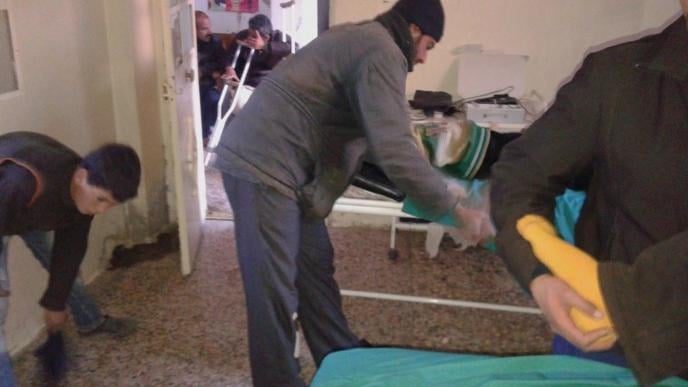
The inability of the opposition organizations, such as the local councils and the interim government, has not prevented the activists of the town of Hass in the southern Idlib countryside, from founding a simple center for rehabilitation and physical therapy. This center works to provide treatment free of charge to all arrivals, according to its director Fadi Naassan.
The Centre, and since its inception, has worked to receive all the incoming cases, such as war casualties as well as general cases, according to Abdul Sattar Darweesh, one of the center's therapists.
He adds: "The center receives 20 patients on a daily basis. We were able to give full treatment to about ten cases."
Very much unlike the view of the Kafr Nabl Local Council member, that physical treatment is a secondary need; it actually constitutes an urgent need for a great many Syrians.
One case demonstrating the importance of physical therapy, is that of child Khaled Sharaf al-Din, who is a visitor of the Hass treatment center.
The child tells Rozana: "I received a shell injury to my foot. I received treated on impact at the hospital, but my knees became ossified. I tried to apply physical therapy on my own at home, but the treatment was weak." He adds: "Since the opening of this center, I began receiving treatment for my foot. It now is better than before."
Despite the [Hass] center being but a small replica of regular rehabilitation centers; it has made great achievements compared to its humble capablities. Through offering care and rehabilitation for many patients, it has helped them return to normal and healthy lives; and that, without being given any support from the interim government or any of the other opposition institutions.