


Reports | 25 05 2020
In the past few days, inflammatory bowel disease has spread among children in Lebanon in their hundreds. The disease, while not considered a hazardous or death-causing disease; remains quite cumbersome—both for the injured child and his family, as it requires treatment stretching for a full week.
Pediatrician, Doctor Fadi Hatoum, says that 40% of cases entering the hospital are due of severe dehydration, as a result of severe vomiting and diarrhea. He adds that rotavirus, adenovirus, and Hepatitis virus are the main causes of disease.
The doctor attributes the spread of the disease to contamination of food or of water sources, as a result of the lack of monitoring and medical surveillance on food and drink offered. The volatile weather, characterized by rising temperatures in the day and cold in the night, helps in the spread of viruses; a climate feature of spring solstice on the twenty first of March. There have been no deaths reported so far, however.
Medicine Available in Pharmacies
Treatment requires a full dose of medicine until the child recovers. A child should take anti-vomiting suppositories, antipyretic suppositories, anti-inflammatory syrup "Normax, in most cases;" in addition to a serum to compensates the deficiency in mineral salts. The price of the full dose per child is circa $20.
Medicines are available in all pharmacies, as per the proprietor of Adam Pharmacy, who suggest ten patients—whether Lebanese or Syrian—visit her pharmacy daily. She adds that the disease is still under control, and has not yet reached pandemic levels.
Due to the weakness of the children's immune systems, they are more prone to becoming exposed to infection than adults. That does not mean that adults are protected against the disease, however.
Another pharmacist expressed different concerns for Lebanon. According to him, inflammatory bowel disease will be but a a small joke if compared to the coming threat—namely hepatitis, which has spread in Damascus and its suburbs. A number of ambulant people may help bring the infectionwith them from Syria into Lebanon.
The pharmacist points to the fact that the vaccine is unavailable in government clinics. It would, on the other hand, be possible to vaccinate children at doctors' private practices; whereby the doctor orders the vaccine from medical companies, and administers it in two phases separated by six months, at a cost of about $100.
The pharmacist says: "There are significant risks coming from Syria. The disease will have severe repercussions in Lebanon, if vaccines do not quickly become available in public health centers."
Syrian Refugees
[Syrian child refugee] Mahmoud entered the Sahel hospital in Beirut's southern suburb, and spent two nights there with a serum administered to him after severe diarrhea. His father says, that the "Sahel hospital is contracted with the United Nations High Commissioner for Refugees, and we therefore pay only 25% of the invoice. I ended up, however, paying $200 in addition to $30 to the doctor who gave us his referral to the hospital, and another $20 for the medicine." Abu Mahmoud, mocking his situation, adds: "Thank God I am an official UNHCR refugee with documentation to prove it; I would have otherwise had to pay the entire cost, amounting to a thousand dollars."
Abu Mahmoud was forced to pay half his salary to cover the costs of his son's illness. If his other child were to fall similarly ill, he would not have had anything to buy for them.
Camps—Complex Inflammatory Situation
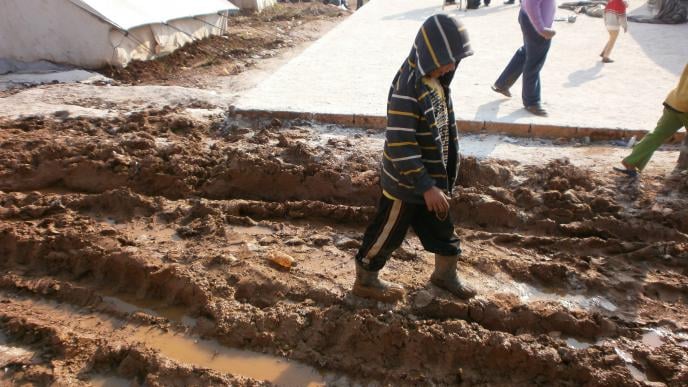
Syrian refugee camps are bereft of even the minimum conditions of life, save for a small tent coyly attempting to stave off the cold. This increases the chances of children being diagnosed with inflammatory bowel disease, exacerbated by the health status of the child if the patient fails to receive treatment quickly.
Iman, a refugee from Idleb in the al-Jerahiyah camp, had two of her children fall ill. She is barely able to find enough to survive at a meager seven dollars a day. This mother says that, without the help of some neighbors, she would have lost her children.
Meanwhile, teachers in schools for Syrian children, attempt to emphasize hygiene in the hope that such may help prevent their children catching disease.