


Reports | 25 05 2020
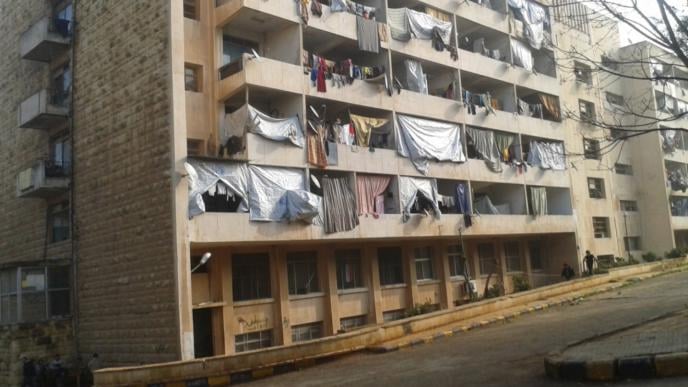
With the onset of the armed conflict in Aleppo and its countryside, hundreds of displaced families moved to live in the Aleppo University dormitories. If life in the areas of Aleppo controlled by the regime are strained under the weight of ever deteriorating living conditions and services; the suffering of those currently residing in the university dorms is by no means any better.
Khaled, who studied at the University of Aleppo says: "The dorms were filled with students who come from rural Aleppo, Idlib and its countryside, and Raqqa—who represented the majority of the dormitorys' residents. When the international observers visited the university in mid-2012, student demonstrations erupted denouncing the arbitrary arrests against students because of their participation in the demonstrations."
He adds that with the entry of the opposition factions into the northern and eastern districts of Aleppo, displaced families fled towards the western neighborhoods. They were housed in the residential units from which the students were evicted; with the exception of one single housing unit allocated for male students, in addition to one and a half residential unit for female students. During this period, the risk of arrest started to become a real menace for of young university students; thus prompting hundreds of students to interrupt their studies, and drop out.
Two Families Per Room
The Aleppo University dormitories comprise 20 residential units built in the mid-Twentieth century. 18 units were dedicated for students, male and female; one unit dedicated for doctors and nurses working in the University Hospital; with one additional housing unit for foreign students.
Upon the arrival of displaced families, the rooms were distributed based on the number of family members and room area. There also are some spacious rooms in which two families—usually related by kinship—are housed together.
One woman resident of the university dormitory, says: "We left our homes with nothing on us. They put us here in the university dormitories; they put one family in each room... The rooms are too small compared to the number of family members... The smallest family comprises seven members. After we settled in our room, we registered for aid."
She adds that one of the charities gave them the [rationing] cards, and they started to receive the food distributed to them every month—such as sugar, rice, bulgur, pasta, and canned goods. But, she says, "In the end, what we really want is to go back to our homes."
Dilapidated Buildings
Most Aleppo University dormitories suffer from frequent communuication, electricty, and sweage breakdowns, on the one hand; added to the severe lack of hygiene, on the other hand. In the past, before the university housing units being filled with displaced families, there were female cleaning ladies who used to clean the housing units; but they were laid off soon after.
Huda, a student still living in the University dormitory, says: "We have by now become used to study by candlelight due to power outages. As for the water, we have to fill it into jerrycans, due to the penury in water tanks."
In addition to the aforementioned, the remaining student housing units are experiencing a severe case of crowding. A room whose area does not exceed 12 square meters, for example, houses seven students. This has negatively impacted students' academic achievement, as some of them to confirm Rozana.
The University dormitory has, thus, been turned into a crowded population center, with shops to sell vegetables and other food products, as well as numerous other professions. In addition thereto, a free elementary school was built for students who were forced to drop out of their own schools, in order for them to pursue their studies. It is comprised of 12 Carvans sponsored by UNICEF.
