


Reports | 25 05 2020
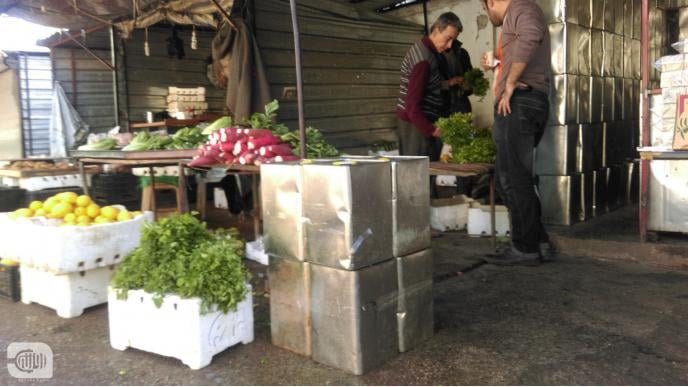
A street not longer than one hundred meters in the [regime-controlled] Homsi neighborhood of al-Inshaat has, at the hands of refugee and displaced traders, been turned into a popular market. With the same zinc panels the used for make-shift ceilings, they also divide their small shops between themselves.
Save for its unusual name—Tin Market—as well as the incredible diversity of what it offers (vegetables, dairy, nuts, clothing, butcheries, household tools, sewing kits, fast food joints, sweets, and a multitude of other things; there is nothing out of the ordinary in this small market, or that may seem unusual for the rest of similar popular markets in Syria. Yet... This quite recently established market has a different tale behind its origins.

Abu Abdullah, a spice merchant in the Tin Market tells Rozana his story: "After fighting quickly broke out in the old city of Homs, I was unable to save my shop... I remained for a long time without work; until I heard from my friends about a new market. that had been built.. and here I am today, opening up shop again in the Tin Market."
The man stands all day in front of his metallic shop, among the bags of grains and spices awaiting the first sale of the day to bring him luck in the morning. But, he says, "some days, I do not even achieve a Lira's [one Syrian Pound's] worth of business... I will start looking for a night job."
The relatively cheap prices of the Tin Market were insufficient to attract customers, as its area is considered dangerous by many of the city's people who prefer to stay clear of it. Its proximity to the [rebel-controlled] al-Wa'ar neighborhood, and the constant mortar shelling that has caused the deaths of many, being the prime reasons fot their abstinence.
The Tin Market was established by a group traders displaced from different areas in Homs who have, since nearly two years, managed to obtain a license from the Province of Homs to build this market near al-Fardos mosque in the al-Inshaat neighborhood.
Collective Rents
Most traders operating in this market live in neighboring districts, having mostly abandoned the stricken areas in Homs; with most of them suffering from poverty. Safwan, head of a family, rented an apartment in al-Inshaat with three of his brothers, who have their own families, too. He tells Rozana "The rent jumped to 20 thousand [Syrian] Pounds in the last three months. We can no longer afford to pay... I share this rent with my brothers."

Fines and Unfair Penalties!
"I only wish that were the biggest of my problems," said Safwan, referring to his difficult living condition in one apartment with sixteen other people. Adding that "only last week, I was fined 10 thousand Pounds, on the charge that I was selling wholesale and not retail as I was authorized; after they found 70 Kilos of potatoes in my possession."
The vegetable traderr justifies his purchase of such a large quantity by saying that "potatoes do not spoil as quickly as other vegetables; as there is large demand for it." Local and municipal fees and tax exemptions in Homs for market traders, usually helps them offset such inerous and unfair penalties and fines. However, he says with a sigh that the fine incurred was much higher than the potential sale value of his potatoes.
The war has not spared them despite theri escape. Muhammad, for example, was on his way for a vegetables' delivery when a mortar shell landed next to him causing his death last April. His father, heartbroken, says "We ran away from the bullets and shells in [rebel-controlled] al-Khalidiya, came here and said al-Hamdulillah [Thank God]... But they did not leave us in peace. My son was killed in front of my eyes."
Dozens of civilians were killed by mortar rounds that fell on the Tin Market early last year, amid the silence of the market's traders; who did not dare accuse or blame any of the parties to the Syrian fighting.
After he lost his son, Abu Muhammad does not want to return to the market in old Homs; he has grown accustomed to his present life. He says "there is nothing that I want... Just they leave us safe, and that is it." He hopes the country wil regain its stability, so that he can open the "Chinese Store" he always dreamt of opening.