


Reports | 25 05 2020
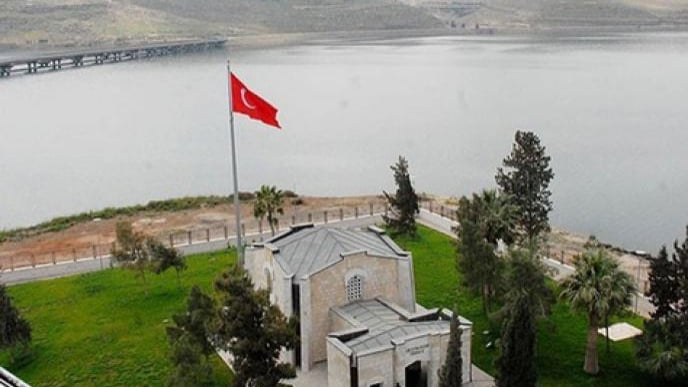
A Turkish army convoy made an incursion into Syrian territory on Saturday evening, and transferred the "Suleiman Shah" tomb north of Aleppo, into Turkish territory, according to the Anatolia News Agency.
The agency added that the operation was successful, with Ankara neither asking permission or assistance from anyone; "only informing the international coalition forces of its operation, so as to avoid any casualties."
Anatolia stated that the entire operation was concluded this morning, after Turkish troops seized control of a piece of land in "Eshme" northern Syria, and raised the Turkish flag. Before the withdrawal and transferring the remains, the agency pointed out that "all the buildings that were found in the tomb's location were destroyed, after the valuable remins were transferred to Ankara; so as to prevent any attempt to exploit the place."
Who is Suleiman Shah?
Shah Suleiman the Magnificent, is the grandfather of Osman I, founder of the Ottoman Empire in 1299 AD. He perished of drowning in the Euphrates River, whilst trying to flee the Mongols who had invaded his empire, in the thirteenth century.
He was initially buried at the location now called "Türk Mazari," near the Ja'bar castle in Syria, but later transferred to another location, before finally resting in Ankara.
History researcher Mustafa al-Abd spoke earlier to Rozana about the transfer of the remains, to an area near the border with Turkey; explaining: "In 1973, the Euphrates Dam water was going to sink the Suleiman Shah shrine. After a round of Syrian-Turkish negotiations, it was decided to move it to another area near the village of Kara Kozak, in the countryside east of Aleppo, a mere 25 kms from Turkey."
Al-Abd adds that "this shrine is the only land with Turkish sovereignty beyond the [actual] borders of the Turkish state."
A Shrine in A Conflict Arena!
The "Shah's" tomb remained largely unscathed, despite the ongoing conflict in Syria; neither approached by ISIS gunmen, or those from other opposition factions.
The tomb, located in Syria and under constant protection of Turkish guards, was never subjected to any military faction from the days of the French occupation; through the regimes of Hafez al-Assad and his son Bashar, and even during the period of ISIS' control over the areas of rural Aleppo.
Activists in the region attributed such mainly to the agreements concluded by Ankara with the parties in control of this region.
The first agreement signed by Ankara over the shrine had been with Paris, during the era of the French mandate over Syria, in 1921. That agreement stipulated that: "the tomb of Suleyman Shah shall come under Turkish control and form an integral part of Turkish territory. Any attack thereon, shall be considered an attack on Turkey itself."
The Shah's Tomb—Untouched by ISIS!
Since ISIS' entry into Syria it set campaign in motion to demolish tombs, which symbolize certain symbolic personalities of signifcance to some communities, or those of certain historic figures.
ISIS hence set about demolishing the tomb of [the Prohpet's] companion "Ammar bin Yasir" in the city of Raqqa; the tomb of "Uways al-Qurni" also in Raqqa; the tomb of Raqqa's Wali [Ottoman governor] Saad Eddin Pasha Azem [1775]; and blowing up the shrine of the wife of the Prophet Ayoub in Idlib, among others.
The reason for the demolition of the historic tombs and shrines—according to ISIS' leaders—is that visiting them is considered a form of Shirk, or idolatry.
Turkey's previous agreement with ISIS had raised many eyebrows amidst Syrian activists, especially after the entry of a Turkish military convoy into Syrian territory, from the Ain Arab region in April 2014, accompanied for protection by ISIS elements who marched with them until they arrived to the Suleiman Shah tomb.
Syrian activist Abdul Hadi asks: "How can ISIS elements loudly declare the destruction of each historical and religious tomb on the basis of it being Shirk, yet stay well clear of even coming near the tomb of Suleiman Shah? Does ISIS really fear Turkish military intervention in the event they approach the shrine order to destroy it?"
He adds, "Unbelievers and apostates are only found among free Syrians; Turkey and other countries—even possibly Israel, they are undoubtedly ISIS' friends."
Several Turkish officials, including President Recep Tayyip Erdogan, and his Prime Minister David Oglu, had actually several times over the past three years threatened and declared their intention to intervene to strike ISIS, in case it attacked the tomb of Suleiman Shah.
Human rights activist Mahmoud al-Ali, considers the political statements of Turkish officials as very natural and understandable.
He says, "It is only natural for Turks to defend the Suleiman Shah tomb due to his special place in Turks' hearts, which proves huge care. So do the many agreements that they have struck with France, Syria, and finally ISIS."
Al-Ali explained that "It was a deft political move on behalf of ISIS to accept the entry of Turkish convoys without harassment, to help avoid Turkish threats. Ever since it dominated the region, ISIS seeks to try to open the Jarablus [Karkemish] crossing in both directions. The Turks only opened it for humanitarian cases within Turkey, while it is opened for those exiting Turkey on Mondays and Fridays only."