


Reports | 25 05 2020
Abdel-Rahman moves around Arnous Park in the center of Damascus, in a wheelchair, accompanied by his former fiancee and current wife Afaf—as he likes to introduce her. He says: "I always introduce her to others this way, so that everyone can knows what a great woman she is, and and how happy I am that she exists."
Afaf attempts to imterrupt him mid-sentence, with a tiny nudge of her hand; but he persists. He goes on: "Were it not for this fact and her presence beside me, I cannot ay what my urrent situation would have been like."
When Your Life Suddenly Changes
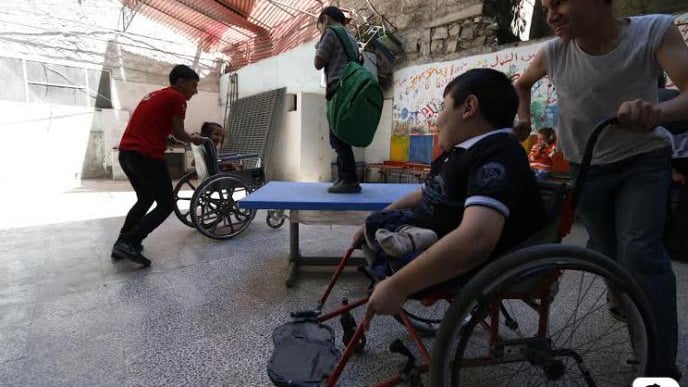
Many of those with special needs, whether mental or physical, were able to overcome their problems, and turn them into motivation to succeed.
Abdul Rahman says: "I was born a normal person, and lived a normal childhood. I studied to become a translator and graduated several years ago. I worked as a taxi driver, and proposed to Afaf in marriage two years ago; before receiving an injury in the recent events, and losing my ability to walk."
At the beginning, Abdel-Rahman suffered the difficulty of coping with his new situation; he who used to drive people around in his car, has today himself become in need of help, he says. He adds that he was able to overcome this situation, thanks to his family and his fiancee. After 8 months of the incident, Afaf asked him to expedite their marriage.
At first, he could not accept the idea of marriage; but Afaf's insistence has reintroduced him to normal life again. It now has been six months since their weeding.
On this period, Afaf comments: "I am very happy with Abdel-Rahman al-Hamdulillah [Thank God]. I do not consider my marriage to him some kind of concession or an adventure of compassion or kindness. I am convinced that he is the right man for me."
Discharged From the Hospital, She No Longer Found Him!
Things do not always follow this scenario of of love and commitment to the relationship. Suha's fiance, for example, abandoned her after she was in a traffic accident that has led to her losing the ability to walk. Soha says that she was working as a teacher in kindergarten: "My fiance stayed beside me in the hospital to which I had been taken after the incident. When I returned home, I learned from his mother that he decided to leave me."
To overcome loss of a mototr skill and the loss of someone you love is not easy. But Suha managed to have a fresh new start, with the help of her brother and his wife. She enrolled in an association, and started to practice some activities, such as handicrafts as well as learning languages.
What About Compassion?
Society usually looks down at a person with special needs with compassion, at other times completely ignoring them in some cases; thus making their life more difficult.
"The feeling of helplessness on behalf of a special needs person is virtually non-existent in civilized countries; as schools, colleges, institutions, and municipalities have the capacity to receive and deal with them. They also have allocated areas in public places and transport," as confirmed by psychologist Aya Muhanna.
She adds that sense of helplessness is greater in countries that suffer from a slow evolutionary process. The lack of people equipped enough to adequately deal with them, not to mention the erroneous social stigma attahced to them by society, may often destroy them and push them into isolation.
It is important to empathize with people with special needs, but without making them feel pity or shame. This comes through educating children in schools and through the media; as well as supporting the integration of children with special needs with other children, and constructing customized spaces for them. It also is important to train cadres capable of rehabilitation, psychological support, and health, according to the possibilities available, as the psychologist says.
She explains that "there are people born with disabilities, and with the passage of time have learned to fend for themselves since the beginning. They are relatively better off than people who suffer injuries later in their lives, which cause them disability."
Political Exploitation of Humanitarian Cases
Some believe that the Syrian media is still largely incapable of focusing adequate attention onto children with special needs; while others consider it actually exercises a negative role, by ignoring this segment altogether, with the Syrian media focusing on political affairs exclusively.
Journalist Bisan al-Sheikh sees that the priority of the official media in Syria is different than the concerns of citizens—whether healthy or with special needs. In principle, it seeks to disseminate a sepcific message, not to transfer citizens' concerns to officials.
As for the private media which sprang up after the Revolution, according to the journalist in the al-Hayat [newspaper] issued in London; it still is in its formative stage, and has yet to reached professionalism.
The problem in her opinion, however, also lies in the political exploitation of humanitarian cases, which usually becomes active during periods of war, with each party seeking to "demonize" the other by providing models for victims. This is caused by political partisanship, each party defending its own group, and a lack of professional experience.