


Reports | 25 05 2020
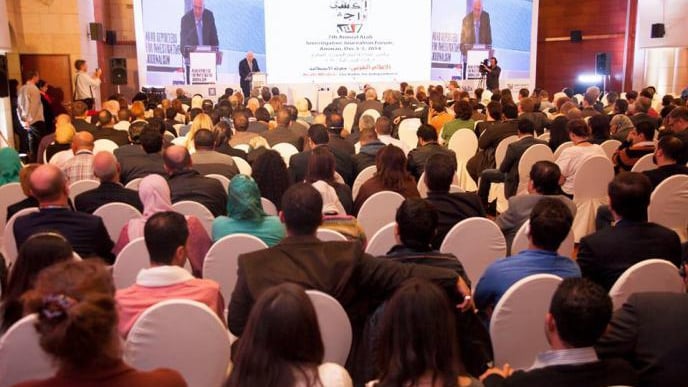
The activities of the Arab Investigative Journalists [ARIJ] Forum, hosted in Amman between 5-7 December under the slogan "Arab media: the battle of independence," reflected disturbing, yet also refreshing, contradictions.
The atmosphere of anxiety and fear among Arabs media people—who are part of their frightened societies—is justified. It stems from the high levels of repression of freedom of opinion and expression during the past months in the majority of countries in the region; following the brief thaw that followed the storming winds of change in early 2011.
There still remains, however, some hope in the possibility of the rise of an independent press, a true "fourth estate," questioning people of influence, or querying them at least; in conjunction with an elevation of professional and objective values, and the ability of such values to unite the media and communities in countries fissured by wars and fragmented by destruction and chaos.
These contradictions surfaced through the frank and painful discussions at the "ARIJ" Forum. Media was forced to take a revealing look at the changing reality of who wants to be an independent journalist or merely a false witness.
Only a minority stood up to defend the criticism that has touched their countries in some sessions; perhaps to ensure their return to their countries—or jobs—without any risks; despite the fact that all journalists are supposed to be critical of all and any restrictions or violations of their work, or disregarding human rights, including the right to knowledge. Such timidity was also manifest in the distribution of the Best Written or Visual Investigations Awards ceremony.
The Judging Committee decided to cancel the award for the Best Televised Investigative Report; the journalist who was posied to win was, due to editorial and channel ownership pressures, unable to broadcast the report. Hence, the Televised Investigation award was cancelled in order to avoid violating the requirement to win the nomination: The Report would have to be published/broadcast. Thus a report exposing the abuses of power remained unpublished—as is the name of the would-be winner.
Worse yet was the second winner in the Written Report category, "Rasha Al-Kilani," forcing her to assume a pseudonym to achieve an exposé on the corruption of the former Iraqi Prime Minister Nuri al-Maliki—which included purchasing politicians and the poor with money and land owned by the state, in return for their votes in the battle for legislative elections.
The investigative journalist completed his investigation while Maliki was still in power, publishing under a pseudonym, in English, and on a U.S. site, for fear of being targeted for killing by Iraq's strongman; who sits today in the vice president's seat, and has an army of security agents and fleets of armored cars.
Hope came from Syria wracked by a fierce war. The hall erupted with joy at the announcement of the names of the two joint first prize winners for the written category, who both achieved a report entitled "Double Exile... Networks fraudulently seizing the Real Estate of displaced Syrians and refugees." The fellow journalists completed this investigation despite the difficulty of working inside their country, locked in a bloody war for nearly four years, now.
Although the winners stem from the capital, within the area controlled by the Syrian regime, they asked all their Syrian colleagues attending the conference to climb to the podium to celebrate the victory of Syria; the prize was for all of them.
This was the first time since Syria erupted in which journalists from a regime-controlled area meet with those from areas beyond regime control. Everyone present felt the chills, due to the difficulty of the moment, and sensing the value of professional journalism bringing together those separated by wars. That, coupled with their love for their country and their commitment to the ethics of the profession, in a country where the targeting of local and international journalists is ongoing both at the hands of the regime or the expiatory organizations.
Thus, from the heart of misery and fear in which both Syria and Iraq live, the truth light shines, expressing hope that the press can expose the corrupt, and achieve victory over those who want to kill the truth or strangle her.
The forum's atmosphere was, however, overshadowed by fear and divisions; regime opponent, to Ikhwan, to liberal, to pro-regime, and independent. The conflicts of the powerful have seeped to journalists.
Some colleagues from Egypt were even split about the songs played at the closing ceremony, which saw two Egyptian colleagues sharing several awards. Some Egyptian colleagues even pulled out in protest, after hearing the Hussein Al-Jasmi song Bushret Kheir [Good Tidings], used as the official song of the presidential campaign of Field Marshal Abdel Fattah el-Sisi, who eventually won the elections.
Prior to that, some objected to the notes of keynote speakers touching upon the decline in media, opinion, and expression freedoms in Arab countries, including Egypt, which has turned into one of the most dangerous countries in the region for media professionals. Some felt their country had been unfairly targeted; unaware that Egypt was strongly represented in this meeting, because of its weight, long history of the Egyptian media, its multiple colors and its prestige in the Arab world, as well as the ongoing escalating violations clear to all and sundry.
Divisions between pro-regime journalists and regime opponents were evident in a profession requiring impartiality and objectivity, and whose mission is to monitor the practices of people in power, to ensure the separation of powers.
In Jordan, colleagues spoke of their fear of the work under the Anti-Terrorism Act, which may turn any journalist or activist into an accused terrorist.
Yemeni colleagues lamented of having to work amid fear of militias, the influence of tribal leaders, and the old guard—all of whom have become stronger than the legitimate government authority. Some of them are forced to receive permits for filming from the Houthi group that has swept Sanaa and other cities.
The lot of Libyan colleagues was not better, what with the existence of two governments, parliaments, and rival militias.
Even in Tunisia; the first winner of the Arab Spring countries, there are fears of curbing media freedoms after the win by the Nida' Tunis political party led by an octogenarian, a remnant of the rule of the Habib Bourguiba and former dictator Zine El Abidine Ben Ali eras.
But amid a surge of hate speech and murder on identity card, it is also assumed that this dark juncture represents a "golden opportunity"—to quote the American investigative journalism icon Seymour Hirsch—for journalists to lead their mission faithfully, and provide safety valves for their communities against violence and corruption.
In the background of the current disturbing scene, torches of freedom of expression are, one by one, being extinguished throughout the Arab world; a foretaste of a retrgression towards a long era of obscurantism, intolerance, and suppression of freedoms, abetted by a community-wide blanket of support.
It now appears that the majority of the Arab peoples—media people included—who saw a unqiue gain in the freedom of expression resulting from the changes in the region; are going to accept the sacrifice of this global right, as well as the violation of human rights, in exchange for promises to restore stability and economic prosperity.
It is also sad how leaders dare to re-impose the old system, taking advantage of the chaos spreading across the region, with the collapse of the entire structures of countries such as Libya, Yemen, Syria, and Iraq.
Thus, security has trumped democracy as a priority for rulers as well as the majority of people and media personnel, while the slogans of change whither: communal justice, the rule of law and democratic values, curbing rampant corruption, upholding the right of access to information, and building a professional media monitoring authority and holding it to account. According to this equation, many generations may pass before we again witness independent voices in the Arab world.
What does raise concern, is the emergence of underhanded alliances between governments and businessmen running media organizations facing any voices of opposition, now being portrayed as a threat to the security and stability of societies.
In such an atmosphere, the profession of journalism becomes impossible in this region. Journalists, academics, and writers who challenge the official discourse, face censorship and unfair trials; not to mention verbal and physical violence. Many journalists have been raising the white flag, and have backed away from confrontation for several reasons; including fear or an opportunistic desire to satisfy the new rulers in exchange for securing personal gains.
What are we to do in the face of the rising tide of misinformation and character assassination?
I am afraid that there remain very few tools to stop an overall collapse. A handful of brave journalists committed to serving their communities will go on uncovering abuses of power, and will continue to fight the independence of the media alone at an exceedingly high cost; against a broad retrogression from the freedom of the press and human rights.
And while such brave souls will pay dearly, having chosen to work in the most dangerous profession in the most difficult area; yet they are convinced that Arab media professionals will eventually win the battle for their independence.
This Article was Published in Jordanian Daily Al-Ghad.