


Reports | 25 05 2020
[Nuri] Maliki tightened his sectarian grip over Iraq, and in this aspect, he was representing Iranian state interests. When he faced escalating protests he pushed ISIS to the fore; the latter never missed a beat. Maliki, whose corruption reached such levels that it provoked protest to the point of open popular revolt, with the potential outcome of threatning US interests in Iraq; ordered his troops to abandon Mosul and other cities to allow ISIS to move into them. Maliki's army waged no battles, and a survey of the press very clearly indicates: Orders were given from Baghdad, ergo from Maliki, for a withdrawal.
Maliki coveted a third re-election. Yet the depth of Iranian interference, and the extent of corruption has become an albatross around his neck; not to mention the increasing feeling of injustice on part of the Sunni community. Changing him has, therefore, become a necessity; but here, the Iranian role was decisive: Maliki was to step down from the prime spot to vice premier, and power was to pass to his colleague in the Dawa party Haidar Abadi—Iran's crony. And that is what exactly happened.
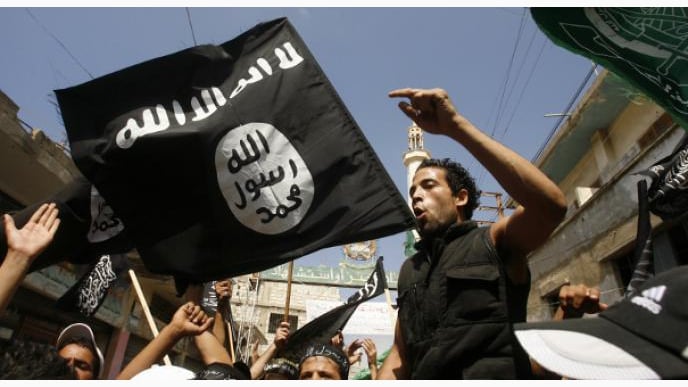
ISIS, which adopted a scorched earth approach, has become a lethal tool to arrange Iraqi internal affairs. ISIS is a game between Iran and the U.S., by which to blackmail the Gulf states and force them to pay the money for the war on the ground in Iraq; Gen. Qasemi [Head of the elite Iranian Revolutionary Guard] on the ground, and Obama's airforce in the skies.
Thus, the sectarian conflict is deepened; Iran and the U.S. become allied, the enemy being ISIS. ISIS, however, only surfaced after protests particularly in Sunni cities; this alliance, then, is directed against the Sunni community. This, at any rate, is how the situation is understood, and it is this understanding that imbues ISIS with a certain justification among that community.
In Syria, al-Nusra, ISIS, and the other jihadists emerged only after the wholesale release of jihadists from the regime's and Maliki prisons. These jihadists occupied territory that had been liberated from the regime. Their political function clearly is to face the Revolution and support the regime. The greater the jihadist encroachment over the past two years, the more the regime had been able to tighten the siege on the liberated cities?!
The jihadists, with the Americans entering into an international coalition against them, and having themselves declared war against the "Nusairi" [Alawite] regime, and "Shiite" Iran; presented themselves as their complete opposite. The regime and Iran are against the people; the U.S. did not respond to the opposition's pleas to intervene against the regime while fighting ISIS and al-Nusra! Thus on the ground, and in people's consciousness, the notion that the U.S. and Iran are allied against the rebel groups, is cemented. The fact that the majority of these groups belong to the Sunni community and the war is against jihadism; then it becomes a coalition against the jihadism representing "Sunnis."
Turkey and Qatar balked at the Alliance, the regime, and the Iranian role before that. Saudi Arabia and the United Arab Emirates entered the coalition, but under the American scheme saying that the war will not stop at ISIS only; but will also include the regime, albeit at a later stage. If the Saudi became a partner in this war, it is in order to confront Iran, not only ISIS. Saudi Arabia—in public awareness—represents the Sunnis, as much as Iran represents the Shiites. The old coexistence, especially after the end of the Iran-Iraq War, came to an abrupt end with the entry of Iran as the strategic ally of the regime opposite the Revolution; and with Saudi Arabia presenting itself, particularly through al-Arabiya channel, as a supporter of the "Sunni" people opposite Iran. This is a climate of Sunni-Shiite conflict.
With the extension of the nuclear deal with Iran, the bombing of Iranian aircraft in Iraq, and the regime forces bombing of the city of Raqqa in the coalition forces' airspace; it seems as if there were an Iranian-American alliance, whose goal is to rehabilitate the regime, not to push it towards a political solution. Meanwhile, in Iraq, the political process is also stumbling. In such a scene, ISIS is moving forward as a representative of Sunnis, not a terrorist organization or a political tool to rearrange the state of affairs in the region! ISIS now—and with the continuing exclusion of Sunnis from the Iraqi political process—represents the Sunnis. In Syria, the scene is the same; both the alliance and the regime target ISIS while leaving Hezbollah forces and the rest of the Shiite militias untouched. ISIS becomes the standard bearer, moving forward as representing Sunnis against Shiites.
ISIS is now being used as a pawn in the regional and international conflict. Iran uses it to fight the U.S. in Syria and Iraq; the Americans utilize it as well as to fight Iran in Syria and Iraq. Both Iran and the U.S. are giving ISIS free rein to advance and retreat here and there, as if it were a force that cannot be stopped. What can be inferred from this, is that Iran is taking advantage of it to expand in Iraq, Syria, Yemen, and Lebanon; while the U.S. benefits from it as a pressure lever on Iran. What I mean is that the U.S.-Iran bargaining process has not yet been settled, thereby leaving ISIS as a convenient criminal political card to push towards an agreement. This is especially salient, since America wants to put limits on Iran; while the latter wants to expand its regional role. This necessitates continuous wars between both sides, on the territory of others, of course, until an agreement is reached.
In the next seven months—the duration of the extension of the Iran nuclear deal—and the ongoing haggling between the U.S. and Iran, ISIS will advance as a force rejecting Iranian and American intervention in Iraq, and Syria; possibly even threatening the security of the entire Gulf, due to Gulf governments' support of this intervention.
In such context, ISIS will probably yank the Sunni card from the hands of Saudi Arabia, thus becoming the face of the Sunni-Shiite conflict. It is no secret, of course, that Saudi Arabia is too weak to take a stand against the coalition and the U.S. The region's utmost fear will be that the tension between Iran and the U.S. shall continue during the next two years of Obama's mandate, as he is the most prominent appeaser of Iran! This will enhance ISIS' presence, intensifying the tragedy of Iraqis and Syrians, and further thrusting the region into an ever-raging inferno of fierce religious conflicts!
* Opinion articles do not necessarily reflect the opinions of Rozana