


Reports | 25 05 2020
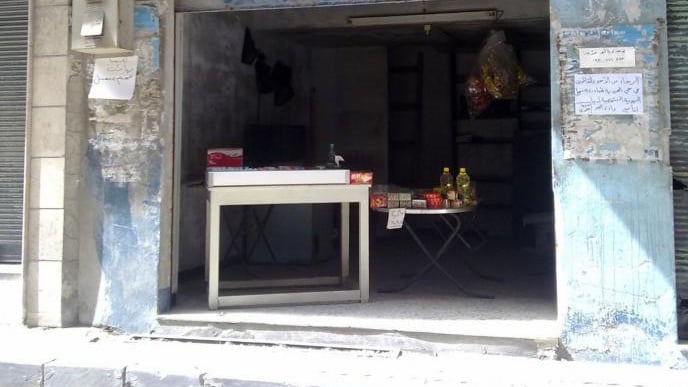
Abu Musa and Hassan, his neighbor, both seem to have been able to rehabilitate a small shop from which they attempt to eke out a living, after returning to their neighborhood in the old city of Homs.
Hassan started two weeks ago to sell some of what little food and detergents charities and organizations offered him; while Abu Musa, sitting next to him, sells bread to the people of the neighborhood.
"There is no real aid received by people returning to this, almost forgotten neighborhood," says Abu Musa. He adds that aid is limited to lentils, and bulgur, and some detergent.
In his interview with Rozana, the man explains: "I have been suffering hunger for the past three months. I appeal to all humanitarian organizations and charities to provide us with more aid. My old age does not allow me to work."
Abu Musa, aged 81 years with no children to care for him or his ill wife, used to own a shop selling auto spareparts before fighting broke out in Homs. According to him, "Shabeeha" [regime thugs' militia] left nothing in his shop except some papers and torn invoices.
The octogenarian adds, with a sigh: "They looted us... They pillaged us... And if they would've been able to do more, they would've. During the entire period when there were clashes, I had been displaced to Hama. When I returned, all I found was left from my house and shop were the walls."
Abu Musa tells another story about how the regime exploits the circumstances of the displaced and covers for the thieves. He explains how the regime forced all residents of the neighborhood to sign police control reports, in which the returnees indemnify the regime from all and any damages to their homes, saying: "That was a prerequisite to connect the power supply to the neighborhood houses. It additionally cost me more than 25,000 pounds."
This amidst the regime promoting a rosy picture of the situation in the old city of Homs, in which the regime claims that the area is liveable and accommodating. Based on the words of Abu Musa and Hassan, reality looks much different.
The Fox Guarding the Coop?
Fouad mocks the security situation in the Hamidiya neighborhood, and the proliferation of [regime-affiliated] People's Committees in most of its alleyways.
He tells Rozana "The Fox is guarding the chicken's Coop! I am fed up with these Shabeeha thugs! I recently returned to check out my home; everything had been stolen except the fridge and the washing machine. So I said, Hamdullilah [Thank God]." He adds that when he returned again to settle in his home, he no longer found them. Most likely the people manning the [regime] checkpoint got wind of them.
Mobile Clinics
Syrian Red Crescent cars roam the streets of the old city of Homs every Thursday, to check on patients and provide them with medicines through these mobile clinics.
Ahmed, a Red Crescent volunteers tells us: "Every week we come to this area, and we check the health of every patient comes to us. We give them all their medication needs for the month."
The young man adds that some patients' health condition is bad and they need surgery. The Crescent is incapable of offering any broader range of services for the moment. He concludes: "Other organizations need to help us find a solution for these patients."
Invitations to Return
Despite all the difficulties facing those wishing to return to their homes; many residents of the Hamidiya neighborhood, persist and display a real desire to return.
Jumana returned to her neighborhood, and has yet to finish repairing her house. She says "Neighborhood residents need not wait! I have only one door in my house; they have to return as soon as they can."
There are pages active on social networking sites, such as "Simply, All About our Hamidiya Neighborhood," hard at work to display a new image of the destroyed neighborhood. According to what is published on this page, many of the Hamidiya residents communicated with them and displayed a willingness to return.
The page, established by the Homs Reconciliation Committee, displays pictures of families who have already returned and settled in their homes, and carries messages and calls urging all displaced persons to return to their Hamidiya quarter.
Yet, despite all the efforts on the part of those enthusiastic for the return of the neighborhood residents, the question remains: What benefit would these invitations be, if the homes one will return to have been destroyed?!