


Reports | 25 05 2020
By: Ahmad Mustafa al-Ghourr
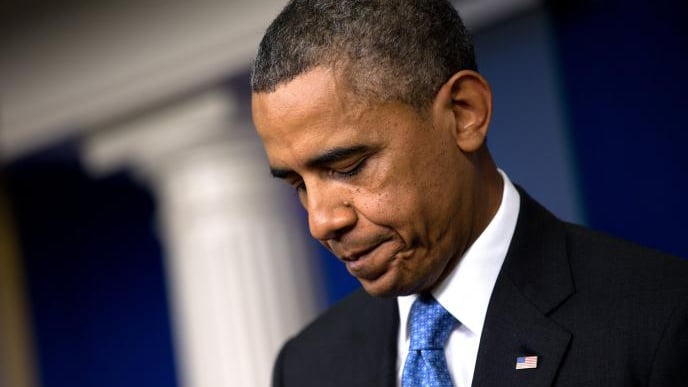
Distressed, he leaves his seat pacing in the Oval Office, he stops in front of a window, contemplating the White House lawn, concerned by the complexities of internal US affairs in all their difficulties and pitfalls; while international affairs pull his attention with their never-ending issues and crises. During the previous eight leaden years his predecessor "George W. Bush" spent in this House, he managed to drag it and the country into world wars and crises, shattering America's image the world over and witnessing American flag burnings everywhere. He, in turn, will soon have spent an eight-year term which he opened by a furtive attempt to remove the accretions of his predecessor's legacy. It, however, seems that he has lost his compass, and will end his second term in the footsteps of Bush!
When he first appeared on the scene, he seemed to personify all the elements of change that tickled the imagination of the American voter, and attracted foreign observers to the US elections anew. A young black man, who made "Hope" a central theme of his campaign at a time when Americans had lost all hope; as a candidate, he seemed to represent a complete break with the Bush Jr. era, and capable of opening a new page to a world, weary with wars and their attendant psychological and economic implications.
The burden of challenges and problems, however, proved far greater than he had expected; and crises cannot be resolved by statements alone. While Obama did make good on the promise to immediately withdraw from Iraq; he left Iraq a quagmire teeming with crises and a fertile ground for terrorist groups. He also did maintain a presence in Afghanistan, Pakistan, and Yemen, not necessarily with boots and arms on the ground; but in the air, via drones. Osama bin Laden was also killed; but al-Qaeda has become more extensive and widespread, with far more impactful and unexpected strikes. While Bin Laden was physically liquidated, his thought still lingers.
If he made good on these promises, as dire or paltry their results may prove; there remain other promises still pending, and merely remembering them wears him down. The Palestinian issue remains at a standstill, a continuous cycle of settlements and Israeli raids... Where, indeed, is that peace for which he had won a Nobel Prize?! Guantanamo remains open; hostility against Islam continues in direct contradiction to the gleaming words of his Cairo University speech; the Russian bear has nibbled parts of Ukraine; Iran is still on track to produce a nuclear weapon, still stoking the fires of strife in the region, and still provoking unrest in both Iraq and Syria; and the Syrian regime is still killing innocent people. The regime had indeed handed over its chemical arsenal, but killing and destruction persists.
He gazes intently at the window... He feels distressed at his erstwhile electoral promises—mere cards thrown to the wind, with none of them implemented. He reminds himself in self-justification, however, that in reality American policy is based on the principle of so-called "interests" that ought to be respected. Americans are proficient at washing their hands of promises if they collide with their interests. It is interest that dictates policy, not principles; principles are for lip service, while interests are for implementation. Obama, very much like W. Bush, is the US president; garlic will not lose its smell, even if washed with rose water!
Obama may be different from W. Bush—in statements. But in the end, one way or another, he still finds himself pursuing a method very similar to that of his predecessor. Bush had adopted the logic pre-emptive wars, starting a global war with al Qaeda, destroying Afghanistan, and causing damage to neighboring Pakistan. Then, without any clear evidence decided to get rid of Saddam Hussein, on a trumped-up charge of possessing weapons of mass destruction. After the destruction of Iraq and the failure to find weapons, it was necessary to find a compelling reason for the world to justify what had happened. Thus, the Bush campaign to promote democracy in the Middle East and around the world was utilized to justify all and any US aggression.
Obama is now moving in the same way as his predecessor. Yet instead of Bush's "pre-emptive war" his were "pre-emptive strikes;" instead of waging a Global War On Terror, he will fight terrorism in specific parts, according to the mechanisms of power and the requirements of US interests. For example, none of Bashar al-Assad's acts in Syria were compelling enough for Obama to direct a military strike against his murderous regime, and help stop it killing the Syrian people. Yet Obama suddenly rose to fight ISIS in Iraq and Syria, merely because ISIS fighters very publicly executed a handful of his citizens: But what about the hundreds Bashar kills everyday, and whose pictures fill screens and newspapers?!
Obama's name is about to go down in the annals of US war books—whether unwillingly dragged into them, or forced by concern for US interests. He will find himself facing a difficult paradox: For how could the Nobel Peace Prize-winning president spark a war, any war—he, whose electoral speeches were replete with rejection of wars?! Obama closes his eyes, remembers the stories of departed leaders whom he so admires, and compares their fortunes to his. How will he, the great admirer of Gandhi, Martin Luther King, Mandela, and Abraham Lincoln and their ideas, lead his army into a quagmire with no end in sight?! Obama was brilliant, when he launched his presidential campaign in front of the historic Lincoln House. But it seems that he will end his second term in front of the George W. Bush's house!
He gazes still at his office window. He sinks into his thoughts, weary and burdened by crises; while in his mind, he bitterly recalls the words of his erstwhile adversary, Hugo Chavez describing Hillary Clinton as "the blonde version of Condoleezza Rice..." And he desperately tries to convince himself that he has not turned out to be "the black version of George W. Bush!"