


Reports | 25 05 2020
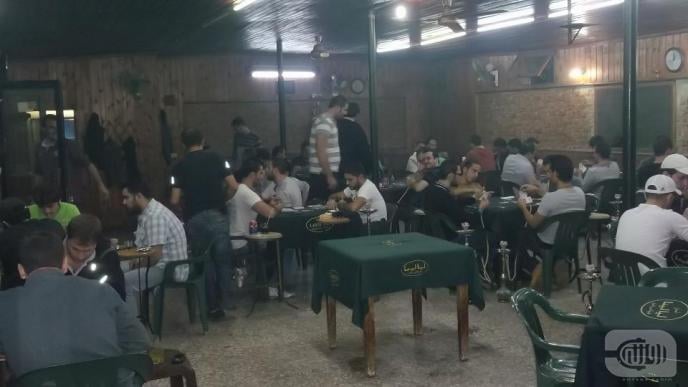
Al-Assafiri is part of the traditions and tales of Latakians, filled with stories of the sea, anticipating loved ones, and memories; a favorite place for many, with its greenery, sea, coastline, bustling restaurants, and parks.
Children with their parents visit it, as well as young people of all ages, to spend a good time. The Al-Assafiri café is one of the oldest and closest of all Corniche landmarks to city's peoples' hearts.
A Green Past and Present
Until the 1970s, the café was in the heart of the sea. Yet the landfilling oprations of the, which increased during the mid-1980s, furthered it away from the water.
Umm Assad tells Rozana: "When Abu Assad and I got, we used to come to al-Assafiri. We were over the moon, sitting on our chairs, and dipping our feet into the water. Now, we are far almost 300 meters away from the sea."
She adds that because of the giant ships and containers, one can even barely see the sea anymore while sitting in the café. This café has, since its establishment as she says, hosted the most important old Arab singers, such as Umm Kulthum and Mohammed Abdel Wahab.
Her husband, Abu-Assad Beyluneh, a traveler tells Rozana: "The promenade stretched from the castle to the sea. Where the park now stands, was the sea. People used to come from Europe to see the wonderful scenery here, and the place still smells of the sea and the memories of those departed."
According to the man, al-Assafiri is one of the oldest restaurants along the Syrian coast; but not in its current form. It used to be more of an archaic and commonfolk nature, before expanding to comprise two halls, a summer and a winter hall.
Abu-Assad explains: "The restaurant rises five meters above sea-level with fishing boats and the sea surrounding it. It made it more like a small island. It assumed a new character after the 1980s, with its garden and playgrounds; yet, despite this evolution, I find nature, rocks and sea, more beautiful."
Childhood and Youth
Hani Shammout, a self-proclaimed friend of the Assafiri area, says: "I frequent this area on a regular basis since childhood. I used to come here with my family to swim and play, as well as to eat fish—Which I never did have the opportunity to catch myself. To this day, I almost never leave the area; my family or friends and I visit once a week, at least."
In his interview with Rozana, Hani asserts that al-Assafiri café is more than meely a park for him: It is the gate to the sea in which he had lived over the past years, as he puts it. He explains that the place has become part of his memory and his beautiful days; and that the sea serves as the identity of his memories which it occupies.
A Military Complex?
The al-Assafiri area was not immune to the presence of regime soldiers, security personnel, or the regime-affiliated People's Committees. They too have become visitors; not a pleasant issue for some of the area's regulars.
Says Umm Mustafa: "To me, this area is an intrinsic part of our heritage and our history. Whenever a friend from another province vistied we'd introduce them to al-Assafiri, and they became enchanted. But in the current circumstances, it no longer feels safe for my family to visit; with all the conspicuous presence of all these soldiers and security men. This makes me worried for my young daughters and sons."
Because of these developments university student Nadia no longer comes to al-Assafiri, periodically as she used to. It became a gathering place for un-monitored military people, as she describes them, adding: "Their only 'task' is to harass girls some with silly pick-up lines and rude moves. I now only visit al-Assafiri with my family, and only once or twice a month."
A Lovers' Meet
Despite the periodic descent of regime goons onto al-Assafiri, and their harassment; there still remains a place for love.
Ammar Habib, an area regular, sees that al-Assafiri café to him means a private space. He describes it as the 'vassal' of love, in which he and his loved one meet.
Says the young man: "It is the most beautiful place that cocooned our private moments, and hid them. I spent many unforgettable moments with my loved one here, scribbling our memories onto the walls, and throwing our worries and qualms to the sea. We get hope and happiness of the people's faces. Everything is cause for joy and optimism in this place. I am glad that the sea was the first witness to te love sory between two birds, Ammar and Hiba."