


Reports | 25 05 2020
By: Musab al-Numeiri
The eyes of politicians and analysts are now firmly set on the ongoing negotiations between the United States and Iran, on the Iranian nuclear file, and their outcome; due to this issue's importance. Any agreement between them, will determine the outline of Iran's new strategy beyond, thus inevitably directly reflecting on the entire Middle East where, in most countries, Iran's tentacles are active. We will know, a little later perhaps, what cards were used and what concessions were made by each party in order to reach a common ground for negotiation. Then we may learn the new map, and to the benefit of which particular regional power will the balance of power and glory tip, in this hapless Arab East.
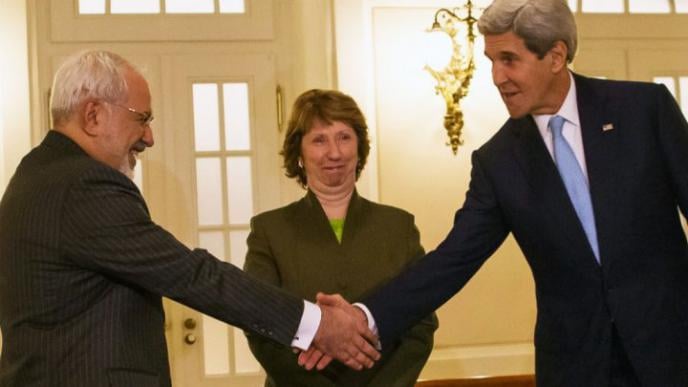
Official declarations following the initial Kerry-Zarif-Ashton rounds in Muscat, decpited slow progress as well as gaps in positions vis-à-vis cerain issues; while simultaneously hinting that reaching an agreement is mandatory. Iran has several cards on the negotiating table, and it will not give up its nuclear program for naught, or without compensation for the loss of that dream it has long sought to pursue. Iran's project is to control the Middle East. It possesses tools to implement this project, as well as political currents and armed militias affiliated with it in one way or another; notwithstanding the multitude of labels, or small flags which these use to camouflage their allegiance. These proxies range between the Assad regime in Syria; Hezbollah in Lebanon; the former Maliki government, the Mahdi Army militia, and Moqtada al-Sadr in Iraq; the Houthis in Yemen... etc.
The Americans, on the other hands, come to the negotiating table anxious to make significant progress in this file. Following his loss in the midterm elections Obama, previously vacillating and indifferent to what is happening in this region, needs this progress. He would like to project an image of the assertive leader who found the solution to the nuclear file; while ignoring that it was he who had left the region, and its people, to flounder into the abyss.
Many issues behind the scenes are indispensable in attempting to understand the importance of this agreement for Obama. This was revealed in Obama's message to the Supreme Leader Khamenei, referring to the importance of the two countries cooperating in the efforts to eliminate ISIS. It is striking to see no response forthcoming from the other party to this the message, which was ignored like three previous such letters, according to an article in the Iranian daily Keyhan. One of them was sent in 2009, asking for cooperation and the opening of a new page in relations. The second came in February 2013, during the nuclear negotiations, wherein Obama told the Supreme Guide that he was ready to reach an agreement. The third letter came last month, where he touched upon the stalled military intervention in Iraq because of opposition from Iran's allies there, and its position on the Khamenei's nuclear file negotiation conditions. In this letter, Washington's need for Iran's help to snatch its foreign policy from the impasse it reached in the region, is apparent.
This weak, ragged American position, and the scramble to earn Iranian satisfaction and to urge them to cooperate, matched by an Iranian knowing calm; indicates how rewrading persistence is. The Iranians are in no hurry, whereas time is running out for Obama especially in the midst of Congress midterm elections. One can see how Obama's gaze is firmly fixated onto the nuclear file, which Iran waves in his face like a vixen to charm him away from the fact that it has snatched Baghdad, Damascus, Beirut, and Sanaa. In any case, the only thing that is clear and obvious amid all that is happening now in the Middle East, is the pitless bottom Arabs are in.
* Opinion articles do not necessarily reflect the views of Radio Rozana.