


Reports | 25 05 2020
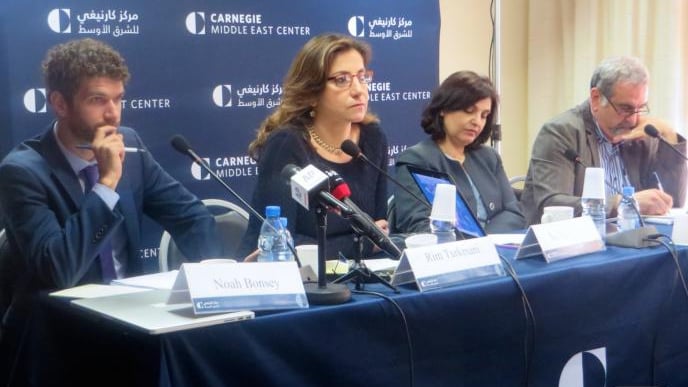
Madani [Civil] organization chosed Carnegie Middle East Center in the Lebanese capital, Beirut, to launch its report entitled "Hungry for Peace." This took place in a lecture given by Rim Turkmani, President of Madani [Civil] organization; and former Executive Director of the Syrian Trust for Development, Omar al-Hallaj.
The report, which included a study of the reality of the conflict in Syria, concluded that truces and ceasefires represent the best hope for ending the suffering of the Syrian people, by reducing the levels of violence.
In an interview with Rozana, Rim Turkmani advised that any solution or truce must be a local affair par excellence, adding: "Ceasefires represent a very necessary process. But we must be careful; as they are sometimes used in the wrong direction, with each armed faction attempting to use a ceasefire to improve its positions at the expense of the other factions."
Ms. Turkmani explains that "There are other caveats on how to deal with these agreements. If there is an initiative, we need to know who to support." She adds: "When parties to such initiative belong to civil society organizations, or local society and dignitaries; the outcome is far better than those initiatives which are limited to military authorities only. This is another aspect of which we must be wary. Therefore not all matters local will lead us towards a solution; but there will definitely be no solution that exculdes this domestic factor."
Organizers of the report, refuse to call what happened in some areas of Syria as reconciliations. Especially that these cases that have been much trumpeted by the official regime media, only came after a long regime-imposed siege, using starvation and intimidation as a negotiating tactic.
They believe that the starting point should be the development of a centralized plan, which takes into account regional and international constraints. On this, Turkmani says: "The starting point must be to develop a centralized, not a local, peace plan. This plan should, however, take into account regional and international constraints and impediments to a solution. It should also support existing initiatives that came out of the people themselves."
Omar al-Hallaj explains to Rozana, that truces and ceasefires should commence in the regions with particular situations and conditions. He stresses the need to allow enough space for a discussion in depth by all parties, as well as the importance of clearing the humanitarian elements from the fighting as a first step, as he puts it.
Hallaj points out that "These operations may not take the form of an agreement in all cases," explaining: "We may not necessarily directly reach a final solution. There are many things that need to be done gradually, and in steps, before reaching a final solution."
Madani organization will embark on many other activities following the launch of the report; including intensive meetings in European capitals. And since there is no clear timeline for the start of the implementation phase, anticipation will remain king in the coming period.