


Reports | 25 05 2020
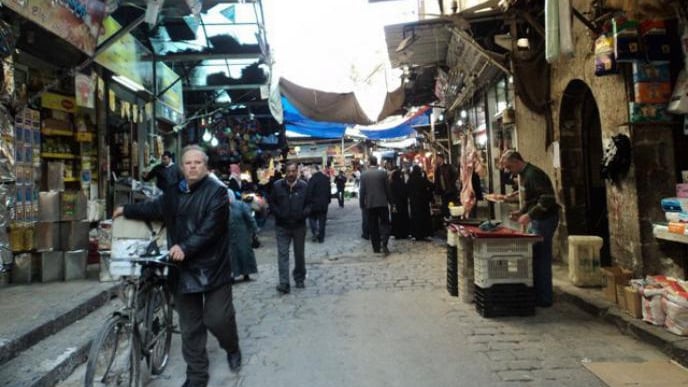
Given the current circumstances in Syria, the lack of employment and meager incomes; families today buy half of what they used to previously. Syrians, therefore, started searching for shops and markets that can supply them with their daily needs at prices corresponding with their diminishing monthly incomes. Hence, Bab Srijeh Suq [Market] became the new shopping Mecca for price-conscious Damascenes.
Bab Srijeh is one of Damascus' important and historical markets. It is best known for its shops simultaneously showcasing the past and the present.
"Bab Srijeh has a mysterious and sweet beauty, permeating the antique shops and popular new restaurants and cafés. When you walk around the market, you are immediately taken by the beauty, simplicity, and antiquity of it all," says Hussein, whose main draw is the magic of the place and its treasures, rather than it being a shopping destination.
The young man adds, "The age-old songs you hear walking between shops takes you away... Even these noble old walls, the road, the smell of fresh bread and traditional food, the wafting aroma of rare spices, which you may even not find at the best world class restaurant."
Bab Srijeh is, like the rest of the ancient capital's seven gates, a symbol of old Damascene life. They summarize the city, and give clear images of Damascus and her life.
Says Abu Alaa: "In Bab Srijeh, vendors still chant the same phrases that attracted me, as a child, to come buy fruits or sweets." He points out that the Bab [Gate] Srijeh dates back to the Mamluk era, as the Mamluk governor al-Terouzi lived here.
Affordable Prices and High Quality
Not a single week passes without Hind, a college student, visiting Bab Srijeh. Even if not shopping, it is enough for her to roam the market, to feel as if she had been on a short trip, she says.
Even more: "Normally my fiancé and I come here for lunch. There are many cheap eateries offering a variety of cuisine types—From Kibbeh [Meat pies] to kebabs to poor-man dishes such as: fava beans, Hummus, and Fatteh [Frothy bread and chick-peas marinated in yoghurt and butter] at affordable prices and a wonderful taste."
Hind attributes the reasons for affordability and quality to the competition between shops in the market. There are many shops, and many that serve the same cuisine. There are more than 15 Hummus restaurants, for example.
For his part, Firas says: "Kebab dishes are the least eaten these days, due to the circumstances and diminishing incomes of people. Yet at Bab Srijeh, one can eat barbecue many times, as they are affordable and tasty in this market."
He continues: "Every week I bring my family to eat kebab at Abu Hassan's. A kilo of grilled chicken kebabs costs only 600 Syrian Pounds—only 50 Syrian Pounds more, when there's a special occasion. You cannot buy a meal outside for this amount anywhere anymore."
He adds that an average-sized family with a comfortable financial situation would require a minimum of 700 Syrian Pounds to prepare a simple lunch, given the current circumstances.
Mouayad, a street vendor on a bicycle in Bab Srijeh, carries his batches of greens—parsley, radish, and lettuce—and tours the market displaying his wares to people.
He tells Rozana about his work: "I call for the cheapest price, as there are many shops selling greens on the market. I have nothing but my bicycle to enter this profession and sell; I therefore stroll around the market and reach my customers quicker than the rest of the shops here."
Mouayad confirms to us that the market has become part of his life. Even if he were not to pass by as a vendor, he would still pass as a simple visitor.
Recreation—Damascene Style
Bab Srijeh also boasts its own historical Hammams [Public Bathhouses], some of which are still working to this day, and open for customers.
In this regard, Bashar says: "Bab Srijeh has a particular warmth, especially its Hammams. Visistors find care and hygiene inside the bath's halls, in addition to all the necessary utensils and cleaning accessories."
Bashar considers that the pleasure of taking a bath at one of the many historical Bab Srijeh Hammams is unmatched in any other place. He adds that the fact they are still continuously in operation since ancient times is fascinating, with Hammams such Izzedine, al-Jadid, and al-Tirouzi as prime examples.
Bab Srijeh—A [Gate] to Revolution
Many Damascene youths participated in the Revolution; thus receiving their share of its burdens and problems.
Says Haitham: "The year 2012 was special due the diversified revolutionary activities it witnessed, despite the security blockades on Damascus neighborhoods generally. In Bab Srijeh, the first demonstration came out from near the Dahabi [Golden] Mosque and was escorted by te Graffiti-Man Brigade in March 2012. Its slogan was 'O Allah, they bombed Homs, O Allah."
He clarifies: "The revolutionary activities were not confined to demonstrations. The free people of Bab Srijeh renamed the Koranic schools for the Prophet's companions, rather than have them carry the names of the murderers," referring to the Assad Koran schools.
Haitham concludes by saying that "Bab Srijeh's first martyr funeral was that of martyr Saleh Siwar, which came out of the al-Tirouzi mosque on July 18, 2012".