


Reports | 25 05 2020
Ever since some areas in Syria went out of regime control, alternative courts known as "revolutionary courts" sprang up therein, based on the Unified Arab Law, as set by the Council of Arab Ministers of Justice in 1996.
The latest of these experiments was the "Unified Judicial Council" [UJC] in Aleppo, which announced the cessation of its activities on 14 December 2013.
The era of "revolutionary" justice came to an end, with religious Sharia ruling bodies now becoming the majority in those areas beyond regime control. Were failures of the "revolutionary" judiciary the cause of their appearance?
Talal Houshan, the first judge to defect from the Syrian Judicial System at the beginning of the revolution, speaks to Rozana about the reasons for the failure of the "revolutionary" judiciary, and the vacuum such created allowing the formation of Sharia judiciary.
In his opinion, the failure of the revolutionary judiciary was due to the lack of dissident judges, as well as the lack of support for the Free Syrian Judicial Council, the first judicial body formed after the first judges defected the Syrian Judicial System.
Ruling Military Faction Authority
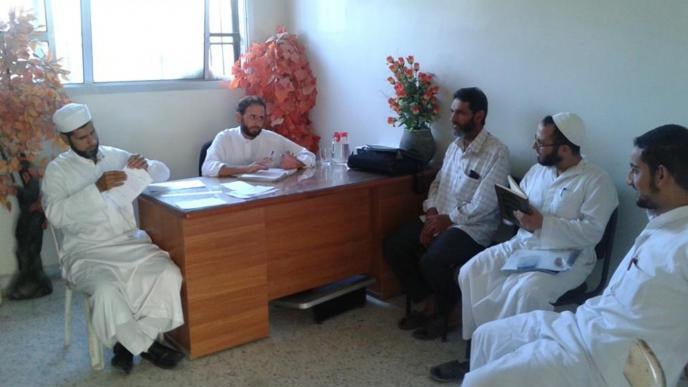
Sharia judiciary is not much better off in terms of institutional structure from its revolutionary counterpart: There exists no unifying presiding structure that can provide explanation for the variances in judgments from one Sharia court and one judge to another. These judgments often depend on the ideological bent of the military faction dominating the region, and its affiliations.
In the city of Aleppo, the formation of a Sharia council was announced in mid-December 2012, with the agreement of all factions in the city. al-Nusra Front then quickly left this body, followed by ISIS, with each forming their own respective disparate Sharia bodies in the areas each faction controls. To this were added the Sharia bodies attached to the Mujahideen factions and the Free Sham Army.
Sharia Judge Abu Muhammad, from Daraya [in the Damascus countryside], does not consider the justice previously applied by the military battalions as "justice." They issued their fatwas [religious decrees] without even actually seeing the accused, according to the man.
Abu Mohammed adds that there is a difference between a fatwa and a court verdict. Fatwa is the law; its application is key. He considers the spread of Sharia judiciary as the true beginning of the existence of the judiciary in the revolutionary era, and attributes the differences in fatwas to the application of customary laws, as well as the variance in interpretations from one region to another.
The UJC Stands in the Middle
The UJC in Aleppo attempts to assume an equidistance between both the revolutionary and Sharia judiciaries, by suspending some articles contrary to Islamic law, and including Sharia judges as part of its judicial structure.
Despite these accommodations, it had to suspend its activities, after its offices were stormed by the "Fa istaqim kama oumirt" [Be Upright as Ye Have been Ordered] faction. A number of its judges had also previously been beaten and arrested, by elements of the Sharia Authority of al-Nasra Front.
Judge Talal Houshan, attributes the UJC's failure to the lack of moral and material support from opposition organizations, the National Council and the Coalition, in the first place. Another reason is that it can not rely on any judicial law in governance; laws require a legislative authority to promulgate them (the people).
He adds, that "such would be impossible before the fall of the regime. All they [the UJC] tried to do was to enforce the Unified Arab Law, with the suspension of articles in violation of Islamic law; yet they were unable to reach agreement with the Sharia bodies to enable the UJC to do its work."
Hudood [Religious Punishments] Cannot Be Applied Now
A number of videos and pictures spread on the internet by ISIS depicting the application of the adultery and theft hudood in the areas under its control, particularly a video which caused a sensation showing the stoning a woman to death in Hama.
According to the Sharia Judge Abu Mohammed, hudood cannot be applied now in these circumstances. The law alone does not build the community. Sharia judges should possess certain qualifications that cannot be limited to mere knowledge of Hadith [the sayings of the Prophet] and interpretation, without proper knowledge of Fiqh [Islamic jurisprudence].
Says Abu Mohammed: "The proof is that the Qura'nic verses carrying the legal provisions were the latest verses to be revealed. There is, therefore, an urgent need to examine the reality and gradually apply Sharia law. The existence of a guardian authorized to apply this law is also a necessity, as well as being mindful of balancing between the potential damage resulting from the application thereof and its consequences."
The Need For a Civilized Judiciary
Abu Yusuf, a lawyer from Daraa, believes that the judiciary is not merely concerned with the issuing of a judgment; it rather requires work predicated on management sciences to restructure the judiciary.
He also confirms that his being a Muslim and his desire to arbitrate in accordance to Islamic law notwithstanding; Islamic law also calls for civilized application and to benefit from those experienced and competent in the judicial field.
Sharia Judiciary: A Tool of Political Control?
Majid Mohammed, a Kurdish activist, points an accusing finger to some elements in the Syrian opposition using Sharia judiciary as a prelude to control the Syrian people, and accustom them to this forced form of law, with which they were not previously consulted.
The activist considers this abnormal condition of depending on Sharia judiciary in the opposition-controlled areas, as an attempt to assume control on the ground, through these religious bodies.
Sharia or civil? Which will be applied in a future Syria? The more important question is which judiciary will help protect the rights of Syrian people with all its components, and safeguard the social structure from disintegration?!