


Reports | 25 05 2020
The question of women's bodies, whether completely covered or nude do not fall into the space covered by religions; it rather falls in the realm of politics, economy, animating the rights debate, and provided for by law. Most importantly, is that modern laws were promulgated on the basis of the personal freedom of nudity—nudity in a modern “show” culture—thereby relegating any other traditions to disapproval and mockery, and rejection. It thus becomes the right of a woman, to be used and objectified by men in a pornographic film!
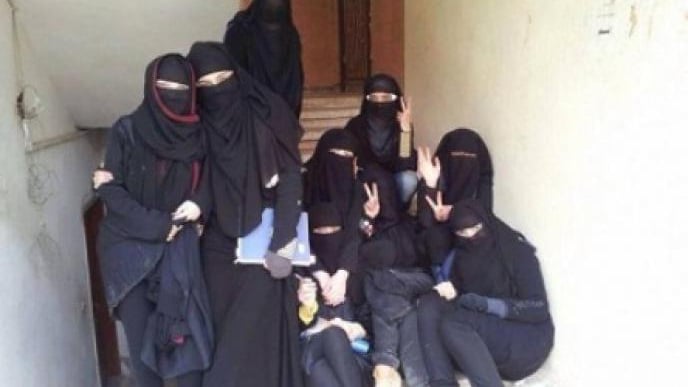
Considering that ours still largely is a male-dominated culture which manifests its control of women by covering them from head to toe (the Niqab, for example), such as insisted upon by Islamist militants; the bikini code becomes a secular symbol, while the Islamic veil, as well as religious Jewish women’s wigs, become a religious symbol. The latter turned into a symbol of the certain death during the Nazi era, while the former has turned into the denigration of entire peoples, acting as a barrier between them and free interaction with the modern world, its currents—as should be the norm—or its daily history as it is being made.
When it became politically expedient to burn the Jews in Germany and other parts of Europe, religious Jewish women were no longer able to wear their traditional hair wigs or thick black socks, nor to attend religious events, as a result of fear; Men were no longer able to carry their Stars of David. The question worrying some today is: "Is Europe now reliving the same continuum, changing the victim's religion from Jewish to Muslim?" Until the end of World War II, Jews appeared in the European drama as copies of the image enshrined in William Shakespeare's "The Merchant of Venice." They were, thus, "Shylocks" with a Jewishness built upon hatred of the other, and the idea that a Jew must convert to Christianity, as his Jewishness will cause him to forfeit his right to live in some European countries. Nowadays, enter the Muslim terrorist!! A bigot, a usurper of women's rights, a threat to the Europe’s civilization and culture—in both its religious and secular manifestations—who cannot hope to integrate into European society, as a result of his culture and his designated "caricature." Who designated this Muslim "caricature?" And why? Does a Muslim today have to convert to Christianity or Judaism, to rid himself of this image that hangs like an albatross from his neck? Within the context of contemporary media’s quasi-omnipotence, are we facing a new symbolic Holocaust?
European peoples and their culture are—despite of all this media hype underlying the politics of the issue—more humane and sophisticated than to repeat what was done to the Jews for almost seven decades. Even the aggressiveness of neo-Nazis can be considered relatively peaceful!! Despite the inroads this xenophobic thought has made into the cultural space, and its infiltration into the traditional right-wing parties—for one may argue that there is very little difference, for example, between Jean-Marie le Pen’s fringe rightwing party, and the Union for a Popular Movement (UMP) whose government issued a law to prevent Hijab, in France? All the aforementioned indicators should, however, spur the establishment of a modernized European Islam inspired by Andalusia’s humanism, not Osama bin Laden’s eschatology. This is a task not to be shouldered by the oppressive and tyrannical regimes in the Muslim world; rather by the Europe’s politicians and intellectuals, especially Muslims.
Jewish symbols are no longer inacceptable in Europe now, whereas the symbols that refer to Islam are the subject of disapproval and denunciation—with Hijab a particularly conspicuous example. This represents a new persecution of Muslim women.
Arab cultural elites still believe their culture still has an avant-garde role in resolving the problems of Arab society. They refuse to acknowledge the simple fact that the contemporary space is, rather, a political one, and that all aspects of life are merely moving in his field—whether culture, the media, religions, the burqa (head-to-toe cover for women), bikini or wig. Therein lies the problem, and its solution. This, by no means, is to say that the role of culture is dead. Culture should, rather, desist from patronizing and from isolating itself from the political, arguing that it alone holds the panacea—while in reality it is being isolated by the political to wither, ossified into mere formal celebratory icons to be rolled out for mere formalities and events.
Secularists in the Muslim world are—by emulating the Western example of dealing with women through the coverage/nudity duality—are in the throes of a deep and serious problem. By emulating this Western model, the discussion veers from the core issue of women's freedom, of which the Western model represents only one manifestation. Without raising the issue of the freedom of women to the level of an existential question it becomes a mere issue of emulating the West, because it is the stronger, more civilized, and more free other. This, while arguably true, prevents viewing the existential angle of women’s freedom as human beings—as an affiliated and immanent act of existence… And this is where we revert to where we started in our research of this phenomenon. The Arab political space is one that undervalues and denigrates universal and individual human freedoms. Women are, thus, part of this denigration, not isolated from the historic politics of domination of human beings in the Arab world. Such isolation is, however, welcomed by autocratic authorities in the region to make the issue of women's freedom a trivial side battle, which leads to its antithesis—an issue of "covering vs. exposure,” not of “freedom vs. oppression."
It is, thus, very natural for me to respect the complete independence of a woman’s choice [of whether to be veiled, wear a wig, or a bikini in a public space—part of her personal freedom] as an equality in the level of awareness of human freedom. Is our problem in the Arab world the Hijab or headscarf or the authority forcing it? Who exactly is the authority behind the Hijab? In a unique deal struck decades ago, between the corrupt and repressive authorities in the Arab world, and between Islam and its loyalists, the street was left for Islamists in those Arab countries, as well as in some Muslim communities in the West. Who left this street to the Islamists? And why? However, this also raises the questions: Can we accept the way the Muslim community is being treated, as one large "al-Qaeda"? Can all Muslim women be categorized as either Niqabis or Hijabis? How many father or brother can impose the Hijab and Niqab on a woman?
Syria is a historic example: Syria was the seventh country in the world to grant women the right to vote and stand for elections in 1949—much before countries like Greece (1958), and even Switzerland (1971). There had been no problem in the constitutional rights of women since that date. The problem started in Syria with the autocratic authority of Assad the father who by means of his 1970 coup ruled Syria with an iron fist and who, alongside his successor and son Bashar, have to date killed nearly a million Syrians over the past four decades. Not one family has escaped detention or death for political reasons of one of its members. The victims of Bashar al-Assad alone since the start of the Syrian Revolution in 2011 to date have reached half a million victims, with more than 10 million refugees and displaced people. There hundreds of thousands of detainees with tens of thousands having been liquidated under torture. More than 11 thousand children were killed at the hands of the Assad regime, and more than 150 thousand women are now attempting to sustain their families after their men have been killed by the Assad regime. Add to that 13 thousand cases of murder under bombardment, torture, rape and detention, documented by United Nations organizations. Is the right to life, or the right of being covered or uncovered that is at stake here? If the right to life has been nonexistent in Syria for more than three years, will discussion of the Hijab become a pressing issue?
The dyad which has ruled women in the Islamic world has been the criminally corrupt authorities such as the Assad regime on the one hand, and the Islamic currents loyal thereto, in one way or another, on the other. The problem of women in the Arab World is, thus, similar to that of men—the rule of mafias and corrupt murderous regimes such as Assad’s. there is no other solution to this other than a state of freedom, human rights, and institutions. Absolute freedoms and rights are absolute from the viewpoint of the Universal Charter of Human Rights; yet, in day-to-day dealings in the social and political fields, it is historic. We cannot, therefore, address the issue of women without first predicating it upon an absolute freedom, by creating a constitutional base to ensure women's, as well as men’s, freedom and equality in terms of human value—an issue necessitating a state of liberties and rights, first and foremost.
ISIS and women: This organization is—in all the chapters from its creation, to its appearance on the scene, to its practices—similar to Al-Qaeda and the Taliban in Afghanistan. There is not one single leader of Syrian origin, mostly Iraqis, Chechens and other nationalities. This organization, and those supporting it, only came in order to abort Syrians’ dreams of having freedom, like other peoples. This is why this model was backed by Iran and al-Assad—with the latest transgressions being the stoning to death of a young widow (26 years) accused of adultery in al-Raqqa (northeastern Syria), in addition to beheadings, and the displacement of Christians from Mosul in Iraq—all of which are practices hitherto unknown to Syria and its people and their history. The only practices resembling them are, in fact, those of the Assad father and son, as I mentioned.
Our problem is not only in the women's rights issue, but our problem with the corrupt and criminal Assad regime, concerning the right to life. That is why we call upon the world to stand with our people.
* Opinion articles do not necessarily reflect the opinion of Rozana.