


Reports | 25 05 2020
After three years of conflict, Syria is experiencing a grave educational reality. UNESCO has announced that three million Syrian people have been deprived of education, not to mention the bombing of a large number of schools.
Yet Syrians have not lost hope of completing their education. Numerous organizations and bodies are working to secure as much as possible to support the educational process.
Mohammed Hasno, Project Manager of the Support Coordination Unit (SCU) of the [Syrian National] Coalition says: "When Syrian regions revolted against the Assad regime, Assad responded by meting collective punishment through the closure of schools and the displacement of students and teachers, as well as completely cutting support. This situation required the establishment of working groups, based on local councils and the newly-established education directorates in the liberated areas; in order to collect information and data for the reopening of schools."

In his interview with Rozana, Hasno adds that the reality of the educational situation necessitated the gathering of information about affected schools, and a census of the actual numbers of students, based on class and professors’ availability, as well as educational levels.
He explains: "Accordingly, projects aimed at improving the educational reality in the liberated areas were prepared. These have been submitted to international organizations and donor countries; as educational projects require multiple donors. They are costly, and the existing institutions are incapable of auto-financing their projects.”
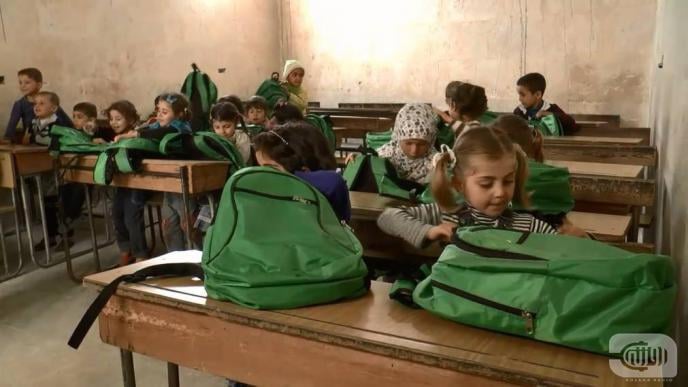
The Madrasati [My School] project is under implementation in Lattakia, Hama, and several other provinces, covering about three hundred schools. Yet, the huge needs of the Syrian interior—basic infrastructure for education, such as schools—makes it a difficult task and requires more than one project to run in parallel with the Madrasati project, to cover these needs.
Mohammed Haji Yunus, Director of Examinations in the Idlib region says that, via the SCU, support has indeed arrived for schools within the areas controlled by the opposition in Idlib, under the auspices of the Madrasati project. He explains that equipment arrived disassembled for easy transport, and was installed in schools without any delays.
A large number of Syrian students register their names on the waiting lists of schools located in opposition-controlled areas. However, due to the lack of capacity to absorb large numbers, some may have no option but to forego their opportunities to complete their studies.
Ola, for example, is a ninth-grade student from the Idlib countryside who has already missed one school year inside Syria. When she came to Turkey to pursue her studies, she was unable to secure admittance into any school in the city of Reyhanli. The answer given to her was that there were no vacancies, and that her name would be registered on one of the many tall waiting lists.